
Books on theology and books on gardening are more than plentiful, but rarely are both topics fused in the way these books manage to do. Christine Norvell gives us the intellectual grasp of the relationship between creation and the life of the soul, while Samantha Stephenson explains how, by cultivating both the earth and our souls, we can actively contribute to God’s new creation.
The Sycomore Fig Tree: Biblical Botany and Scriptural Truth: Seeking God in Life Transitions, by Christine Norvell (117 pages, Stone Tower Press, 2026)
Grow Where You’re Planted: Reclaiming Eden in Your Own Backyard, by Samantha Stephenson (139 pages, Sophia Institute Press, 2026)
One aspect of Christian faith that is neglected, it seems to me, is the idea of new creation. New creation is one of the key themes of the Bible as a whole. The Bible’s God is the Creator, of course, but his creation is not a finished product, it is an ongoing project. Old Testament prophesies forecast God taking over, confounding the powers of the world, and renewing the created order. In the beginning, the Bible’s image for humanity’s origin and its divine vocation of stewardship is a garden. The climax of redemption history also takes place in a garden. And at the end of the story, the final goal for the cosmos and human beings is not simply “heaven,” but a “new heavens and new earth.”
The Israelites were an agricultural people, and Jesus’ discourses and parables are saturated with imagery from nature, from vines to fig trees to mustard plants. The Lord’s miracles and healings were not merely token signs “to prove his divinity,” though we often reduce them to that. They were signals of a new creation being launched: a reality in which the world’s captivity to decay would come to an end and death itself would be abolished. The forgiveness of sins is a sign of this transformation. St. Paul tells us, “Therefore, if any one is in Christ, he is a new creation; the old has passed away, behold, the new has come” (2 Corinthians, 5:17).
Yes, Paul is referring to moral renewal. But we tend to forget the connection between morality and creation. Sin is a “wound in the fabric of creation,” as Mike Aquilina reminds us. “Saving souls” is how evangelism is often described, but the life of the soul is bound up in the created world in its manifold aspects, both “visible and invisible.” Salvation is not merely individual but has a global, indeed cosmic scope.
In this respect, Jesus’ teaching was in continuity with the prophesies and expectations of Israel, which foresaw the return of exiles to a new, abundant land. Early church fathers like St. Irenaeus also taught the eventual redemption and restoration of the created order—even plant and animal life.
Putting belief in new creation in practice is not easy today, though. We are increasingly out of touch with the world of nature, even oblivious of where our food comes from. Those of us who no longer live an agrarian life (let’s face it, the majority of us) need guidance on how to integrate new creation into our daily lives. Here, just when we need them, are two new books that will enrich our sense of the beauty of creation and its timeless spiritual lessons.
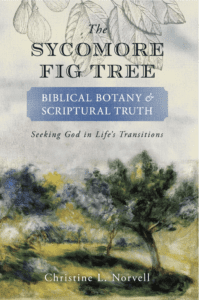 Christine Norvell, a former Senior Contributor to this journal, delves into the Bible as well as her life experience in her book The Sycomore Fig Tree: Biblical Botany and Scriptural Truth: Seeking God in Life’s Transitions. This work is an engaging mix of biblical history, theology, autobiography, and yes, botany. Norvell takes as her subject a tree that figured prominently in the life of the ancient Middle East: the sycomore fig tree (not to be confused with the North American sycamore, though the two spellings are often used interchangeably).
The sycomore fig and its tree are mentioned many times in scripture. In fact, the fig is the third tree mentioned in the Bible, after the Tree of Life and the Tree of the Knowledge of Good and Evil. Later in the Old Testament, we read that the prophet Amos was “a herdsman and a dresser of sycamore figs” (Amos 7:14). King David employed an official to tend to his royal sycamores. During the Golden Age of Solomon, the Israelites lived in safety, “every man under his vine and under his fig tree” (1 Kings 4:25). It was a sycamore tree into which Zacchaeus, a tax collector, climbed to see Jesus pass by. And Jesus himself used the fig tree as a symbol of the approaching kingdom of God.
What was so special about this tree and its fruit? For answers, Norvell delved into biblical commentary, agriculture, horticulture, ancient geography. She discovered that the sycomore, both tree and fruit, offers wonderful metaphors for spiritual growth and experience. As Norvell points out, “In the Bible, trees appear in the first and last chapters, in the first psalm, in the first gospel. Every time they represent someone or something else.”
In the case of the sycomore fig, it was seen as a common plant, whose fruit served as food for the poorest people. It was a plant every part of which was used: its fruit, its wood (which served to make houses, doors, and utensils), its branches and leaves. The tree was not native to Israel but was transplanted there, likely from Africa. The sycomore was and is a resilient plant, deep-rooted, able to regenerate itself and overcome adverse natural conditions. It is beneficent and welcoming, providing bountiful shade and pasturing animals with its large leaves.
Right away we detect a number of spiritual themes here, and Norvell declares that the sycomore’s humble richness is “a picture of enduring fruitfulness, a steadfast hope of what a fruitful life in Christ can become.”
And there are even deeper mysteries. The sycomore fig only ripens after it is pierced, a task performed by a “dresser” (recall Amos above) using a special hook. In the Bible, this piercing represents a call to repentance, a piercing of the heart by God’s word that causes growth in the soul. As a result, the soul becomes more fruitful in the things that matter to God, just as the fig becomes bigger and more luscious. It is a piercing that was ultimately fulfilled in Jesus’ Crucifixion, in which the Righteous One suffered for the sake of the unrighteous. We too must remain open and vulnerable to the “piercing” of the Divine Gardener that removes dead, diseased, or unproductive elements in our soul, allowing new life to be born.
Norvell recalls her major “life transition”: her experience of moving with her husband to a new state and taking on a new job, with the attendant loneliness and difficulty fitting in to her surroundings. She came to see these experiences as a “piercing” from God, a challenge not to put demands on the people around her but instead trust in God’s providence.
“Dead growth” is a remarkable oxymoron in the world of gardening. When you let part of a plant die, a new shoot will appear: “The plant can push its energy into birthing the new if the dead has been removed. Often within a few weeks a new blossom appears in the same cut place.” Or as the Lord put it: “Every branch which is part of me but fails to bear fruit, he cuts off; and every branch that does bear fruit, he prunes, so that it may bear more fruit” (John 15:2).
The sycomore tree, then, is a symbol of providence, of sacrifice, of how God draws extraordinary results from humble beginnings. It also reminds us of judgment, the urgent need to be prepared and to repent: at one point in the Old Testament, God strikes the sycamores, a major food supply for the Israelites, as a wake-up call. There is sternness as well as comfort in the sycomore’s message, but all is for the ultimate good and flourishing of God’s creation.
Norvell’s prose is quiet, humble, and engaging. Her book is well researched and abundantly illustrated with photos and artwork. Last but not least, it is utterly original—a unique contribution.
***
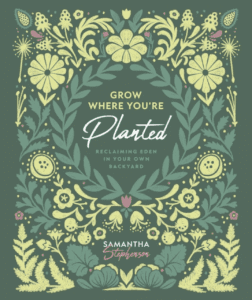 What if we want more practical, hands-on, down-to-earth (quite literally) advice on new creation? For that we can turn to Samantha Stephenson’s Grow Where You’re Planted: Reclaiming Eden in Your Own Backyard. Stephenson is a Catholic writer and blogger devoted to the ideal of “a slower, more rooted way of life” and to the project of “how to live a fully human life in an increasingly artificial world” (I quote from her website). She puts all of this in practice as a homesteader with her husband and four children on a plot of land in Idaho.
Grow Where You’re Planted is a sort of almanac that blends “soil and soul,” as the author phrases it. The book is aimed in a special way at families with children, who will benefit from seeing nature come alive. Stephenson takes us from season to season, offering detailed information about how crops behave in various natural conditions and tips about how to plant various produce effectively in the space you have at home. She pauses for scriptural and theological reflection along the way, and these “seeds for contemplation” are worth the price of the book, even if you choose to enjoy it as you would a poem instead of a gardening manual.
Stephenson’s chapter titles alone convey the book’s themes and ideas, tracing a graceful cycle through the year: “Spring—Sowing Seeds and New Life”; Summer—Tending and Diligence”; “Autumn—Harvest and Gratitude”; “Winter—Rest and Rootedness”; “Spring Again—The Cycle of Life: Ever-Changing, Ever-New.”
Like Norvell, Stephenson concentrates on vegetative growth as analogous to the growth of the soul in God’s grace. Tilling the soil is a school for the soul, teaching us the balance between preparedness and trust in God. On the one hand, the grower must be prepared and self-sufficient; but she must not put greater stock in her efforts than in God, the Provider. Gardening is a balance between “tending and diligence” and patient waiting on the Lord, who works by a process of quiet, invisible growth. Watching things grow in a garden, we learn to respect the divine sense of timing. As Stephenson puts it (and here you can sample her elegant prose):
So much of the gardener’s work is done in that quiet, trembling tension between trust and uncertainty. To wait in faith—knowing the fruit may never appear in our season or in our sight—is to entrust the harvest not to our own hands, but to the mercy of God. This is the hidden labor of the kingdom: sowing in hope, surrendering the harvest.
Gardening, like life, sometimes throws up surprises and disappointments. But these can be opportunities to learn new things and especially the virtues of patience and docility, to allow “God’s refreshing grace to penetrate our souls, rooting us more deeply in His truth—not as we’d like it to be, but as it actually is.” Like Norvell, Stephenson had to overcome pain in her life, in this case an autoimmune disease. She found healing and recovery from creating a “well-tended place of beauty” at her home, discovering the enchantment of God’s presence in nature.
Suffice it to say, after you have finished this glossy and handsomely decorated book, you will not be tossing seed out onto any old patch of ground. Stephenson provides tables detailing what vegetables and fruits to plant when and where, how to plan and space your crops, and what kind of soil and tools to use to make your crops flourish. There are also sections on preserving the produce through the winter by canning, with all the information clearly laid out for those who want to take gardening to a higher level (as for myself, I have my hands full with the small planter of herbs in my backyard). On the spiritual side, you won’t be blind to the concrete referents of Jesus’ parables after reading this book.
The book is completed by an appendix filled with wonderful “garden to table” recipes, from Resurrection Cookies to Burst Cherry Tomato Pasta, accompanied by more spiritual food for thought. Here is a rare combination of deliciousness and profundity.
Books on theology and books on gardening are more than plentiful, but rarely are both topics fused in the way these books manage to do. Christine Norvell gives us the intellectual grasp of the relationship between creation and the life of the soul, while Samantha Stephenson explains how, by cultivating both the earth and our souls, we can actively contribute to God’s new creation. These books reach me at an opportune time, as I have recently become fascinated by St. Irenaeus, the early church father who preached an evolutionary theology of creation and redemption. I thank the ladies for writing these books, and I am grateful for the privilege of reviewing them.
__________
The Imaginative Conservative applies the principle of appreciation to the discussion of culture and politics—we approach dialogue with magnanimity rather than with mere civility. Will you help us remain a refreshing oasis in the increasingly contentious arena of modern discourse? Please consider donating now.






Leave A Comment