
G.K. Chesterton and Fulton Sheen were kindred spirits, with the older man serving as the younger man’s mentor and inspirational model.
Author’s Note: Venerable Fulton Sheen is due to be beatified on September 24 in St. Louis. Calls are currently being made for Chesterton’s cause for beatification to be opened. The following is intended as a tribute to the sanity and sanctity of both men.
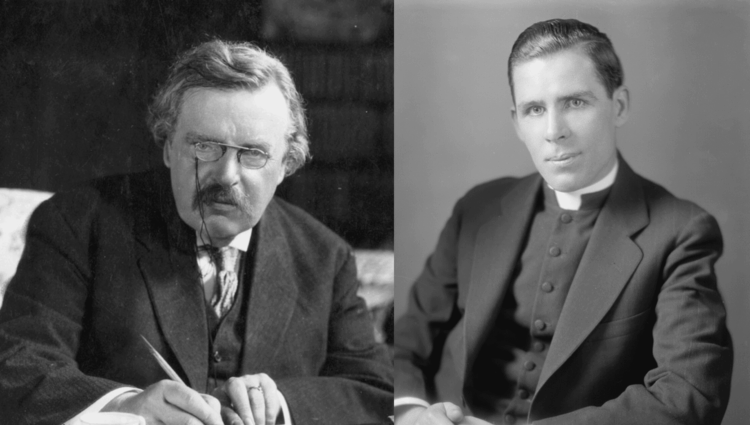 G.K. Chesterton and Venerable Fulton Sheen were two towering pillars of faith in the twentieth century. Perhaps, switching architectural metaphors, they could also be seen as two towering lighthouses, guiding people through the stormy waters and perilous currents of modernity with the light of Christian orthodoxy. They were separated by time, Chesterton being born two decades earlier than Sheen, and also by place, Chesterton being as quintessentially English as Sheen was quintessentially American. And yet they were kindred spirits, with the older man serving as the younger man’s mentor and inspirational model.
As a young priest, Fulton Sheen met Chesterton and asked him if he would be willing to write the preface to Sheen’s first book, God and Intelligence in Modern Philosophy. With customary humility and self-effacement, Chesterton responded that he was not a philosopher and knew nothing about philosophy. Sheen retorted that Chesterton’s Orthodoxy was an excellent book of philosophy, at which point Sheen recalled that Chesterton, “scratching his bushy head”, agreed to write the preface.
It’s not known how many times Fulton Sheen met Chesterton after this first meeting in 1925, but we know that he was amongst those who attended Chesterton’s funeral in 1936.
By the time of Chesterton’s death, Sheen had already risen to prominence and the attainment of what the modern world calls “stardom” through his success on the radio. His hosting of a weekly show on NBC called The Catholic Hour began in 1930 and proved hugely popular. By 1950 it attracted four million listeners and prompted several thousand letters each week. This phenomenal success would be eclipsed by Sheen’s popularity in the new medium of television. From 1952 until 1957, his weekly TV show, Life Is Worth Living, attracted as many as thirty million viewers each week, most of whom were non-Catholics, and it is said that he received over 8,000 letters a week in “fan mail”. Never had a Catholic apologist and evangelist ever reached as many people through the medium of television, nor would anyone do so until the global coverage of the travels of St. John Paul II after his election in 1978 and the founding of EWTN by Mother Angelica in 1980.
Throughout his life, Venerable Fulton Sheen retained his deep admiration for Chesterton. This can be seen in anecdotal memories of those who met Sheen. Dale Ahlquist, President of the Society of G.K. Chesterton, offers such an anecdote:
One day a woman called me up because she wanted to tell me about the time she met Bishop Sheen. She had been a librarian at a university and Sheen was visiting. He was at the height of his popularity. He was being escorted through the library by university officials and one of them introduced her to the bishop by saying that she had read all of Sheen’s books. The bishop smiled and asked her: “But who’s your favorite author?”
She didn’t hesitate: “G.K. Chesterton.”
Sheen smiled even bigger. “Mine, too!”
Sheen said that the writer who influenced him the most was G.K. Chesterton.
In similar vein, several years ago I received an email from a priest who recounted a delightful anecdotal memory from his time as a seminarian in Texas:
I had written to the late Archbishop Fulton Sheen in 1975 asking his advice about writing a master’s thesis on his works. He responded personally to my letter and recommended that I write not on him but on G.K. Chesterton. He wrote that everything he did was inspired by Chesterton! Later the next year Archbishop Sheen arrived at our seminary in Dallas to offer Mass and preach. After Mass he greeted people personally and when I approached him I reminded him of my letter. He immediately responded by saying, “You’re the one! Yes, Chesterton’s the man. I could not have done anything without Chesterton. Write on him.” I was amazed that he remembered my letter and I was amazed at his frank humility about his work. Even though I never wrote a thesis, I enjoyed my communication with Archbishop Sheen. He was one of my childhood heroes.
In October 1979, two months before Fulton Sheen’s death, St. John Paul II embraced him during a visit to St. Patrick’s Cathedral in New York City. “You have written and spoken well of the Lord Jesus Christ,” the pope told him. “You are a loyal son of the Church.” A third of a century earlier, in June 1936, following the death of G.K. Chesterton, Cardinal Pacelli (the future Pope Pius XII) sent a telegram for and on behalf of Pope Pius XI, which was read at the requiem Mass for Chesterton at Westminster Cathedral: “Holy Father deeply grieved death Mr Gilbert Keith Chesterton devoted son Holy Church gifted Defender of the Catholic Faith. His Holiness offers paternal sympathy people of England assures prayers dear departed, bestows Apostolic Benediction.”
How appropriate that G.K. Chesterton and Venerable Fulton Sheen should have received such praise from two holy pontiffs. They had indeed both “written and spoken well of the Lord Jesus Christ” and they were both “loyal sons of the Church”. They were also “gifted Defenders of the Catholic Faith”. May they continue to defend the Faith through their powerful intercession.
Gilbert Keith Chesterton and Venerable Fulton Sheen, pray for us.
__________
The Imaginative Conservative applies the principle of appreciation to the discussion of culture and politics—we approach dialogue with magnanimity rather than with mere civility. Will you help us remain a refreshing oasis in the increasingly contentious arena of modern discourse? Please consider donating now.
The featured image combines an image of G.K. Chesterton and an image of Fulton Sheen. Both files are in the public domain and appear here courtesy of Wikimedia Commons.






Leave A Comment