
Pope Leo’s educational vision aligns directly with the Catholic understanding of God’s creative goodness: He sees education as proceeding from our foundation as made in God’s image, which sees us as more than mere passive recipients of being, but cooperative causes in its creation.
 “The authentic teacher arouses the desire for truth” is found early in the latest document of Pope Leo XIV on education, Drawing New Maps of Hope (2.2). Measuring a mere 8 pages with footnotes, Leo seeks to pack tightly the Church’s expansive tradition in this field while moving it forward. The line that begins this reflection encapsulates both the ancient wisdom of the practice of teaching itself as well as the modern challenge for both the modern teacher and the Church at large. While there is no shortage of information all claiming to be the truth, and no shortage of instruction for the modern teacher on how to communicate this truth effectively to students, the desire itself in those very students to learn will commonly be seen as the most pervasive problem in school today. Teachers are well past the cliche of teaching students “not what to think, but how to think” and now must instill the very desire to think.
The rise of the Large Language Models, their development and invasion to seemingly every area of professional, and even now personal, life has been well documented. This is felt most widely in the sphere of education. By now, nearly every teacher has seen the graph, shared by many with varying levels of sardonicism, horror or a combination of the two, showing the plummet of ChatGPT use beginning in June, which happens to be the start of summer break. Here Leo’s educational vision aligns directly with the Catholic understanding of God’s creative goodness: that humans, made in His image, are not passive recipients of truth but active participants in its discovery and transmission. Leo sees education as proceeding from our foundation as made in God’s image (3.1), which sees us as more than mere passive recipients of being, but cooperative causes in its creation. This happens in education when the teacher not only causes the good of truth in students, but equips them to become causes in the good of truth themselves.
This conflict between Artificial Intelligence and education proceeds from the disparity between the so-called intelligence of LLM and the intellect as a power of the soul. Briefly, it is the product of the necessary relationship of the rational soul, of which the intellect is an essential power, and the body. Though the intellect itself is not tied to the body (which is why even pre-Christians like Aristotle could recognize the immortality of the soul at the death of the physical body), because we are hylomorphic beings our intellect operates through our body. This necessary relationship for operation not only works between our own intellect and our own body, but it also works through our intellect to the intellects of other people. This is the basis of teaching whereupon the intellect of one is shared with the intellect of another, which is done through the body of the teacher and the body of the student.
Because the soul is the form of the body (see ST I. Q 76. A 1), it is that which gives limits and meaning, like any other form does. The intellect, being a power of the soul, is not just a compiler of information, but is that within the soul that forms and makes meaning out of information. One ancient way we have made meaning with scattered information, providing an early form of education, was through our recognition of the constellations in the night sky.
By ascribing nautical language to elements of education like “constellations,” the “anchor of salvation… a sail unfurled… lighthouse in the night” (Drawing New Maps of Hope, hereafter DN, 1.2), Leo evokes both the wonder and peril that is found in the act of teaching and learning. It was in the stars that ancient people first were able to recognize meaning in the vast, seemingly desolate void of space. It was in the recognition of patterns in these natural constellations that sailors found guidance in their seafaring. Leo seeks to instill in the Church the same sense of meaning and guidance when it comes to Her mission of education. This is how she fulfills her ultimate call from Christ to love others. Just as sailors looked to the stars in hope they were traveling in the right direction, and their education in astronomy and navigation ensured this hope, so Leo can also proclaim, “Educating is an act of hope” (DN 3.2). The Church’s plan of education is the “Map” that is written because of this hope.
Because truth and goodness are convertible with being (see ST I. Q 16. A 3), facilitating truth becomes an act of charity. Not surprisingly, instructing the ignorant has long been considered in the Catholic tradition to be a spiritual work of mercy. This is because of the order of the rational soul, specifically the intellect, toward truth. With the rise of consciousness to the importance of truth, itself a sort of correction to the cultural relativism of the previous generations, the Church’s mission and evangelical weight behind the ministry of education becomes all-the-more pronounced. Education, like any work of mercy, must be accomplished in relationships.
There is even greater significance to this convertibility when it comes to education, as true education can only happen in the context of relationships because both enterprises, education and relationships, participate in the virtue of magnanimity. When one’s capacity for rational thought increases through education, one’s intellect increases. This increase in intellect, being a power of the soul, is the definition of magnanimity. It is not unlike the increase in one’s capacity for love, whose object is goodness (see ST I-II. Q 27. A 1) and is the perfection of the will (see ST I-II. Q 13. A 5). This theory of education, and its connection to the works of mercy in a Christian context, should remind one of a similar educational principle from Plato’s Republic that “true education” makes one’s soul more capable of receiving good and rejecting evil (see Book III). This is because our love of goodness will naturally unite us to that goodness.
It is significant that Leo reiterates the ancient call of the Church to the “family as the first school of humanity” (DN, 4.1). Education is perhaps, surprisingly to some, significantly less about information and more about relationships. The information that is passed through families is more deeply internalized and more naturally lived to the degree that it is contextualized by relationship. This school of humanity is meant to branch outwards to the common shared humanity in the wider culture. One imagines the fruit of a call from Pope Leo XIV for educational initiatives within the Church that promote this “integral anthropological vision” (DN, 4.2). We have already seen Catholic classical academies and Catholic trade schools open. What new projects will the Church produce to meet the changing needs of the world?
This is the strongest connection the Drawing New Maps of Hope has to its predecessor upon which it is built, Gravissimum Educationis (1965). This document promoted both the human right of education in general, as well as the right of the baptized, to a Christian education. This language of rights was certainly consistent with the emphasis of human rights of this period when the travesties of the Holocaust and World War I were still fresh in many minds. Though the humanitarian crises have not ceased since this time, the Church still recognizes the necessity of the family in providing education, especially the Christian education, of the next generation.
What is sometimes misunderstood about the “right” to education, which Christians can and should recognize and uphold, is that it should not imply a right to every type of education. This assumption of the superiority of a certain kind of education led to an idolization of the modern university system, pushing many into said system with little preparation or desire in its unique demands. This imposition forced a change in education mission for many universities into a more utilitarian mindset, which is inherently inimical to the classical, virtuous and, ultimately, soul magnifying approach to learning.
While skepticism of the modern university system is becoming more widespread, and from this a renewed interest and respect for necessary trades, there cannot be an assumed disjunction between these and the capability or desire of those occupying said trades. Education, and one’s right to it, need not fit into a certain box, but it still must be ordered toward a certain end. Aristotle walked with his students, the Parepatetics, around the streets of Athens so that he could use the physical world to point them to the metaphysical. Christ used premises in the natural world to point his uneducated hearers to supernatural conclusions. All people can be drawn through their stations to deeper rational thinking. It is in cultivating this capacity that educated individuals can work to build a society of gentle doves and wise serpents (cf. Matthew 10:16).
Leo then appears to address the increasing polarization surrounding education and misinformation by appointing “Catholic education… the task of rebuilding trust in a world marked by conflicts and fears” (DN, 4.3). Without citing specifically the many challenges to the authentic pursuit of truth found in the natural and mechanical echo chambers of our own design, Leo points to education as that which, by helping people think more clearly through the problems facing their day-to-day life, can help us love more powerfully. This paragraph addresses one of the most destructive sources of suspicion in the field of education: the pervasive assumption that truth claims become impositions on the mind, and so absolutist or dogmatic claims about the nature of reality must be thrown down like shackles. This view that truth itself is just a hidden expression of power, makes authentic education impossible.
After teaching long enough one begins to hear many aphorisms about the nature, purpose, or importance of education. In paragraph 8.2, Leo leaps beyond the old cliche asking whether education is an art or a science by calling it a dance that requires a “choreography.” To compare education to a dance seems to include both the elements of an art and a science, while also recognizing the strenuous physical activity and need for flexibility in its execution. There is also in most dances a back-and-forth between the dancers that illustrates the interplay between teacher and student, which must occur in authentic education.
Like his other recently released document, Dilexi Te, Leo closes this one in a similar chiastic structure. Just as his early paragraphs used the image of stars, specifically constellations, as an image of wonder, reason, and guidance, so does he close. One final point in the interesting use of stars for this document can be combined with Leo’s numerous appeals to education and its connection with hope.
Another writer in the Catholic tradition, Dante Alighieri, also recognized the importance of stars as signs of hope in his magnum opus, The Divine Comedy. Alighieri ended each of his three sections of the epic poem with the word “stars” because they were what his pilgrim used as guiding lights on his journey to heaven. With Leo’s continued use of the image of stars, “constellations” rather (DN 1.2, 8.1, 8.3, 10.4, 11.1), to begin and end this letter, one is reminded of humanity’s introduction to the search for wisdom, which began as Plato says in wonder (Theaetetus). One cannot also help but remember humanity’s end in this search for wisdom. This end is found in God, whom Dante describes as his pilgrim reaches the final stage of his journey to heaven, as “the love that moves the sun and other stars.” What we need now is a model of education that is born in and facilitates wonder, and seeks wisdom; one that will point us to, and beyond, the things of this world to those of heaven.
___________
Republished with gracious permission from “What We Need Now” (November 2025).
The Imaginative Conservative applies the principle of appreciation to the discussion of culture and politics—we approach dialogue with magnanimity rather than with mere civility. Will you help us remain a refreshing oasis in the increasingly contentious arena of modern discourse? Please consider donating now.
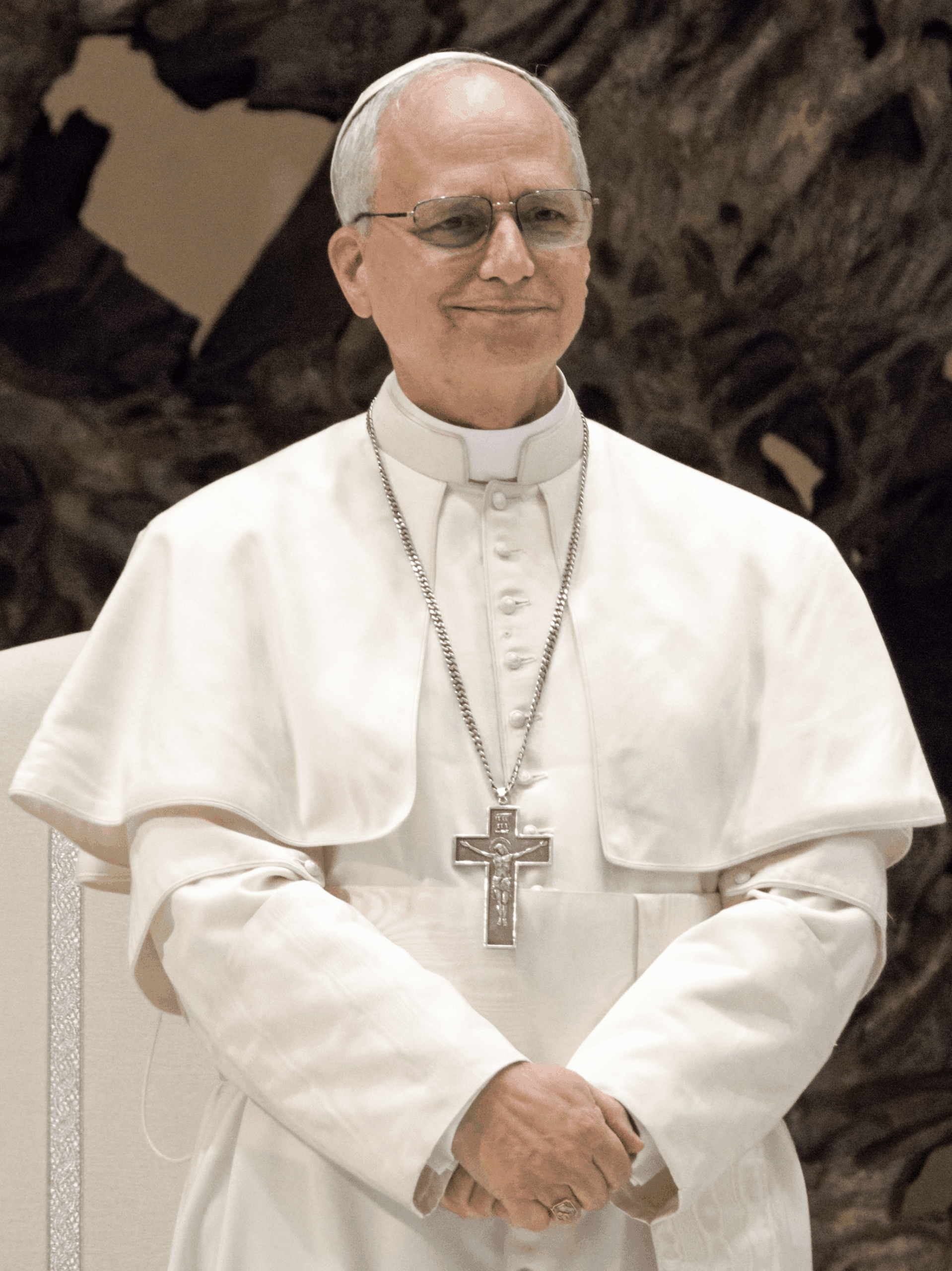
The featured image, uploaded by Edgar Beltrán, The Pillar, is Pope Leo XIV during a meeting with the media on May 12, 2025. This file is licensed under the Creative Commons Attribution-Share Alike 4.0 International license, courtesy of Wikimedia Commons.



This reflection does a beautiful job of capturing the heart of Pope Leo XIV’s Apostolic Letter “Drawing New Maps of Hope”. It emphasizes how the Pope sees education not just as a technical task, but as a profoundly human and spiritual mission forming the whole person, not just producing skills. I especially liked how it lifts up his concern that in our hyper-digital age, education shouldn’t reduce students to “profiles” or algorithms, but honor their dignity and story. The idea of the Church as an “educational constellation” a network of schools, teachers, families, and institutions working together feels deeply hopeful and relational. Overall, it’s a moving and timely call to reimagine Catholic education as a bridge between tradition and the challenges of our rapidly changing world.