
Long before I knew what literary criticism was, I was a boy, living and growing up in southwestern Minnesota, a remote part of the world…
Since then, I’ve come to that age where I’ve retired from what I’ve done with the decades of my life. Over those “professional” years, I shied away from being called “the writer in residence.” It helped me slip away earlier on Friday afternoons, avoiding that soft knock on the door, the tentative undergraduate wishing to slip quietly into the office for a chat with ”the writer in residence,” he or she in the process of becoming “well-schooled,” most of which is blank imaginative hunger.
And “the” question: “When did you learn to write?”
A semi-precious question.
What could I say?
There was the grandfather who owned a print shop and in setting type taught me to spell backwards which meant counting my “sorts,” holding the “composing stick” properly, “slugs” rattling, starting and ending each line with an “em quad,” “nicks up,” spacing material, “snug” lines, and type that was never off their “feet.”
Oh, and be very, very patient. And the horror if in spelling a word I changed type fonts. Obituaries to begin with and the writing a tad too florid.
So, not when did I learn to live or breathe, or throw a baseball or football, ride a bike, fly fish, love my wife, play golf, pray, what the more pragmatic might call “important stuff,” except for prayer that is, and golf, and fishing, and my wife.
“Tell me a story,” I would softly say, eyes closing, quoting old Red Warren, “tell me a story of deep delight.”
“Right now?”
“Yes. It’s Friday so we have time. A story, then, one on the tip of your tongue, urgently to be told with purest praise, a fragment you’ve been kindling for weeks in your mind, bargained by loss of sleep, one which will become the first page of your own story-book in time.”
Followed by:
“I’d have to think about it for awhile.”
It seems mundane this little office scene, but the young who wish to write more often than not have yet no stories gathered into tidy bundles, have not learned to live that half-mocked routine where the tongue is sometimes thin and sometimes thick.
“My grandfather,” I would begin, “had an old round-topped steamer trunk.”
And then I would continue, without quotation marks.
Did you know that trunk made its way from Sweden to southwestern Minnesota, to Westbrook, to be exact, where he set up as a “jour printer,” a small town newspaper with all the news fit to print. He taught me to set type, backwards. “Fontology,” I would say, pleased with my own joke.
For years that trunk sat in my aunt’s basement until I rescued the thing and spent a good deal of rehabilitating time: removing rust, new leather handles, rosettes, removing scummy greenish paint, new stain on the oak binding strips.
Rehabilitating time, I would repeat, with a side-long pickerel glance at that young person sitting in that ubiquitous spare office chair.
Rehabilitating time….
I said that I had come to use that trunk as a catch-all and only recently did I go through much of what I had “tossed” into that trunk over time, memorabilia and such, including that sarong from a Malaysian student, and never worn in public–for good reason and thus no snickering please. There were some grade school pictures from now six decades ago, grades one through six, and among them a once forgotten remembrance of a sweet-faced child standing next to me: Sharon Doten.
Did you know, I said, the suave power she had over me in first grade? Such nuance and imperative, such lifting the lid of youthful passion and the font of indolent poems about nettles and unspeakable desolation, and stories of an every-day showcase for dewy shared sensibilities, and other such hyperboles….
That village in southwestern Minnesota was small, 350 stout Scandinavian souls give or take, a German now and again, one French family, but no Bohemians. It was divided by a single railroad line, and a once-a-day train that serviced grain elevators which to this day rise up from that flat prairie like whitéd sepulchers, which is as close to a Hart Crane moment as I can get.
Mr. Doten was the depot agent, I would add, with a by now a six decade far away look in my eyes on this usual Friday afternoon in time, those afternoons of vulnerable pieties witnessed by a “student.”
There were two rooms in that depot; one was a waiting room with benches and a large pot-bellied coal-burning stove. That depot is the same depot marking the spot where my grandfather arrived, late nineteenth century, with his round-topped steamer trunk, and descended into his life, his time.
The other room was Mr. Doten’s office which had a marvelous old oak roll-top desk and then a large window and another desk upon which sat the telegraph apparatus. Mr. Doten was a generous and patient man. Uninvited, likely on a Friday afternoon, on my paper route, I would stop at his depot office to learn international morse code, tapping out three dots, three dashes, three dots such that those up and down that telegraph line must have thought the apocalypse was at hand, beginning in a small southwestern Minnesota town, Storden, population 350 and then west six miles to Westbrook where my grandfather again began his newspaper business and where I again learned to set type backwards and who also owned the movie theater where Houdini once performed, coming to town on the train in his own railroad car.
Houdini, escape artist, childish eyes….
Stories….
Spots of time….
Including the one about that slow moving train and the time it paused and from one nicely furnished car, safely and tenderly treated, descended Dan Patch to walk one short block to the village park and to graze placidly on the tender grass.
Maybe….
It could be true but if not should be.
Mr. Doten told me never to remember the dots and dashes but listen to the code sounds instead.
Listen to the code sounds instead, which in time I came to understand and came to know how one could with grit fashion something out of woolgathering, eulogies when called upon, and bits and pieces even of sensual pride, so life and love so very often go, code sounds, each one a supposed tripped over remembrance. And write an occasional high school sports page story for The Echo which was less newsy and more a revision of the Iliad. A football game as the Trojan War, cheerleaders and a homecoming queen supplanting “booty.”
It’s a sweet memory these days at this age when in quiet moments a man might be inclined to waltz around in the roll-top desk pigeon holes of his heart, choosing this one but not that one yet, which in time six decades ago was just beginning to bloom much like the student in the office chair, or so I pray.
The Doten family lived in a frame house just east of the Baptist church which was just across the street from the stolid, brick Lutheran church. This was the same Baptist church, by the way, and which you may recall, struck by lightning in the course of a Lutheran church service which led to more than usual smugness on the part of that Lutheran congregation and caused the Baptists to abandon that church and move to the outside of town where they built a church upon the model of a Motel Six, and no steeple.
“Praise God, from whom all blessings flow,” that 1674 doxology lovingly sung by Lutherans and at just that point in the worship service about blessings flowing, a burst of lightning exploding, 54,000 degrees fahrenheit, more or less, and havoc upon that Baptist church steeple.
Cravings for signs, I guess, creation in its original form, or maybe a criticism of that congregation’s singing, serene to a fault. Lutherans love to sing, I would add, nodding to the student sitting in that office chair; such a pity they can’t and one more good joke lost on the young.
But I digress and may be accused of scorning one’s instinct for faith, which is not true for someone with an abiding belief in a 500-year comet’s return. What I dare not waste is history which I believe is rehabilitated time. There are differences and Friday afternoons are ironic testimony.
On warm summer evenings and cold winter evenings, it was a short walk to the Doten family home where Mr. Doten would fiddle with the dials on his ham radio; the word “ham” is “pejorative” I would usually say about that time to that student still patiently sitting in my college office wondering when and if I would ever get to the point, to the answer to the question, “When did you learn to write?”
The radio signals would come in from all over once those vacuum tubes warmed up, coming in on radio waves and lo there would be this voice which Mr. Doten would identify as such-and-such from Luxembourg. And I would repeat the word, “Luxembourg,” with as much luxury as the word “Paraguay” or “gleeting” or “bristly-brave,” words among words among words which glimmer even to this day within my mind as lichen glimmers on old wood, things to linger over.
And then that short solitary walk home where I learned something about solitude–especially on cold January nights with no moon, stars only, or the mystical northern lights–an advent kind of word I once told a student: solitude.
And to bed. And dreams. And memories. Fostered by, I tell the student who may or may not still be sitting in that office chair, fostered by craft, stamina, self-mastery, and form, and faith.
“You need to forgive me,” I would then say; “forgive my age and excess of memory, my belief that metaphor is a snug house stocked with the furniture of paradox, irony the fuel in the fireplace, humor the suffragette at the stove, and a round-topped steamer trunk stuffed with all of life’s trial runs, tugging now with eternity’s urgings before the letting go….”
Forgive me.
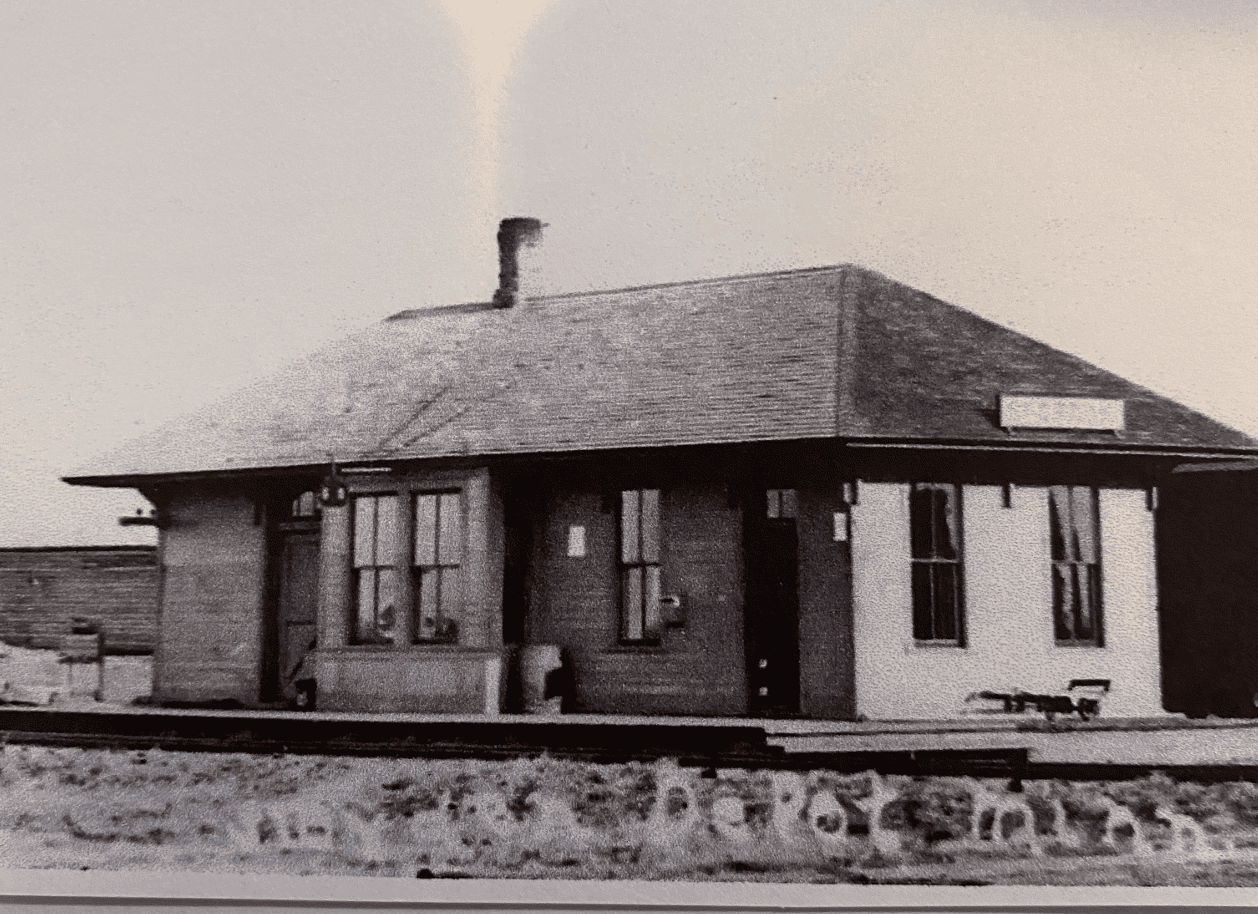
Storden Depot, circa 1910
“Ransford Doten at the Depot”
The town’s still there, but not as he remembers:
Elms over-arched the roads, and at the edge,
Close to the grain elevators, the depot Ransford Doten
Worked. Steady work. Railroad’s good. Better
Than loading grain cars. A man falls in he’s lost,
Sucked down, waving, beating, out of breath.
*
At the depot, Ransford Doten sits, the rails empty,
Ties and telegraph poles stacked in pyres, the wires
Down in rolls. I remember him reducing prayer to code,
The hand sending signals: three short, three long,
Three short. Repeat, tapping hard soft hard. Repeat.
Stop and look and listen for an answer coming back.
__________
The Imaginative Conservative applies the principle of appreciation to the discussion of culture and politics—we approach dialogue with magnanimity rather than with mere civility. Will you help us remain a refreshing oasis in the increasingly contentious arena of modern discourse? Please consider donating now.
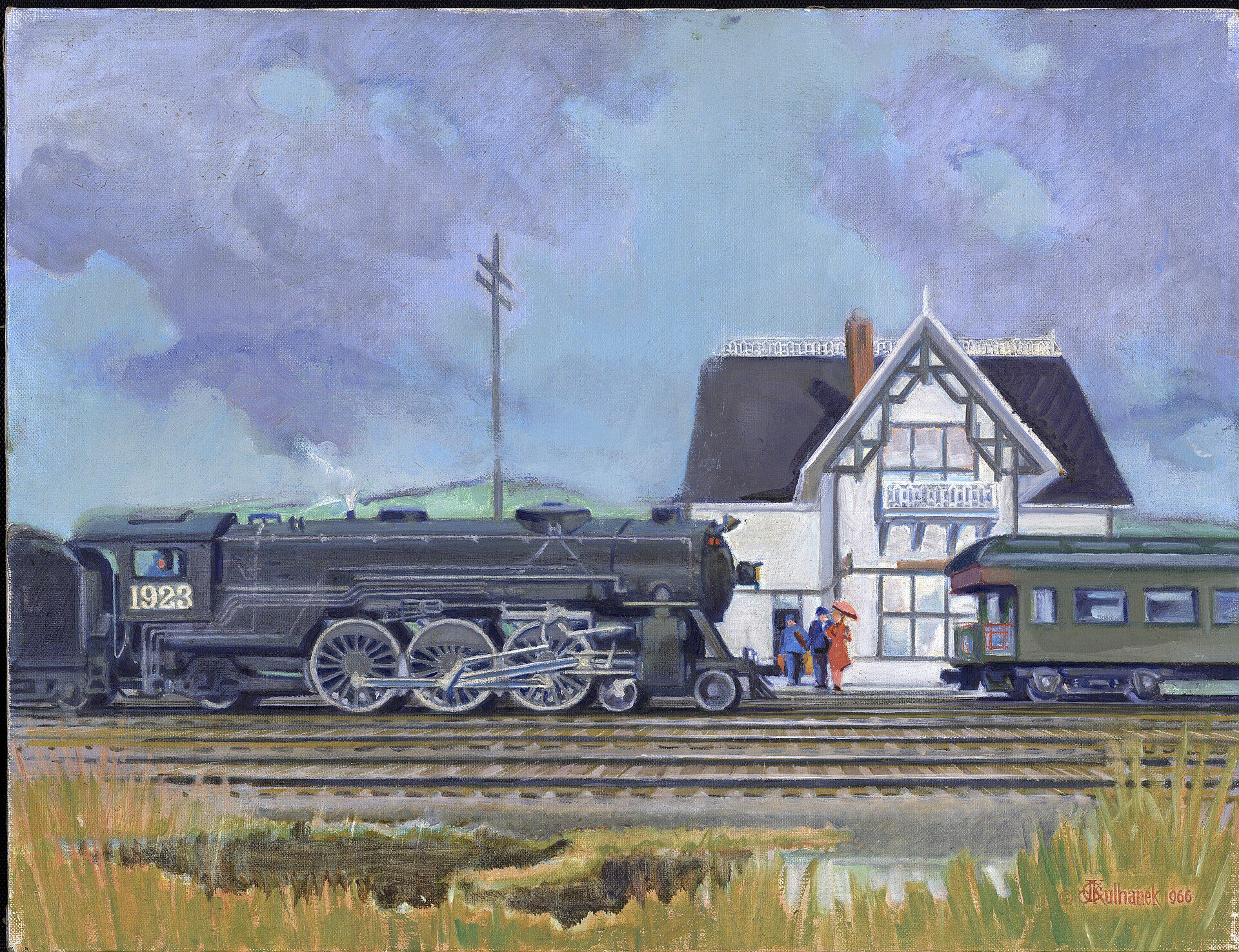
The featured image is “Whistle Stop” (1966), by James F. Kulhanek. This file is licensed under the Creative Commons Attribution-Share Alike 4.0 International license, courtesy of Wikimedia Commons.





Leave A Comment