
 As he personally drafted his first inaugural address on a yellow legal pad, President-elect Ronald Reagan set as a primary goal restoring America to its former greatness. Reagan saw that America had lost faith in itself, as a result of the Carter years, the Watergate scandal, President Nixon’s forced resignation, and the loss of the Vietnam War and the ensuing communization of South Vietnam and Cambodia. As Reagan would later write in his autobiography, “the lost vision of our founding fathers” had to be recaptured.
To renew America’s self-confidence, his administration would undertake two urgently needed political reforms: one, to initiate a foreign policy of “Peace Through Strength” that would end the Cold War by winning it; and two, to jump start the American economy through significant deregulation, reduced federal spending, and across-the-board tax cuts. And he had an instrument in hand that would enable him to achieve these goals—the bully pulpit of the presidency.
Reagan would use inspiring oratory to help the people regain “that unique sense of destiny and optimism that had always made America different from any other country in the world.” But his rhetoric neither pandered nor set impossible utopian goals that lead to exhaustion or resentment. It was built on the intrinsic virtues of the American character which he had reflected on for years and had come to represent in the minds of a majority of the American people.
In his inaugural address, Reagan outlined the severe economic crisis that confronted the country and set forth a series of corrective actions: it is time, he said, “to reawaken this industrial giant, to get government back within its means, and to lighten our punitive tax burden.” (The highest marginal tax rate then stood at seventy percent.) Building his rhetoric upon American industriousness, Reagan sought to awaken a new spirit of patriotism.
Along with these exhortations, Reagan identified the federal government as the primary cause of the crisis. He had long studied the proper role of government. He knew what most Americans wanted from their government through his many conversations with them in the 1950s as an emissary for General Electric and then as a two-term governor of California. He was the first president since Calvin Coolidge to use blunt, anti-government rhetoric. “In this crisis,” he said, “government is not the solution to our problem; government is the problem.” Reagan’s rhetoric was built on his understanding of unique American virtues, like industriousness that had become enervated by four years of Carter’s regulations, taxes and intrusions.
He rejected the oft-expressed liberal notion that “society has become too complex to be managed by self-rule,” or that government by an elite group was superior to “government for, by, and of the people.” With impeccable logic, he asked: “If no one among us is capable of governing himself, then who among us has the capacity to govern someone else?” He reassured the people he had no intention of doing away with government but rather “to make it work—work with us, not over us; to stand by our side, not ride on our back.” Here was no radical libertarian with a copy of Atlas Shrugged on his desk, but a traditional conservative guided by The Federalist. Reagan was a 20th century federalist, echoing Madison’s call for a balance between the powers of the federal and state governments. He tapped into the American spirit of independence, which he knew needed bolstering through presidential rhetoric.
Peace Through Strength
 In the realm of foreign policy, Reagan promised to strengthen ties with those who shared a commitment to freedom but to remain ready to act against “the enemies of freedom” in order to preserve national security. He paraphrased the traditional U.S. policy of “peace through strength,” saying, “We will maintain sufficient strength to prevail if need be, knowing that if we do so we have the best chance of never having to use that strength.” His words echoed the ancient Latin dictum: “Si vis pacem para bellum.” (“If you want peace, prepare for war.”) Reagan rejected the idea of a Vietnam syndrome that paralyzed the will of the American people. He understood that Americans think of themselves as bold and strong; he insisted that the moral malaise from the Carter years was only temporary.
As he approached the end of his address, the president referred to the giants “on whose shoulders we stand”—George Washington, Thomas Jefferson and Abraham Lincoln—as well as the servicemen buried in Arlington Cemetery who had sacrificed everything to preserve our freedom. Reagan personalized their sacrifice by reading from the diary of a young soldier Martin Treptow, who had fought and died in World War I. My pledge, wrote Treptow, is that “I will work, I will save, I will sacrifice, I will endure, I will fight cheerfully and do my utmost, as if the issue of the whole struggle depended on me alone.” Reagan sought to connect Americans with the courage and sacrifice of past generations.
The president ended his inaugural address as he began it by appealing to the faith of the American people. While the present crisis does not require the same magnitude of sacrifice as that of Treptow, he said, it does require “our willingness to believe in ourselves and to believe in our capacity to perform great deeds, to believe that together with God’s help we can and will resolve the problems which now confront us.” Americans were, he believed, connected to one another through a noble history of past and future sacrifice and their participation in great deeds.
“And after all,” he said, “why shouldn’t we believe that? We are Americans.” In his first major presidential address, Reagan was what he had been throughout his public life: optimistic, confident, faith-filled, inspiring. He eschewed the extraneous adjective, the worn-out metaphor. He employed simple direct language.
The Farewell Address
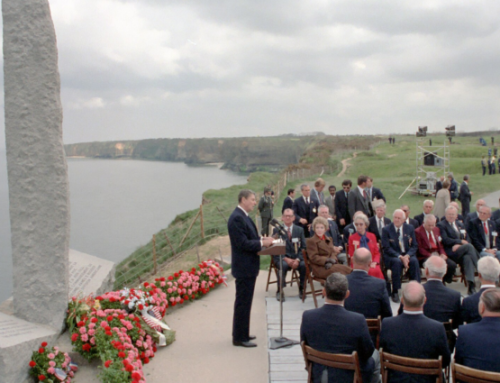
 Eight years later, in his January 1989 Farewell Address to the American people, President Ronald Reagan displayed his sure command of political rhetoric by denying and thereby correcting the simplistic notion that he was just a Great Communicator: “I never thought it was my style or the words I used that made a difference,” he said, “It was the content.” Reagan was not swayed by polls or focus groups, understanding that the most effective political rhetoric was based on lasting ideas not transitory trends. That is, Reagan observed: “I wasn’t a great communicator, but I communicated great things,” gathered from “our experience, our wisdom, and our belief in principles that have guided us for two centuries.” On an occasion when most politicians would have boasted about themselves, Reagan chose humility.
Ronald Reagan was a superb orator, one of the greatest in American politics at ease with a formal address to the U.S. Congress or the British Parliament, a “fireside chat” with the American people from the Oval Office, or a blunt challenge to a foreign power. The process of becoming an orator had begun many years before.
The Hollywood Years
 Reagan readily admitted that he honed his rhetorical abilities during his years in Hollywood. In Speaking My Mind, a collection of his speeches that he personally selected, Reagan said that he had been elected—in part—because he was an actor who knew “how to give a good speech,” who “knows two important things—to be honest in what he’s doing and to be in touch with the audience. That’s not bad advice for a politician either.” He emphasized that it was not just “my rhetoric or delivery” that carried him into the White House but that his speeches contained “basic truths”—like the necessity of preserving individual freedom—that the average American instinctively recognized. “What I said simply made sense to the guy on the street,” he wrote.” Always, Reagan sought to speak to the mind, not merely the impulses of the moment.
Reagan learned to talk to that “guy” as a young radio broadcaster in Des Moines, Iowa, the heartland of America. He conceded that on his first day, he was nervous sitting in a small, windowless room in front of a live microphone. After some stumbles and even awkward silences, it suddenly came to him. He knew many of the people listening. He wasn’t talking to faceless, unknown listeners but to guys in the local barber shop with whom he joked and talked sports and told stories. All alone in that booth, he relaxed and “started talking to the fellows in the barber shop the same way I did during our regular get-togethers.” He had discovered a basic rule of public speaking which he followed all his life: “Talk to your audience, not over their heads or through them. Don’t try to talk in a special language of broadcasting or even politics, just use normal everyday words.” And he learned personal control—he was rarely if ever upset or rattled. He channeled the best in his audiences, especially their optimism and their patriotism. On the eve of his election as president, when a reporter asked Reagan what he thought other Americans saw in him, he replied: “Would you laugh if I told you that I think maybe, they see themselves and that I’m one of them?” He added revealingly, “I’ve never been able to detach myself or think that I, somehow, am apart from them.” He persuaded without pandering; he inspired rather than manipulated.
Perhaps surprising those who warn against rhetorical repetition, Reagan said he was a “big believer” in stump speeches because that was the only way your message “will sink into the collective consciousness” of the people. “If you have something you believe in deeply,” he said, “it’s worth repeating time and again until you achieve it. You also get better at delivering it.”
In Speaking My Mind, Reagan explained that his November 1988 speech at the Vietnam Veterans Memorial most represented what he had tried to accomplish as president—to help “restore the spirit and faith of America.” In his talk, he read from a note that he and Nancy left at the Memorial wall in remembrance of those who fought for their country and its safety and “for the freedom of others with strength and courage.” We have faith, he said, “that, as He does all His sacred children, the Lord will bless you and keep you, the Lord will make His face to shine upon you and give you peace, now and forever more.” The words reflected Reagan’s personal faith and America’s Judeo-Christian heritage.
The Power of Words
 Reagan believed, and constantly demonstrated, that words have the power to change the course of events. One of his most memorable addresses was his “evil empire” speech in March 1983 at the annual convention of the National Association of Evangelicals. Critics warned that “extreme” language about the Soviet Union would accentuate the Soviets’ paranoia and insecurity. Reagan was not concerned: “For too long our leaders were unable to describe the Soviet Union as it actually was…. The Soviet system over the years has purposely starved, murdered, and brutalized its own people. Millions were killed.” Is not a system that practiced such brutality “evil?” he asked. “Then why shouldn’t we say so?” He had always believed, he said, that it was important to define differences, “because there are choices and decisions to be made in life and history.” Reagan had faith that the American people would approve boldness in foreign policy—he paid scant attention to the devotees of conventional wisdom who always counseled compromise. He shrugged off the barbed criticism of the media that accused him of “sleepwalking through history” and dismissed SDI (the Strategic Defensive Initiative) as “Star Wars.” He drew courage from his convictions, and his understanding that the American public respected honesty and forthrightness.
A good speech, for Reagan, must be truthful. It must not pander, nor give in to fear or a selfish preservation of the status quo. It must take into account the audience’s mood, and guide their passions and imagination, while using the language of the common man. Most important of all, a great speech must be concerned with “great things,” with first principles such as liberty, justice, and equality that have shaped America.
Books on the topic of this essay may be found in The Imaginative Conservative Bookstore. Republished with gracious permission from the Intercollegiate Review (December 2014).



Leave A Comment