
 In ancient times and modern, theories of poetry interpretation abound. By Aristotle’s standards, poetry aptly portrays tragedy. Plato equates poetry with art and demeans it as imitation, as lesser importance, because it is reflection not reality. As a successful poet in the first century, Horace not only proffers advice on how to write poetry, but also how to interpret it. Strangely enough, however, some translators argue that Horace contradicts his own advice.
In his opening commentary in Ars Poetica, Horace offers direct and simple advice to the aspiring poet. First, the work should be “true to itself, essentially simple” so that the subject matter is neither too light nor too difficult to write about. The writer should also use a balance of new and old words since “words that have fallen away may rise again.” In this sense, chosen words are a “vehicle” in their structure and line because their very arrangement can evoke emotion like grief, gratefulness, or even rage. As Horace continues, he reiterates many of Aristotle’s points about suitable speakers, consistent characters, and the unity of the whole poem. Up to this point Horace has adopted an informational and even mentoring tone for his poetic progeny. Yet his perspective changes when he discusses poetry’s meaning.
Horace appears to contradict himself when he compares experiencing poetry to experiencing art or pictures. He states,
With poems it’s as with pictures; one pleases you more / The closer you stand; another pleases you more / The farther from it you are. / The first one loves to be seen in shadow; the other to be in the light / And has no fear of the judge’s close critique. / The first gave pleasure once and only once; / The other, ten times seen, will still give pleasure.
Some say the original Latin presents a problem with the antecedent, so that pictures appear superior to poetry. That would mean as a critic then, Horace is declaring that poetry resides in shadow, implying that it is obscure or without definition. That type of translation would pit art and poetry against each other. He then emphasizes that poetry (or the poet) would not welcome critique as art would and what’s more, it would only produce pleasure once, as if a re-reading could provide no further interpretation. These negative observations would detract from Horace’s catalog of advice and operate antithetically to his original purpose. Why would he limit his interpretation? Why would he downplay the very art and concept of all he had just championed?
The issue might just lie within our interpretation, or possibly translation, of Horace. Throughout Ars Poetica, Horace consistently maintains that “poetry wants to instruct or else to delight; Or, better still, to delight and instruct at once.” The majority of his method and advice speak to this end. He even allows for mistakes, proffers contrary examples, and discusses average, foolish, and long-winded poets as exceptions to his ideal. These few lines comparing art and poetry and their interpretation do not mesh with Horace’s overall commentary unless read without an absolute, measured pronoun.
As translations print the word “one,” it is more probable that Horace is speaking of both art and poetry as if either can be seen closely or at a distance or in shadow or in sun or in the eyes of a judge. Either can give pleasure once or multiple times. In this manner then, Horace has not contradicted himself, but instead allowed for the natural ebb and flow of an individual’s experience of both art and poetry.
The Imaginative Conservative applies the principle of appreciation to the discussion of culture and politics—we approach dialogue with magnanimity rather than with mere civility. Will you help us remain a refreshing oasis in the increasingly contentious arena of modern discourse? Please consider donating now.
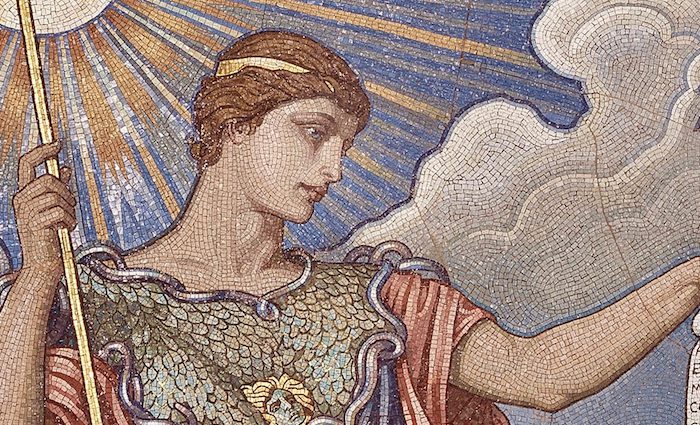
The featured image is a detail from a mosaic of Minerva in the Library of Congress and is in the public domain, courtesy of Wikimedia Commons.




Plato demeaning poetry? I thought the outlandish claim had seen its last day a few decades ago. Need one remind the author that Plato’s dialogue ARE poetry and that the Republic (politeia) “resurrects” poetry as divine?
I understand your reaction. In context, I’m simply referencing the first three or so Books of the Republic as Plato makes the case for intentional poetry. As he dishes out his bans on tragedy and the like, he clearly speaks of “this poetry” as inferior. The right kind of poetry will be a strong and guiding influence that shapes culture in a positive way, the ideal ethos of a society. By Book X when Plato considers mimesis, he is speaking of reality. To survey all of his thoughts on poetry or the range of distinctions was not my intent. I apologize if it appears out of context.