
The right to bear arms protects every other right. Without its preservation, a nation would easily succumb to tyranny. As long as this right is upheld, protected, and exercised lawfully, the torch of liberty may continue to burn.
“A well-regulated Militia, being necessary to the security of a Free State, the right of the people to keep and bear Arms, shall not be infringed.”
 The words that form the Second Amendment were chosen deliberately and purposefully. The founding fathers drew from Biblical principles, English and American history, and English common law to present an amendment protecting the individual right of Americans to keep and bear arms. At its center lie two core principles upon which both the Bill of Rights and the Declaration of Independence were founded: the law of self-government and the right of self-defense. The purpose of the Second Amendment was to promote peace, prosperity, and liberty, both by protecting one’s life and property from invaders and by lawfully resisting a tyrannical government.
The Meaning of the Second Amendment
The Second Amendment is an appendage to the Constitution, which in turn relies on the Declaration of Independence for meaning and purpose. Both documents are only lawful to the extent to which they conform to the “Laws of Nature and of Nature’s God,” as written in the Declaration. The Declaration articulates the law of self-government while the Constitution presents the application of self-government in various contexts, which includes the right to bear arms.
Let us examine the text of the Second Amendment.
A “well-regulated militia” is a collection of individuals covenanted together to defend each other. The phrase “well-regulated” required militia members to remain armed, trained, and vigilant. These “members,” understood at the time to mean all able-bodied male citizens, were to be prepared to engage with invaders—including a tyrannical government, should the need arise—in order to secure and defend the freedom of the states.
The responsibility and right of the people to bear arms for self-defense are God-given, natural rights of individuals. The right to self-defense was not man-invented or government-created. This amendment does not give the people their right to bear arms, but protects against the infringement of this right. From the context of the Bill of Rights and especially in the Fourth and First Amendment, “the people” refers to the citizenry, instead of certain bodies or groups of people.
The unqualified phrase “shall not be infringed” is seen only in the First and Second Amendment within the Bill of Rights. The First Amendment protects the rights to freedom of religion, speech, the press, assembly, and petition. The Second Amendment acts as the protector and enforcer of those rights, should they be infringed.
The phrase “to keep and bear” points toward an individual right of the people to possess and carry arms. Self-governing individuals bear the primary responsibility of defending and protecting themselves.
The word “arms” in the Second Amendment is crucial and must be understood correctly. In 1775, Samuel Johnson provided the following definition of the word “arms,” likely the definition intended by the founding fathers. Arms meant “weapons of offence and armor of defense.” Arms are weapons of war. This distinction is important; for if “arms” meant anything less than weapons of war, the governing powers would have the monopoly of force over the people bearing inferior arms, and the country would be at risk of tyranny.
As we shall see by an examination of the historical background of this amendment, there are strong reasons for why the framers recognized the individual right to possess and carry weapons of war, and the need for a well-regulated militia, as vital to the creation and preservation of a nation of freedom and liberty.
The History Behind the Second Amendment
The historical foundations of the Second Amendment go further back in the past than events immediately prior to the drafting of the Bill of Rights. The legal recognition and protection of the individual’s right to bear arms in self-defense dates back to the Assize of Arms of England in 1181. Something else, however, influenced the founding fathers’ thinking more than historical events, and the common law—and that was the laws of nature and of nature’s God.
Samuel Adams, one of the men who signed the Declaration of Independence, affirmed that “all men are equally bound by the laws of nature, or, to speak more properly, the laws of the Creator. They are imprinted by the finger of God on the heart of man…. [T]he voice of Nature… is confirmed by written Revelation.” The Bible is the foundation for the ideas and principles underlying the Declaration and the Constitution. The founding fathers did not use explicit Biblical examples to support their arguments because they considered it more appropriate to use non-sectarian terminology in the legal sphere. Thus, they illustrated their arguments from history and “secular” writers, presenting the laws of God in non-religious terms.
A quick summary of the Scriptural foundations for the right of self-defense is as follows. In 1 Samuel chapters 21 and 24, David arms himself against King Saul’s attacks, who sought to kill him. The lawful boundaries of self-defense are clear from this example; defense against an attack is justifiable, but there is nothing to resist if one is not in danger of harm. In both Numbers 32:20-22 and Nehemiah 4:13, the Israelites were required to bear arms. Conversely, Judges 5:8 and 1 Samuel 13:19-22 records two historical periods during which foreign nations kept the Israelites from bearing arms. For the Israelites, “weapons control” meant slavery, as other nations kept the Israelites in bondage as long as the Israelites were disarmed. The concept of a militia could also be found in Numbers 1 and 2 Chronicles 12:33; the nation of Israel had no standing army, and the defense of the nation rested on able-bodied males. In the New Testament, Jesus Christ never repealed the duty to bear arms. Instead, He upheld it; in Luke 22:36-38, He commands His disciples to acquire swords even if their cloaks had to be sold to purchase one.
While the founding fathers built the Constitution and the American Bill of Rights on the principles found in nature and the Bible, they were also influenced by historical events. The founders had a strong grasp of English common law and of the historical background of the right to possess and use weapons in self-defense.
The Assize of Arms 1181 is one of the earliest legal documents protecting and even mandating the ownership of weapons for every English freeman between 15 and 40 years of age. England was under a feudal system of government at the time, and the king depended on a well-armed peasantry to defend the country against invaders. The Assize of Arms 1258 extended the right of ownership of weapons to serfs. The statute of Winchester 1258 mandated that the citizenry own and train with weapons. In 1369, citizens were commanded to spend their leisure time training with bows and arrows and to relinquish the playing of games that would distract them from practice. Similarly, the archery laws of 1515 commanded fathers to teach sons, beginning at the age of seven, to handle longbows. Although the mandating of arms is by no means a just law, these legal documents demonstrate that the idea of placing weapons into the hands of the citizens was an old and time-tested concept.
These rights to arms were threatened and restricted by the Militia Act of 1662 and the Game Act of 1671. William Blackstone, the great commentator on the laws of England, asserted that such restrictions were but an attempt by the government to prevent the people from any kind of insurrection and resistance. The individual right to own weapons was articulated in the English Bill of Rights of 1689. It said, in part, that “the subjects which are Protestant may have arms for their defense suitable to their conditions and as allowed by law.” Here, both the right to own weapons and the right to use weapons in self-defense are acknowledged and protected by law.
When King George III assumed that the right to self-defense originated in the government, he instituted standing armies without the consent of the people. This was seen as a tyrannical act that overlooked and overstepped the ultimate authority of the people to self-defense. As tensions grew between the thirteen American colonies and the British government, British soldiers marched into Lexington and Concord on the night of April 18, 1775 to seize the firearms and ammunition of the colonists. The colonists took decisive action to protect their unalienable rights, resist governmental overreach, and restore law, liberty, and order. Many great and valiant men died for the right to keep and bear arms in the bloody battles fought at Lexington and Concord. They understood that weapons of war are vital to the preservation of liberty.
The Second Amendment was written with the understanding of Biblical principles, English common law, and scenes like those of Lexington and Concord, and with a keen sense of responsibility.
The Purpose of the Second Amendment
The Preamble to the U.S. Constitution concisely articulated the reasons for the Constitution and, by attribution, for the Second Amendment. The Constitution existed to “establish Justice, insure domestic Tranquility, provide for the common defense, promote the general Welfare, and secure the Blessings of Liberty to ourselves and our Posterity.”
It must be understood that the Second Amendment is not a source of the right to self-defense, nor does it merely provide protection for a collective right to keep and bear arms. The nature of this right is limited; one may use arms for righteous purposes, not for wrongful ones.
The Second Amendment’s first and most important goal is to protect the people from the tyrannical rule of an overly powerful government. The war over gun control is ultimately a struggle for power. Should the government have the monopoly of force over the people, or should the people hold that monopoly?
The founding fathers, from the lessons learned from battles fought by men such as Cromwell and Washington, understood that for a country to be free and prosperous, the people must hold the monopoly of force. The monopoly of force must never rest in the hands of a select few. As seen throughout history, the most atrocious crimes against humanity were committed by governments which held the monopoly of force over its insufficiently armed citizenry.
This is why the words “arms” in the Second Amendment meant—and should be understood to mean—weapons of war. The purpose of the Second Amendment would be rendered obsolete if the citizens may only own and carry inferior arms compared to those owned by the state.
The position of the Second Amendment in relation to the First is also crucial; the Second Amendment protects the First and must be acted upon when the First is infringed upon. History has demonstrated that when a government decides to oppress its people unlawfully, forceful resistance may be the only way for the people to preserve law, liberty, and order in their land.
The Second Amendment emphasizes the “militia” and the “state,” not the “army” and the “country.” The organization of militia powers in the hands of the people allows for all citizens on official militia duty to bear the swords of vengeance and of self-defense, thus facilitating an effectual defense against tyranny by the “elite.”
Citizens cannot and should not rely on the government to protect them from violence. The government cannot keep all its citizens safe. One’s safety has always ultimately been one’s own responsibility. Individuals have the natural right to defend themselves. Guns cannot be uninvented; even if guns were banned, those who wish to have guns and who will disregard the law will have guns, while law-abiding citizens would be prevented from arming themselves against such criminals. When governments pass gun control laws that limit citizens’ ability to adequately defend themselves, the people are forced to rely on the police for protection. This transfer of the responsibility and right to self-defense from the individual to the government has tragic effects, as seen in the case of Warren v. District of Columbia, D.C. (1981), when a woman was gang-raped for fourteen hours after she had twice called the police, who never arrived. This is not to point fingers at the police; rather, this example demonstrates the importance of personal self-defense and the danger of relying on others for protection.
Even those who do not own and carry guns would benefit from those who do because it is better for criminals to imagine they face an armed citizenry than an unarmed one. An armed society is a polite society; the lack of arms in the hands of law-abiding citizens makes aggression more likely to occur, whether in the form of violence from terrorists and criminals, or from tyrannical overreaches of a government. The genocides that have taken place in the 20th century demonstrate that a government whose aim is to bring harm and even death to its people first disarms them and renders them unable to resist.
The right to bear arms protects every other right. Unarmed people are easier to control, manipulate, and oppress. The founders understood the importance of the right to keep and bear arms as demonstrated by Biblical principles, historical examples, and the English common law. Without the preservation of this right, a nation would easily succumb to tyranny. As long as this right is upheld, protected, and exercised lawfully, the torch of liberty may continue to burn.
The Imaginative Conservative applies the principle of appreciation to the discussion of culture and politics—we approach dialogue with magnanimity rather than with mere civility. Will you help us remain a refreshing oasis in the increasingly contentious arena of modern discourse? Please consider donating now.
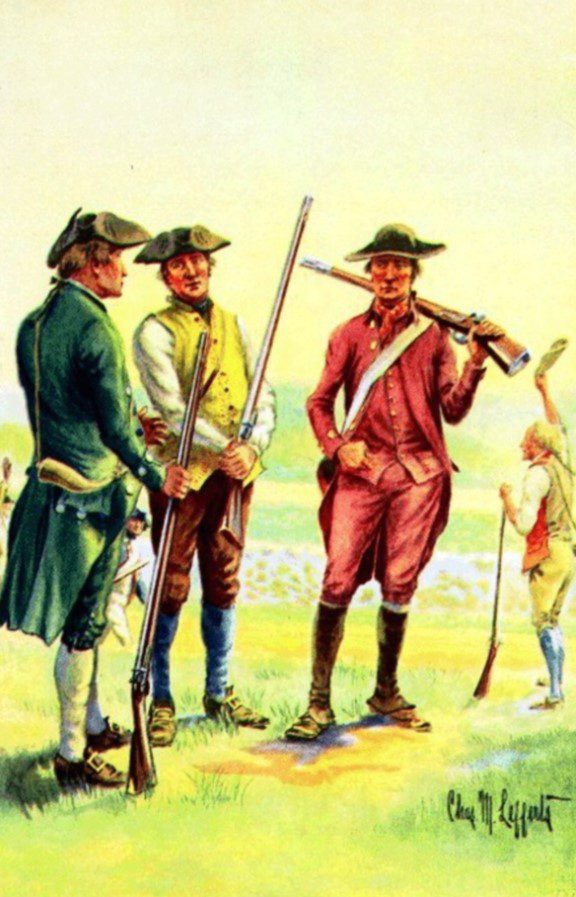
The featured image is “Massachusetts Militiamen (American Revolution)” by Charles M. Lefferts (1873-1923) and is in the public domain, courtesy of Wikimedia Commons.



In order for the right to bear arms to have any meaning if in fact the main purpose is to defend against a tyrannical government, what we would have to do today is disarm the government. Today, no individual could possibly be expected to have enough arms to fight a tyrannical government, and even a whole lot of well-organized, well-armed militias would be no match for the United States government. How many militias could afford their own tanks or aircraft? While we should respect the text as it stands (and not allow it to be reinterpreted to suit the times) until it is repealed properly by the means provided in the Constitution, one cannot help but wonder if the Second Amendment was crafted in a time that is so far removed from today as to be useless.
The notion that the Second Amendment was intended to address a threat that a national standing army may take up arms against any of the separate states is a relic of the 18tg century.
Well, I think it happened in the 19th century once: See, the Civil War or the War Between the States.
Military members failing to obey lawful orders issued by their superiors risk serious consequences. Article 90 of the Uniform Code of Military Justice (UCMJ) outlines the crime of willful disobedience by a military member a superior commissioned officer. Article 91 covers willful disobedience of a superior Noncommissioned or Warrant Officer. Article 92 conveys what constitutes the crime of disobedience of any lawful order (the disobedience does not have to be “willful” under this article).
These articles require the obedience of LAWFUL orders. Not only should an unlawful order not be obeyed, obeying such an order can result in criminal prosecution. Military courts have long held that military members are accountable for their actions even while following orders.
And thus the premise that many in the military would refuse to fire upon/ attack US citizens, exercising/defending their constitutional right to keep and bear arms…..and this moves up the chain of command as many officers would refuse to have the men in there charge carryout unlawful orders against US citizens …….thus negating the advantage in weaponry that the US military has.
On a separate note, how did the US technological advantage in military might fare against the viet cong in Vietnam, or the Russians technological advantage in their war in Afghanistan…….
Well written, and thank you for the history lesson!
I have often wondered if the founders were influenced by the Highland clearances. Just over two decades before the War of Independence, the Scottish clans were disarmed by force by the English, and lost their independence and way of life.
“This is why the words “arms” in the Second Amendment meant—and should be understood to mean—weapons of war. The purpose of the Second Amendment would be rendered obsolete if the citizens may only own and carry inferior arms compared to those owned by the state.”
If the author’s statement (above) is true why can’t the citizenry own machine guns, RPGs, Stinger missiles, etc.?
A good, well argued article, thank you. However a small point –
“The Assize of Arms 1181 is one of the earliest legal documents protecting and even mandating the ownership of weapons for every English freeman between 15 and 40 years of age.”
“These rights to arms were threatened and restricted by the Militia Act of 1662…”
This must be wrong – there were no ‘rights’ to arms only permission from controlling powers to have arms. Surely in the unwritten constitution of England there was never a ‘cannot be infringed’ as in the US one.
Also now there is no possibility of the populace to have arms equivalent to those of the US state which is now perceived as a threat to the populace by many.
Justice Amy Coney Barrett Second Amendment dilemma
In some 229 years neither law professors, academic scholars, teachers, students or congressional legislators after much debate have not been able to satisfactorily explain or demonstrate the Framers intended purpose of Second Amendment of the Constitution. I had taken up that challenge allowing Supreme Court Justice Amy Coney Barrett’s dilemma to understand the true intent of the Second Amendment.
I will relate further by demonstration, the intent of the Framers, my understanding using the associated wording to explain. The Second Amendment states, “A well regulated militia, being necessary to the security of a free state, the right of the people to keep and bear arms, shall not be infringed.”
Militia, a body of citizens organized for military service.
If, as some may argue, the Second Amendment’s “militia” meaning is that every person has a right to keep and bear arms, the only way to describe ones right as a private individual is not as a “militia” but as a “person.” (The individual personality of a human being: self)
The Article of Confederation lists eleven (11) references to“person/s.” The Constitution lists “person” or “persons” 49 times to explicitly describe, clarify and mandate a constitutional legal standing as to a “person” his or her constitutional duty and rights, what he or she can do or not do.
It’s not enough to just say “person/s” is mentioned in the United States Constitution 49 times, but to see it for yourself (forgo listing), and the realization was for the concern envisioned bt the Framers that every person be secure in these rights explicitly spelled out, referenced and understood how these right were to be applied to that “person.”
Whereas, in the Second Amendment any reference to “person” is not to be found. Was there a reason? Which leaves the obvious question, why did the Framers use the noun “person/s” as liberally as they did throughout the Constitution 49 times and not apply this understanding to explicitly convey the same legal standard in defining an individual “persons” right to bear arms as a person?
Justice Amy Coney Barrett dissent in Barr v Kanter (2019) Second Amendment argument acquiesced to 42 references to “person/s, of which 13 characterize either a gun or firearm. Her Second Amendment, “textualism” approach having zero reference to “person/s. Justice Barrett’s view only recognizes “person/s” in Barr, as well in her many other 7th circuit rulings. It is her refusal to acknowledge, recognize or connect the U.S. Constitution benchmark legislative interpretive precept language of “person/s,” mandated in our Constitution 49 times, to the Second Amendment.
Leaving Supreme Court Justice Barrett’s judgment in question.
In the entire U.S. Constitution “militia” is mentioned 5 times. In these references there is no mention of “person” or “persons.” One reference to “people” in the Second Amendment. People, meaning not a person but persons in describing militia.
Now comes the word “shall” mentioned in the Constitution 100 times. SHALL; ought to, must ..
And interestingly, the word “shall” appears in the Second Amendment. “A well regulated militia, being necessary to the security of a free state, the right of the people to keep and bear arms, and shall not be infringed.”
“[S]hall not be infringed.” Adding another word “infringed” to clarify any misunderstanding as to the intent of the Second Amendment. Infringe. To encroach upon in a way that violates law or the rights of another;
The condition “Infringe” has put a stop as to any counter thoughts regarding the Second Amendment, as you shall not infringe or encroach on beliefs other to what is evident as to the subject “Militia.”
Finally, clarifying “..the right of the people to keep and bear arms…
People. Human beings making up a group or assembly or linked by common interest.
In closing, I am not against guns, everybody has them. I’m against using the Second Amendment illogically as a crutch. If it makes those feel better so be it. Just what it deserves, use it with a wink.
William Heino Sr.
All that and no mention that “people” is plural of “person”
And interestingly, the word “shall” appears in the Second Amendment. “A well regulated militia, being necessary to the security of a free state, the right of the people (all persons) to keep and bear arms, and shall not be infringed.”
Outstanding explanation. Too bad they don’t teach this in schools anymore.
I think it’s also fair to note that the text of the 2nd Amendment is separated into two parts by a comma, and that was intentional.
“A well-regulated Militia, being necessary to the security of a Free State, the right of the people to keep and bear Arms, shall not be infringed.”
Many people claim that the 2nd Amendment was written for the military alone, and that “well regulated” means to control tightly. But that makes no sense based on the wording and punctuation. In the first part of the sentence, the militia is to be “well regulated”, and in the second part, according to those who believe it was written only for the militia, it’s supposed to not be infringed. How does one well regulate something and not infringe it at the same time? So we can only surmise that the militia was to be well regulated and the second part of the sentence was not written for the militia. It’s simple logic. And if that’s so, the people do indeed have the Constitutional right to bear arms and that right shall not be infringed.
It’s important to note that well regulated did not mean to restrict. It meant to keep flowing smoothly, and that the members of the militia were to remain armed at all times, ready to fight and vigilant about the enemy.
To infringe means
Exactly that you do not infringe on the amendment an idea as to what you think it means. I only can relate what was missing in the making of the 2nd.
Good article! Explained several concepts I was not previously sold on. I think it would be a good idea for states to establish an organized volunteer militia that would act as a reserve arm of the state national guard. It would require screening and testing prior to membership and the state(s) would cover the costs for bi-annual marksmanship practice. Raising a reserve force of say 2-3 million militiamen/women, would certainly give an adversary something to think about.
In this context of protection from the ability of government to have armed force advantage over its citizens, does then the second amendment include the citizens right of equity in armed force such as tanks, shoulder mounted weapons of war, fighter jets, etc.? A perponderance of armed citizenry would hold government miitias in check and discourage tyranny. Is this a right?
And if the right extends to self protection from another citizen or group therof, then equity of arms depends on the level of weaponry exisitng as a whole.
This is a runaway scenario of sorts. Equalizing force as a continuous balancing act seems to be the dynamic.