
Few would dispute the claim that C.S. Lewis was the last century’s greatest Christian apologist, rivaled only by G.K. Chesterton and Pope John Paul II. While all three wrote voluminously, Lewis’s books had the broadest appeal. Even atheists read Lewis’s Christian books, if only for the art of them. Surely, we can do better than the atheists.
Yet, Lewis’s corpus is so extensive that even his most ardent admirers are unsure where to start—or where to go or where to end—with his written works. While all his books are, of course, worth reading, here are the ten that every imaginative conservative should read.
 Many regard Lewis’s 1943 book, The Abolition of Man, to be his greatest work. In it, Lewis takes on the very real possibility that any one single generation might attempt to remove itself from the necessary continuity of generations, proclaim itself superior to all that came before, and—even without necessarily meaning to—establish itself as the authority of all that will come after it. It can accomplish this, Lewis worries, mostly through birth control and eugenics. Given the recent advances (make that leaps and leaps) in genetic engineering, Lewis was deeply prophetic in this. Here’s a small sampling from this profound book:
I draw the following conclusions. This thing which I have called for convenience the Tao, and which others may call Natural Law or Traditional Morality or the First Principles of Practical Reason or the First Platitudes, is not one among a series of possible systems of value. It is the sole source of all value judgements. If it is rejected, all value is rejected. If any value is retained, it is retained. The effort to refute it and raise a new system of value in its place is self-contradictory. There has never been, and never will be, a radically new judgement of value in the history of the world. What purport to be new systems or (as they now call them) ‘ideologies’, all consist of fragments from the Tao itself, arbitrarily wrenched from their context in the whole and then swollen to madness in their isolation, yet still owing to the Tao and to it alone such validity as they possess. If my duty to my parents is a superstition, then so is my duty to posterity. If justice is a superstition, then so is my duty to my country or my race. If the pursuit of scientific knowledge is a real value, then so is conjugal fidelity. The rebellion of new ideologies against the Tao is a rebellion of the branches against the tree: if the rebels could succeed they would find that they had destroyed themselves. The human mind has no more power of inventing a new value than of imagining a new primary colour, or, indeed, of creating a new sun and a new sky for it to move in.
 If The Abolition of Man was Lewis’s greatest work (and I’m reticent to proclaim it as such, but it is good—really good) of nonfiction, his greatest work of fiction was its expression in novel form, 1945’s That Hideous Strength. The third of the Ransom/Space trilogy, That Hideous Strength imagines a British college coopted by vast forces of evil (wittingly and unwittingly working for the devil), calling themselves the N.I.C.E., the National Institute for Co-ordinated Experiments. The King Arthur of our era leads a desperately small group of believers to resurrect Merlin, not knowing if he remained Pagan, and, if so, the good or bad kind of Pagan, to challenge the N.I.C.E. Complete with loveable bears and very adult problems, That Hideous Strength exists in a universe far removed from Narnia. Here’s one of my favorite passages:
The poison was brewed in these West lands but it has spat itself everywhere by now. However far you went you would find the machines, the crowded cities, the empty thrones, the false writings, the barren beds: men maddened with false promises and soured with true miseries, worshipping the iron works of their own hands, cut off from Earth their mother and from the Father in Heaven. You might go East so far that East became West and you returned to Britain across the great Ocean, but even so you would not have come out anywhere into the light. The shadow of one dark wing is over all Tellus.
 Another contender—a strong one—for Lewis’s best book is his 1952 Mere Christianity. Much like The Abolition of Man, Mere Christianity challenges the reigning thought of the world by juxtaposing it with the permanence of the Natural Law. While the book has its evangelical moments—and they are quite good—it really is a composition of eternal wisdom and can be read as a philosophical treatise as much as it can be as a theological one. The book is so good, it actually makes the reader feel far more intelligent than he actually is. It also prompts the reader to find his best self and to do good in the world.
 Lewis’s autobiography, Surprised by Joy, rivals the three above mentioned as Lewis’s best book (are you noticing a theme here?). Unlike his other works, Surprised by Joy never gets bogged down in intense philosophical meanderings. Raw at times, Surprised by Joy reveals a real, intense, and vulnerable Lewis. His childhood—especially at boarding school—could be so brutal, don’t be too surprised if you lose sleep at night thinking about it. Yet, Lewis came through it all, and in rather good spiritual and psychological health. The book, as a whole, is a book of victories, large and small, but always meaningful. Here is his response to hearing the name of the Norse god, Balder:
I knew nothing about Balder; but instantly I was uplifted into huge regions of northern sky, I desired with almost sickening intensity something never to be described (except that it is cold, spacious, severe, pale, and remote) and then, as in the other examples, found myself at the very same moment already falling out of that desire and wishing I were back in it.
For my fifth C.S. Lewis selection, I’m cheating more than just a little bit. I’m choosing a book that was actually written about C.S. Lewis—but done so as a series of interviews with those who knew him well: In Search of C.S. Lewis (Bridge 1983), edited by Stephen Scofield. The insights into the great British author are nothing if not stunning, from time to time. Many—from students to colleagues to friends—offer their recollections. The weight of evidence becomes clear after only the first third or so: Lewis was never uninteresting!
 In 1969, Cambridge University Press published what was arguably the best compilation of Lewis’s academic essays, simply called Selected Literary Essays. In the book, published posthumously, Lewis looks at everything and everyone from William Morris to T.S. Eliot, from the King James Bible to the meaning of time. One of Lewis’s all-time best essays (and considering the man was a master of the essay, this is saying a great deal), “De Descriptione Temporum,” is the opening essay to the book. It was his 1954 inaugural address to Cambridge University after he accepted the endowed chair there. In it, he describes the trials and the end of the Old Western Men, men who desire to love the world through beauty and the humanities, rather than through utility and the sciences. Here’s a beloved excerpt:
It is hard to have patience with those Jeremiahs, in Press or pulpit, who warn us that we are ‘relapsing into Paganism.’ It might be rather fun if we were. It would be pleasant to see some future Prime Minister trying to kill a large and lively milk-white bull in Westminster Hall. But we shan’t. What lurks behind such idle prophecies, if they are anything but careless language, is the false idea that the historical process allows mere reversal; that Europe can come out of Christianity ‘by the same door as in she went’ and find herself back where she was. It is not what happens. A post-Christian man is not a Pagan; you might as well think that a married woman recovers her virginity by divorce. The post-Christian is cut off from the Christian past and therefore doubly from the Pagan past.
 The seventh book is Lewis’s little (but mighty and profound) book, An Experiment in Criticism, published first in 1961, just two years before his death. In it, Lewis offers his most incisive as well as expansive definition of mythology. Further, he notes, in a theme he pursued much of his life, the best critics are those who love the genre they’re criticizing. Those who lack any sympathy whatsoever, with the subject analyzed, have no business reviewing that particular book, piece of music, or work of art. His two chapters on myth and fantasy are, alone, worth the price of the entire book.
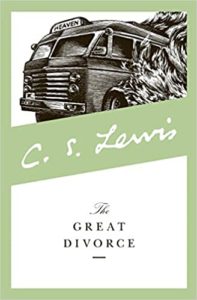 One of Lewis’s best theological fantasies (is it fiction, an allegory, or a work of theology?) is The Great Divorce. Having almost nothing to do with marriage and its dissolution, the book—in Dantesque fashion—follows one man (Lewis himself) from hell into purgatory and toward (does he ever reach it?) heaven, guided by the spirit of George MacDonald. Though it moves at a blistering pace (hence, one must ask if it’s more fiction or more theological treatise), Lewis as author and as character asks the most vital questions one can ask: what is man, what is God, what is free will, what is relationship (to man and to God)? It is a beautiful story that captivates from the first to the last moment.
 Lewis was an inveterate and expert man of letters and writer of letters. Each of his letters is something to be cherished. Of the many compilations of letters that are out there, the best is 1967’s Letters to an American Lady (Eerdmans). As the title suggests, Lewis is corresponding with an American, one who just converted to Catholicism, thus providing some excellent fodder for conversation. What is most striking about the book, though, is that Lewis sprinkles his letters—as though effortlessly—with startling wit. I opened the book at random (right now) and came across this gem: “How little people know who think that holiness is dull. When one meets the real thing… it is irresistible.” Or this one: “I believe we are very near to one another, but not because I am at all on the Rome-ward frontier of my own communion. I believe that, in the present divided state of Christendom, those who are at the heart of each division are all closer to one another than those who are at the fringes. I would even carry this beyond the borders of Christianity: how much more one has in common with a real Jew or Muslim than with a wretched liberalizing, occidentalised specimen of the same categories.” Or this one:
That is very good news about your daughter and family. Also these last minute mercies which keep on turning up in your financial crisis. I suppose living from day to day (‘take no thought for the morrow’) is precisely what we have to learn—though the Old Adam in me sometimes murmurs that if God wanted me to live like the lilies of the field, I wonder He didn’t give me the same lack of nerves and imagination as they enjoy! Or is that just the point, the precise purpose of this Divine paradox and audacity called Man—to do with a mind what other organisms do without it? As for wrinkles—pshaw! Why shouldn’t we have wrinkles? Honorable insignia of long service in this warfare.
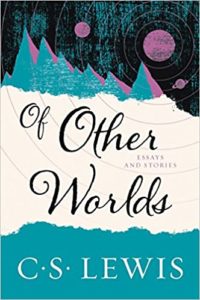 My final book is another book of essays, Lewis’s 1966 (again posthumous by three years) Of Other Worlds: Essays and Stories (Harcourt Brace). The first two thirds of the book are essays on the meaning of stories, on fairy tales, on writing for children, and, most importantly, on science fiction. The latter is especially important as Lewis, along with Ray Bradbury, was the single most important author in the twentieth century to make the genre respectable. The final third of the book is made up of several short stories—all excellent—that Lewis wrote.
Lewis, of course, can’t be defined by a mere 10 books. But his output was so good and so inspiring, that it demands a way in which we might harvest his vast output. This list, I hope, offers you an introduction to Lewis’s ten best. If you’re willing to go beyond this list, then, by all means, go beyond this list! Again, let us remember, Lewis was an imaginative conservative, one of the best writers of the last century, and we should cherish every word he wrote.
The Imaginative Conservative applies the principle of appreciation to the discussion of culture and politics—we approach dialogue with magnanimity rather than with mere civility. Will you help us remain a refreshing oasis in the increasingly contentious arena of modern discourse? Please consider donating now.
The featured image is courtesy of Pixabay.



Good list, I suppose. Disagree with The Great Divorce, which was an interesting idea, but not as impressive as his other works. And even though it’s the most popular, I think Mere Christianity, while good, doesn’t age as well as Lewis’s other books. I would substitute those two with The Four Loves (the best relationship book around) and Screwtape Letters (a book that gets better with age).
Shocked not to see the Screwtape Letters make this list.
Love C.S. Lewis, Bradley. Sad that he was so “Catholic” but wouldn’t convert to it!
Miles, sorry, he wasn’t “so Catholic.” He was a low church Anglican. Anyone who writes of the church as men coming together to pray has an ecclesiology which is far closer to Wesleyanism than to Catholicism.
I appreciate the article, but for me the most insightful and helpful book was Screwtape Letters.
Perelandra and The Discarded Image may not be quite on a level with the works mentioned here but are well worth reading. As for making science fiction respectable, Bradbury is one of the greats, but I don’t believe Lewis would be considered as important as, say, Heinlein or Asimov or even Philip K. Dick.
Yes, you missed one of my favorite CSL books: Letters to Malcolm, Chiefly on Prayer and the best short bio on CSL: C.S. Lewis – A Very Short Introduction by Prof. James Como from Oxford University Press
Bravo for this dissertation. He is so important
Today and everlasting
Thank you so much for this list and summary
content
It’s Classic
Thank you. VERY HELPFUL. For those of us well past college, and haven’t read all we should of Lewis, this is a great starting point.
My son believes that The Voyage of the Dawn Treader must be on this list. I would add The Lion, The Witch, and The Wardrobe. One of our Pastor’s beloved and well-respected professors was a C.S. Lewis scholar and which of his Lewis books do you think were the most worn? The Narnia series. They are important to the Christian imagination. I personally would add Till We Have Faces as well. If I am adding these 3, or counting the 2 in the Narnia series as one, which 2 to take away? It would be difficult to say since I have not read all that you mentioned, especially the essays collections. Maybe choose your favorite essay collection and drop 2, then add in my suggestions!!