
I cannot fully accept the world of John Wick. But like the pagan world and the Old Testament’s eye-for-an-eye, I cannot fully reject it either. The world of Wick is a world of senseless violence and also violence that is roughly sensible because it is informed by justice.
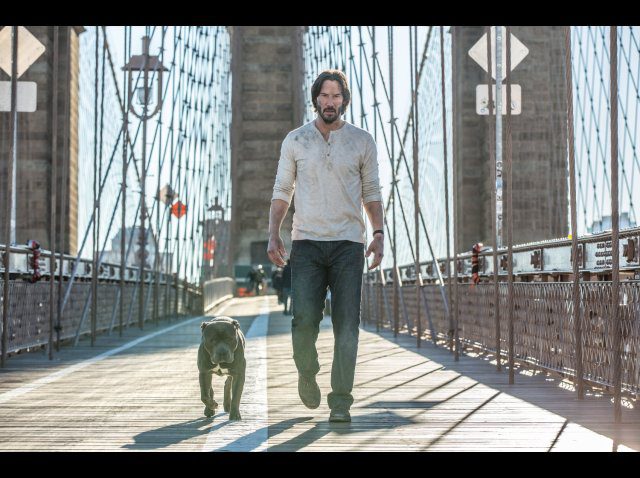
One of the most enjoyable action movie series I have seen recently is the set of three John Wick films (a fourth is due out in 2022). Yet it gives me twinges of conscience.
John Wick is played by Keanu Reeves. At the beginning of the first of the movies (2014), we know little about him except that he is mourning his wife, Helen. Knowing she was about to die, Helen had arranged for a beagle puppy named Daisy to be delivered to him after her death. Wick starts to love the puppy and takes her around with him in his 1969 Mustang. When Wick refuses a young Russian thug’s offer at a gas station to buy the vehicle, we sense the beginning of disaster but also what Wick is: the young thug’s muttering in Russian is answered by Wick in the same language. Later that night, Wick is assaulted at his home by thugs who steal his car, kill his dog, and leave him bloodied.
The thug brings the Mustang to a chop shop where Aurelio (John Leguizamo) recognizes the car and slaps the thug, named Iosef, who turns out to be the son of the head of the Russian mob, Viggo Tarasov. We begin to understand who John Wick is when Tarasov calls Aurelio.
Viggo Tarasov: I heard you struck my son.
Aurelio: Yes, sir, I did.
Viggo Tarasov: And may I ask why?
Aurelio: Yeah, well, because he stole John Wick’s car, sir, and, uh, killed his dog.
Viggo Tarasov: [pause] Oh.
That “Oh” is one of the best introductions one could have, and sets up perfectly Tarasov’s own striking of his son before he tells him that he has crossed the man they call “Baba Yaga” or “The Boogeyman.” Tarasov explains that Wick is called the Boogeyman because he is the one you call when you have to kill the Boogeyman and that Wick has been retired from the assassin’s profession for five years—a retirement granted to him by Tarasov after he completed an impossible task that involved countless murders in short order and helped put the Russian syndicate on top. When Tarasov calls Wick to dissuade him from revenge, the enraged former employee refuses to talk to him.
The rest of the first film involves Wick’s search for revenge and evasion of the bounty put on his own head by Tarasov. He ends up bloody but unbowed, with a new dog he releases from a shelter while trying to get medicine for his wounds. In John Wick: Chapter 2 (2017), set immediately after the first, Wick again is attempting to leave the world of violence but is drawn in by another mobster whom he owes for favors granted during his first attempt at leaving the killing business behind. The end of the second film has Wick on the run after he has violated one of the rules of the assassin business: no doing “business” on properties designated as “sanctuaries,” in this case the elegant Continental Hotel in New York, one of a group of such establishments for assassins.
The third film, John Wick: Chapter 3—Parabellum(2019), is about Wick evading the bounty put on his head for his violation in the second film. Mostly evasion means here “killing those who are trying to kill him.” It also means, however, attempting to get the “High Table,” the ruling body of international underworld figures, to forgive him. The price of this forgiveness is killing one of his best friends, a task he accepts but then declines when he and his friend decide to take on the High Table and prepare for war.
I’ve tried to be as vague as possible about the plots here for those who have not seen the movies. They have fantastic action sequences and manage to hint at a romantic but disturbing underground world of murder and mayhem kept in check by a series of rules. They are visually spectacular, taut in terms of their plots, and invest the viewer’s emotions in the main character even though Mr. Wick never speaks more than a few dozen words per movie. They are perfect movie movies, but they are very very violent. They give me what I think of as “Alypian twinges.”
In his Confessions, Saint Augustine recounts of his friend Alypius, a slightly older lawyer and rhetor in Rome, that he had been, in Henry Chadwick’s translation, “seized by an incredible obsession for gladiatorial spectacles and to an unbelievable degree.” Alypius had been determined never to enter the amphitheater, but he was seized by some friends one evening and forcibly dragged to the spectacle. There he “kept his eyes shut and forbade his mind to think about such fearful evils,” but could not shut his ears. When the crowd roared, he could not control his curiosity and looked. “As soon as he saw the blood, he at once drank in savagery and did not turn away. His eyes were riveted. He imbibed madness. Without any awareness of what was happening to him, he found delight in the murderous contest and was inebriated by bloodthirsty pleasure.”
Is my delight in the John Wick franchise and other similar movies a problem?
Perhaps to start with, the reason I only get Alypian twinges (rather than full-blown bouts of guilt) from enjoying such movies is that the violence is literally unreal. The late, great Catholic legal scholar Charles Rice once told me that as far as movies go, violence was ok while sex was out. The main reason was that one cannot film fake sex scenes without putting real people in unchaste situations. Not so with fake violence in which nobody is actually hurt. But second, fake sex creates a desire for real carnal interaction in a way that fake violence does not necessarily do for violent activity. I would not say that such fake violence never creates such a desire, but the connection is a rather inconsistent one. For myself, it is not always clear even that it is the violence itself that is attractive. When John Wick, who is famed for killing three people with a pencil alone, repeats his feat in the third film, I mostly looked away.
Yet even if the audience knows the violence is fake, the story turns on violence all the same—and it is violence that is done as revenge. I don’t rejoice in random violence, but I do take a bit of pleasure in the end of Tarasov and even more of his vicious son. Should I take delight in the vengeance of a John Wick when the Lord saith, “Vengeance is mine”? I confess this is a more difficult question. I did not always want to see Wick’s blow find its mark, but I had a certain amount of internal gladness that it did.
What makes Wick click with the viewer is the fact that he is a man who attempts to get out of the endless cycle of violence but cannot. He may commit acts of vengeance that he should not, but we sympathize with his returning to vengeance himself when he cannot get peace or escape. We also rejoice that his acts of vengeance are themselves quite often rough approximations of retributive justice.
This is where I think the main issue is. Today many philosophers and theologians reject the idea of “retributive justice”—the idea that violations of justice deserve punishment—as a category. They will say that “restoring order” or perhaps “healing” is the main category of justice. I confess I don’t find that wholly plausible. In his Grammar of Assent, Saint John Henry Newman writes of what we can know from our conscience.
Now Conscience suggests to us many things about that Master, whom by means of it we perceive, but its most prominent teaching, and its cardinal and distinguishing truth, is that he is our Judge. In consequence, the special Attribute under which it brings Him before us, to which it subordinates all other Attributes, is that of justice—retributive justice. We learn from its informations to conceive of the Almighty, primarily, not as a God of Wisdom, of Knowledge, of Power, of Benevolence, but as a God of Judgment and Justice; as One, who, not simply for the good of the offender, but as an end good in itself, and as a principle of government, ordains that the offender should suffer for his offence.
This natural truth is not changed by the message of Jesus. I have no objection to those who interpret the concept of sanctification in this life or in the next (in Purgatory) as healing or the restoration of order. But to ignore the fact that this healing or reordering is also painful and thus itself a punishment strikes me as cutting off an important aspect of reality that is no less true under the Gospel than it is under paganism or the Mosaic Law.
Retributive justice may be one aspect of justice but it is a necessary aspect without which we cannot truly understand the fullness of redemption. Despite the religious language of the John Wick series, there is no fullness of redemption possible in this Christ-haunted world. I cannot fully accept the world of John Wick. But like the pagan world and the Old Testament’s eye-for-an-eye, I cannot fully reject it either. The world of Wick is a world of senseless violence and also violence that is roughly sensible because it is informed by justice. John Wick the character is painfully straining toward that world of justice and the peace that is constituted by order. His story and the world it inhabits is painful because it is hard to see how full justice can be done and peace can be achieved. There is no Armageddon and thus no New Jerusalem visible. Yet John Wick’s world seems more real to me than do the visions of the theologians and philosophers in which human repayment of evil with punishment is not a form of justice and that God is not one who, “as a principle of justice, ordains that the offender should suffer as a result of his offence.”
My Alypian twinges of conscience remain at the level of twinges because what I am attracted to in John Wick is not the shedding of blood but the hint of justice, no matter how imperfectly depicted, to which conscience also bears witness.
The Imaginative Conservative applies the principle of appreciation to the discussion of culture and politics—we approach dialogue with magnanimity rather than with mere civility. Will you help us remain a refreshing oasis in the increasingly contentious arena of modern discourse? Please consider donating now.
The featured image is courtesy of IMDb.





An interesting and, no doubt, intellectual, if not somewhat heartfelt, “review” of a series of movies that I too found goulash and at the same time, fascinating. I do, however, wonder if other viewers found it to be so as an example of “retributive justice”! I fear a small minority!
Gratuitous Violence has no justification.
I saw part of one John Wick film and found it interesting because it was very violent to a degree I had not seen before in films. It is entertainment if that is what one likes, but not all entertainment is equal, some should be avoided, others ignored, and still others enjoyed and found spiritually and morally uplifting. There is no longer much morally uplifting entertainment and I find this unfortunate and quite sad knowing what people are missing and what they are viewing.
As someone who has been avoiding most, Hollywood cinema output, this does make me want to check out this series.
I was put off not by the killing of the puppy but by the manipulative sentimentality. Did the screenwriter not have any other ideas of ways to elicit my sympathy for the hero than having his doggie whacked?
I can have sympathy for anyone. But a professional murderer is about as unsympathetic a character as any can be.
Indeed, most of us want to see that “hint of justice.”
Justice is never mentioned in the Bible by Christ. Mercy is. Justice here is not justice in the USSR.
Mr. Melychenko: 1) Christ most certainly mentioned justice–look again at the Gospels. 2) I’m not sure what you mean by justice here not being the same as the USSR. I never even hinted at such.
This is an excellent overview of the internal struggle towards Justice, which is primary, vs. satisfaction which can only be a byproduct in the healthy individual.
Really, an excellent breakdown.