
Well before his death, Harry Jaffa saw the American regime gradually descending into a deadly brew of positivism, atheism, and nihilism. Given this “collapse of the soul” of American politics, Jaffa’s America was becoming increasingly alienated from both the Declaration of Independence and the Constitution.
The Soul of Politics: Harry Jaffa and the Fight for America, by Glenn Ellmers (394 pages, New York: Encounter Books, 2021)
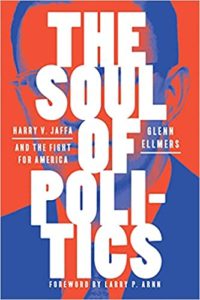 As the subtitle hints, this book is not simply a biography of Harry Jaffa, but a call to fight for the America for which Professor Jaffa fought. Along the way, readers will surely learn a few details here and there about a long life well lived, but those same readers will never be far removed from the fight that animated Jaffa’s life.
Born in New York City in 1918, Jaffa died a Californian in 2015. A teacher rather than a politician, Jaffa very much believed in politics, properly understood. He also believed in America, properly understood.
Given the geographic trajectory of his life from east to west, Harry Jaffa might have been excused had he placed Horace Greeley atop his list of the greatest Americans of the 19th century. After all, he did take Greeley’s advice and headed west, all the way west to southern California with a brief stop at Ohio State University before spending many decades at Claremont McKenna College followed by many years as a distinguished fellow of the Claremont Institute.
But a fellow by the name of Abraham Lincoln more than nudged Horace Greeley off the top of any Jaffa-inspired pedestal honoring the greatest American of the 19th century. For that matter, if pressed, Jaffa might well have ranked Lincoln as the most significant and important American period.
Jaffa’s defense, nay his celebration, of Lincoln assured him of intellectual battles with paleo-conservatives, including Willmoore Kendall and M. E. Bradford. But that defense, Ellmers tells us, did not destroy friendships with paleo-conservatives, including Kendall and Bradford. Jaffa could be cantankerous and combative (as could Kendall), but his fights were over principles and were never personal.
Where did it all begin? Whether by accident or by providence, biographer and fellow fighter Ellmers tells us, a twentysomething secular Jew by the name of Harry Victor Jaffa came upon an edition of the Lincoln-Douglas debates in a used bookstore. He bought the book, read it, “fell in love” with Lincoln, and the rest is history.
One of the gradual results of that affair was Professor Jaffa’s first book, Crisis of the House Divided. Published in 1959, it proved to be the initial installment on a career devoted to the “scholarship of the politics of freedom.” At this point in that career Jaffa regarded Lincoln as a “refounder” of the American experiment in ordered liberty. As that career proceeded, Jaffa came to decide that Lincoln was actually a “restorer” of the original American founding, which he came to decide he had originally short-changed.
In any case, both Lincolns were crucial to the American story. Maybe too crucial, according to Willmoore Kendall. Did the success of the American experiment require nothing less than a series of Lincolns, he wondered? And if so, is that asking much too much, he also wondered?
No doubt both Lincolns were also crucial to the career of Harry Jaffa. But should a biography of Jaffa be crucial to American readers? To be sure, Jaffa is a figure of great consequence to those who study the internecine intellectual battles among conservatives. He was, after all, very much in the thick of such things—and often cantankerously so.
As William F. Buckley once said, whether out of frustration or admiration or both, “if you think arguing with Harry Jaffa is difficult, try agreeing with him.” Not exactly a fan of open-mindedness, Jaffa operated as G. K. Chesterton operated. The Englishman preferred to open his mind as he opened his mouth. How so? Well, so that he could shut it again quickly—and on something solid.
Jaffa, Ellmers tells, also tried to make certain that whatever temptation to broadmindedness he experienced did not take him into Robert Frost defined territory. The poet had no time for those who were so broad-minded that they refused to take their own side in an argument. That weakness never afflicted Professor Jaffa.
The firmness of Jaffa’s views and prose may or may not be enough to warrant a biography. Ellmers, however, does make a powerful case that the life and thought of Harry Jaffa ought to be terribly important to all Americans at this crucial point in American history. We are not a “house divided” today in the way that we were in the age of Lincoln, but we are a very divided nation today. In truth, we are divided more deeply and in many more ways today than we were in the 1850s.
More than that, Ellmers contends that the general “crisis of the west” is so advanced today that “reasonable people” are losing hope. Harry Jaffa, Ellmers reminds us, never lost hope. And neither has Glenn Ellmers. After all, to lose hope is to despair, and to despair is both a “moral failing and an intellectual error.”
Both the American divide and the general crisis of the west have been a long time building. Rooted in the rise of progressivism, the current American divide is not without a hint of historical irony. Acting in part out of a desire to prevent a second civil war, turn-of-the-century American progressives sought to build national institutions, including a national bureaucracy. Over time that budding national bureaucracy has become the increasingly powerful administrative state that defies the limited government intentions of the founders and threatens to divide us in ways that would have been unimaginable in the mid-19th century.
The original early 20th century progressives presumed that rule by disinterested bureaucrats would be both beneficent and efficient, not to mention apolitical. Instead, they set in motion the rise of an unelected elite that is often at odds with ordinary citizens who are the backbone of a free republic, not to mention an unelected elite that is itself highly political and not at all disinterested.
Jaffa died shortly before the 2016 presidential election. But he likely would be in agreement with his biographer who contends that the presidency of Donald Trump revealed that the consensus that dominated post-World War II America was not just superficial, but an “illusion.”
What had long been concealed by that temporary and illusory consensus was something that Jaffa had warned his fellow Americans about again and again, namely their country’s gradual “march” toward dominance by what Ellmers defines as an “unaccountable class of ruling elites.”
In additional words, and by way of making a related point, victory in the Cold War did not bring a halt to this march. If anything, that victory may well have both hastened and intensified the unfolding crisis. The fall of the Soviet Union was thought to have heralded the permanent triumph of the commercial republic as the universal model. Instead it removed a large and cumbersome barrier standing in the way of an eventual triumph by the progressive left.
Harry Jaffa worried about this possibility at the time. The elimination of the Soviet Union, he forecast, would not eliminate the desire to centralize and bureaucratize the United States in particular and the west in general. In fact, once the failure and terror of the Soviet Union had dissolved into little more than a distant memory, the expansion of the progressive agenda would continue to march along, unimpeded by the Soviet albatross. In sum, the failure of one attempt to create heaven on earth would do nothing to eliminate future such attempts. And here we are.
What is not a distant memory for either Jaffa or Ellmers—and should not be a distant memory for the rest of us—is the thinking and the writing of the ancients, especially Aristotle. Ellmers devotes a full chapter to the positive impact of not just Aristotle, but Shakespeare as well, on Jaffa’s thought.
A youthful New Dealer while a student at Yale, Jaffa studied under Leo Strauss in graduate school before following the path of Ronald Reagan to the right. Along the way, he read Friedrich Hayek, but he came to loathe Hayek’s libertarianism just as much as he loathed the socialism that Hayek taught him to “despise.”
Still, Jaffa remained a Democrat until the “shameful behavior” of President John Kennedy during the Bay of Pigs crisis in the spring of 1961. Three years later Professor Jaffa would be signing on to assist the 1964 presidential campaign of Barry Goldwater.
In attendance at the GOP convention in San Francisco, Jaffa would be appalled by the abuse that was heaped on the Arizona senator. He also wrote much of the nominee’s acceptance speech, including the lines that no doubt intensified that abuse: “I would remind you that extremism in the defense of liberty is no vice. And let me remind you also that moderation in the pursuit of justice is no virtue.”
For Jaffa, the important thing was not whether to be an extremist, but what kind of an extremist one was. Ellmers actually begins this biography with Professor Jaffa’s reaction to the student rebels at Claremont McKenna in the 1960s. In theory, he was in agreement with those students who shouted “no justice, no peace.” But he was not at all in agreement with their cause or their demands. Nor did he agree with those college administrators who caved in to them.
The entire affair called to mind the words of another of Jaffa’s heroes, Winston Churchill, whose response to Prime Minister Neville Chamberlain and the Munich crisis was this: “You were given the choice between war and dishonor. You chose dishonor, and you will have war.”
Politics was a terribly important enterprise to this teacher. So were the words chosen by politicians, not to mention certain words written for politicians. But all politics, Jaffa argued, must avoid at least two things. It must avoid a form of cowardice and a kind of courage. That would be the cowardice that “knows no limits of baseness” and the courage that “knows no limits of prudence.”
Lincoln avoided both. Ellmers reminds us that Jaffa wrote Crisis of the House Divided during the consensus decade of the 1950s when all seemed well, even if it wasn’t. Given that political and social atmosphere of consensus, the dominant opinion among American historians was that the Civil War simply hadn’t been worth it. Jaffa, not surprisingly, disagreed. For him, then and ever after, the American Civil War was at once “politically unavoidable and philosophically necessary.”
It became politically unavoidable after secession and the Confederacy had become realities, because only then did war become necessary to preserve the Union and eliminate slavery. And it was philosophically necessary for this reason: since the American founders had established the “best regime” possible, as matters stood in 1861 only a war could preserve that regime and provide the country with a “new birth of freedom.”
This new birth, however, was far from the end of the matter. Jaffa knew as much at the time that he wrote Crisis, and he continued to know as much for the rest of his long career. And today? The only change might be the intensity of his long-held convictions.
Ellmers concludes by focusing on what he regards as the two most serious challenges to the founders’ “best regime.” One is the modern “threat” of bureaucratic world government. The other is the revival of tribalism in the form—or should that be formlessness—of identity politics. Both call for the “end of politics,” as it has been traditionally understood, which is to say as both Aristotle and Jaffa understood politics.
Well before his death, Jaffa saw the American regime gradually descending into a deadly brew of positivism, atheism, and nihilism. Given this “collapse of the soul” of American politics, Jaffa’s America was becoming increasingly alienated from both the Declaration of Independence and the Constitution.
Ellmers clearly agrees with Jaffa’s assessment. In a postscript to this biography he examines the “problem of the divided mind.” Before doing so he turns to Jaffa’s book, American Conservatism and the American Founding, which was originally published in 2002. In it, Jaffa speculated that western man was “somewhere near a terminal process in the history of western civilization—not just in the history of this republic—in which a dark night of the soul could very well be the fate of the world if certain cataclysms with which we are threatened come to pass.”
Despairing words and a despairing tone. But Harry Jaffa did not despair. And neither does Glen Ellmers—despite the “double threat” of the “new tribalism” here at home and the rise of a “global oligarchy” at home and abroad.
Why despair when there is reason to fight and hope for victory. For Jaffa, hope resided in the good sense of the ordinary citizen. There were no guarantees of course, but at least a country could deserve success. And deserving success begins with citizens capable of governing themselves. That capability is also not guaranteed, but it is best nurtured by a combined adherence to the principles of the American founding and to what Jaffa called “moral reality.” As Jaffa himself once put it, “the ultimate ground for the refutation of nihilism is moral reality.”
A non-despairing Glen Ellmers holds out hope as well. In the first place, there is a cognitive dissonance between the “Enlightenment pretensions” of the progressives and their “primitive obsession” with the three R’s of “racialism, resentment, and revenge.”
What’s not clear to him is whether the progressive oligarchs are using the progressive tribalists to achieve their ends or if it’s the other way around. What IS clear to Glenn Ellmers is that history has never before witnessed the birth of a “Holy City of Nihilism.” What’s also clear to him is the necessity to fight to prevent such a birth.
What’s not entirely clear is whether that necessity to fight includes the necessity of fighting a second civil war in the name of preventing or toppling such a holy city. To be sure, the thrust of Harry Jaffa’s life and this book suggests as much, but no one can know what the future holds or might demand. In any case, it wouldn’t hurt to hope and pray that more Lincolns are on their way, Willmoore Kendall’s skepticism about such a possibility notwithstanding.
The Imaginative Conservative applies the principle of appreciation to the discussion of culture and politics—we approach dialogue with magnanimity rather than with mere civility. Will you help us remain a refreshing oasis in the increasingly contentious arena of modern discourse? Please consider donating now.
The featured image is a photograph of Harry V. Jaffa in a bookstore, c. 1959-1962, and is in the public domain, courtesy of Wikimedia Commons.




Thank you, Chuck, very insightful!
I love how, in a few minutes a day on this website, I can learn things I wasn’t interested in as a younger man or didn’t have time for their exploration.
This was a wonderful piece.
Thanks for the very thoughtful review! (This is Glenn Ellmers, the author of the book.)
Thank you so much. I had the blessing to study American Political Theory under Willmoore Kendall in 1962 at Georgetown and to learn about the natural law studying under Heinrich Rommen. Georgetown University.