
With America in great need of political and intellectual warriors to fight for our “Constitutional morality,” what better man to learn from as one prepares for battle than Willmoore Kendall.
Heaven Can Indeed Fall: The Life of Willmoore Kendall, by Christopher H. Owen (256 pages, Lexington Books, 2021)
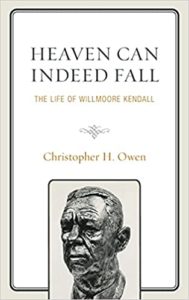 More than 50 years after his death, Willmoore Kendall is the subject of the first, full-length biography of his life and work. Authored by Christopher Owen, the biography is entitled Heaven Can Indeed Fall: The Life of Willmoore Kendall (more about the title later).
Willmoore Kendall was, perhaps, the most brilliant—and original—conservative thinker of the 20th century; and was a major figure of the modern conservative movement in its key developmental stages in the 1950s and 1960s. Yet, today, Kendall, and his contributions to the conservative movement are all but forgotten, even in conservative circles. His writings are rarely studied in political science classes, and his teachings on the “constitutional morality” of the American Founding are largely ignored, not just by liberals but also by the Straussians who have come to dominate the “conservative” interpretation of our political tradition.
Mr. Owen’s well-researched and reasoned biography of Willmoore Kendall may lead to a resurgence of interest in the writings and political thought of this great teacher, particularly among young conservatives. Let’s hope so.
The title, Heaven Can Indeed Fall, is taken from a lecture Kendall gave at the University of Dallas, where he taught in his final years. As Mr. Owen notes, Kendall “sought to show that liberalism was un-democratic and socially destructive. By insisting on rapid realization of unpopular and utopian demands, liberalism (and some types of conservatism) took decision-making out of the hands of the people and undermined existing social goods.” In Kendall’s words,
“There are the people who are going to do justice, let heaven fall where it may. And I say to them heaven can indeed fall and that it can hurt some of the heads it hits mighty hard.”
One of Kendall’s favorite expressions in describing liberal utopianism was to refer to it as “The Committee to Abolish Original Sin.” An anti-utopian, Kendall was just as fervently an anti-elitist. William F. Buckley’s famous expression that he would rather be governed by the first 2000 names in the Boston phone book than the entire faculty of Harvard University sounds as though it might have originated with Willmoore Kendall, who taught Buckley at Yale and who profoundly influenced his thinking.
Willmoore Kendall was a uniquely American political theorist. Christopher Owen makes a persuasive case that Kendall had his own, original set of ideas that set him apart from many other conservative thinkers. “Kendall was not a neocon, not a theocon, not a paleocon, not a country-club Republican, not a state’s rights advocate, not a libertarian.” Willmoore Kendall was “both a populist and a conservative.” As one who knew Kendall slightly, read most of his writings, and studied at Georgetown University under his closest colleague and collaborator George Carey, I share the author’s view.
In Owen’s biography of Willmoore Kendall, we get a real understanding of the man (warts and all) and of his teachings as they evolved over the years.
Kendall was the son of a blind Methodist minister, born and raised in Oklahoma, a child prodigy who entered Northwestern University at the age of 13 only to drop out less than a semester later and a fully-fledged reporter for the Tulsa Tribune as a teenager. Willmoore ultimately went back to college at the University of Oklahoma and majored in Romance Languages. Fluent in three languages, Kendall was still only 17 when he got his college degree. He then returned to Northwestern, where he got a Masters Degree a year later. Mr. Owen describes some of the formidable influences in these early years that helped shape his life. Without getting into all the particulars, one incident at Northwestern, where he was the youngest student there, stood out for me:
“As a thirteen-year-old boy Kendall was not prepared for college. Years later, in a letter to his sister, he noted how mortifying it had been to attend college classes still dressed in knickerbockers. College authorities allowed the country’s youngest freshman to be treated as a freak to perform in a variety of ways in knee trousers. Meeting the football coach, Kendall, wriggling and screaming, was tossed about among the football huskies.”
Not exactly the most positive experience for a 13-year-old college freshman: to be treated like a football by the Northwestern football team.
Mr. Owen’s biography is full of such stories, scattered throughout the book, that help us understand Kendall the man. But the biographer’s real focus is on Willmoore Kendall’s political thought. Kendall started his academic career with his scholarly focus on romance languages but shifted to “politics and economics.” He was a Rhodes scholar and studied under a number of prominent professors at Oxford. Among them was R.C. Collingwood, a professor of philosophy, who had a strong influence on Kendall’s intellectual thought and method of analysis.
Kendall viewed himself as a “man of the Left” while at Oxford and later as a reporter for UPI in Madrid in 1934 (prior to the outbreak of the Spanish Civil War). But, as the author notes, Kendall began to have doubts about whose side he was on, when he observed “the acts of terrorism committed by the Communists.” They were “assassinating delivery boys of right-wing newspapers.”
Kendall still considered himself a leftist when he was hired by Charles Hyneman, chairman of the political science department at Louisiana State University, to teach political theory. Kendall flourished at LSU. Mr. Owen remarks, “Willmoore cut loose as a teacher at LSU, revealing himself a Socratic virtuoso.” Certain that American students could achieve at highest intellectual levels, his classes overflowed “with intelligent inquiry and passionate debate.” He succeeded in attracting bright students to his exciting and noisy classes.
In addition to being influenced by Charles Hyneman (who later authored the definitive book on the threat of judicial supremacy, entitled The Supreme Court on Trial), Kendall also became good friends with the famous Southern agrarians Robert Penn Warren and Cleanth Brooks, who were professors of literature at LSU at the time.
When World War II came, Kendall—aided by his fluency in languages—entered the intelligence business. Called the CIAA and headed by Nelson Rockefeller, it “became the chief intelligence agency for the Western Hemisphere.” His “skill set” helped him do his job well. Even though he later got a direct commission in the army, Willmoore continued to work on Latin American issues. After the war, he accepted the job as head of Latin America research and analysis, whose branch was, in the words of Evron Kirkpatrick, “chock full of communists.” Kendall was “brought in to clean out the division.”
Ironically, the Soviet agent leading the division at the time was Maurice Halperin, who had been fired as a professor at Oklahoma University for his alleged Communist ties only to resurface as an operative of the Office of Strategic Services. As Mr. Owen notes, “Halperin became one of ‘the most productive’ Soviet agents within American agencies. He led OSS research and analysis efforts for Latin America.”
Kendall cleaned out the nest of Communists. As he later confided to an ex-Communist named Nathanial Weyl, “I’m the guy who ‘busted’ the Maurice Halperin operation at OSS and State.”
Just as Ronald Reagan became a conservative after serving as President of the Hollywood Screen Actors Guild and seeing the attempted Soviet subversion of that organization, Kendall’s epiphany came after experiencing Communist infiltration of our government agencies.
His biographer notes: “By the Spring of 1947 Kendall had made his conservative turn, and ever after viewed himself as a man of the right.”
In the same year, Kendall received a tenured professorship at Yale University in political science. Meanwhile, he kept his hand in the intelligence business by working “a day and a half each week for the CIA.”
I found intriguing Kendall’s assessment of intelligence work, having myself worked (more than two decades later) both as a case officer running agents and as a senior analyst for Strategic Research and Analysis in Vietnam.
“Kendall thought intelligence officers… should not merely gather information but ought to interpret complex political realities to shape and clarify the views of decision-makers.… He disparaged covert operations as less effective and more expensive than open-source intelligence and also as undemocratic. The ‘big job’ for operatives was to integrate world events into a coherent pattern for “elected officials.”
My own experience in the military intelligence business in Vietnam led me to similar conclusions. But Kendall’s views were not well received by the higher echelons of the CIA, and and he lost favor in the agency. His acerbic personality didn’t help him either.
Meanwhile, Kendall continued to teach at Yale, where his classes, as at LSU, were very popular with the students. In Christopher Owen’s words, “Kendall soon won a reputation at Yale as a ‘wow’ in the classroom. His classes were… among the ‘most stimulating’ at Yale.”
Fortuitously, Kendall taught William F. Buckley, Jr. and Brent Bozell, Jr. at Yale, both of whom went on to become major figures in the growing conservative movement.
Buckley made a name for himself for his book exposing the liberal and anti-religious teachings of many professors at Yale. The book God and Man at Yale became a best seller. As Christopher Owen notes,
“Kendall’s presence looms large in the background. Buckley never disguised getting help from his former politics professor. He later explicitly acknowledged that Kendall carefully ‘went over’ the prepublication manuscript. He also noted that the book’s most ‘provocative’ sentence came verbatim from a suggestion made in Willmoore’s signature green ink. ‘I believe,’ read the statement from the original preface, ‘that the duel between Christianity and atheism is the most important in the world. I further believe that the struggle between individualism and collectivism is the same struggle reproduced on another level.’ ”
Buckley and Bozell would go on to write McCarthy and His Enemies, a defense of Senator Joe McCarthy’s investigation of communist influence in the U.S. government. Kendall assisted them in writing and editing that book. Later, Kendall helped Bill Buckley found National Review and was its senior editor at the beginning in 1955. National Review was unabashedly anti-liberal in those days, “the magazine immediately went on to the attack against liberals. Its editors asserted that ‘the nation’s opinion-makers for the most part share the Liberal point of view, try indefatigably to inculcate it in their readers’ minds, and to that end tend to employ the techniques of propaganda.’”
While Willmoore had a complex (and messy) personal life and could be difficult to deal with, the friend and colleague of Kendall who knew him best, George Carey, said that we shouldn’t dwell on those matters in assessing his political thought. George Carey, in writing about Kendall’s collection of writings entitled Willmoore Kendall Contra Mundum, had this to say:
“When writing about Willmoore Kendall a strong temptation exists to deal with the man, not his teachings or theory. This I have always felt to be a shame, and at times, a deliberate dodge because the reviewer or commentator sought to avoid coming to grips with the substance of his thought. I content myself with noting, as does Jeffrey Hart in his introduction to this volume, that Willmoore was a character of the first order who could on occasion be extremely perverse. The perversity manifested in his personal life, is not evident in his writings.”
The reader can judge for himself Kendall’ s personal behavior and the reasons for it which the author covers in some detail. What is important, as George Carey points out, is the brilliance and originality of Kendall’s political thought.
Willmoore should be understood as an American political theorist who believed in majority rule—but a majority that acted in a deliberate fashion. He saw the Constitution and The Federalist as documents to be read together, with Publius (the name the authors of The Federalist took in writing these papers) as our guide. From Kendall’s perspective, understanding the Constitution at its fundamental, bedrock meaning “as well as much of our subsequent development as a nation, one must look to The Federalist.”
That is why Willmoore Kendall paid so much attention to the text of the papers that comprised The Federalist, which addressed the problem of majority rule and how best to preserve it. That meant a certain kind of majority rule. In Kendall’s words,
“We have no tradition in America for the kind of majority rule that is prepared to say to the minority… You are going to obey our policy directives because we are a majority. You are going to obey because if you do not obey, we are going to make you obey.”
As Kendall said in a debate with James McGregor Burns, “the man who talks that kind of majority rule in America is consciously or unconsciously preparing the inevitable breakdown of the American Political system.” Isn’t that what the Left is trying to do in America today after Biden’s narrow victory in 2020?
Kendall’s teachings can be found in The Conservative Affirmation, Willmoore Kendall Contra Mundum, Dialogues in Americanism, and The Basic Symbols of the American Political Tradition (which was finished and published after his death by his colleague George Carey.) Kendall’s essays cover a variety of topics and are just as relevant today as when they were first written.
Why then has Willmoore Kendall been ignored for so long? Intellectuals on all sides of the political spectrum agree that Willmoore was a brilliant thinker. Understandably, the liberals didn’t like him because he posed a direct threat to their interpretation of our American political tradition and, more importantly, his teachings stood in the way of their utopian ambitions for America. With Kendall’s death they could just ignore what he had written and pretend that he never existed. Which they did.
However, with Christopher Owen’s new biography of Kendall, it has “stirred the liberal juices.” A respected liberal, Jacob Heilbrunn, has written a lengthy review of the book for National Interest, entitled “How Willmoore Kendall Invented Trumpism.” Actually, Mr. Heilbrunn’s “review” is more of a carefully calculated attack on Kendall than a review of the book itself. Still, it reflects the Left’s fear that Kendall’s political thought could be rediscovered by a new generation of young American conservatives and applied to our present crisis (like Kendall’s ideas once influenced young conservatives like William F. Buckley, Jr. and Brent Bozell, Jr.)
The real problem, however is not the neglect of the consideration of Kendall’s political thought by the Left. But it is the misrepresentations and outright lies of Kendall’s views by so-called leading conservative academics, where the followers of the late Leo Strauss and Harry Jaffa (known as Straussians) dictate what is “acceptable” conservatism.
In those circles Willmoore and “his views on the American political tradition (and other issues) are “persona non grata”. Even at the University of Dallas where Willmoore taught in the last years of his life, Straussians took over the politics department (which Kendall had founded) after Kendall’s death, and students at that conservative university were rarely exposed to the teachings and writings of Kendall. That is not an isolated case. The principal villain in this affair is Harry Jaffa, a Straussian and the founder of the Claremont Institute.
Dan McCarthy described what Jaffa did to Kendall in an article written in 2013 for The American Conservative:
“Kendall was in truth the top Americanist of the post war conservative movement, more concerned to relate his ideas to the Constitution and The Federalist … It’s perhaps ironic that Kendall’s all-American political philosophy found the fewest adherents on the late 20th-Century right but perhaps the future will be kinder to him … Harry Jaffa … portrayed Kendall as a neo confederate. Kendall died in 1968 but Jaffa is still alive, age 94, and still misrepresenting a dead man who can’t defend himself.”
Jaffa accused Kendall of being a follower of the ideas on the American Founding of John Calhoun—which is a complete falsehood. Willmoore Kendall may have been born in Oklahoma, but his loyalty was “to the institutions and way of life bequeathed to us by the Philadelphia convention.” He was a Constitutionalist to his core.
While the “West Coast Straussians” (the acolytes of Harry Jaffa at Claremont) try to re-invent themselves and Jaffa as “would-be populists,” the real conservative populist was Willmoore Kendall, who truly believed in the American people who were, in his words, “conservative in their hips.”
Thanks to Christopher Owen for his marvelous biography of this original, conservative thinker. With America in great need of political and intellectual warriors to fight for our “Constitutional morality,” what better man to learn from as one prepares for battle. This truly is a Willmoore Kendall moment.
The Imaginative Conservative applies the principle of appreciation to the discussion of culture and politics—we approach dialogue with magnanimity rather than with mere civility. Will you help us remain a refreshing oasis in the increasingly contentious arena of modern discourse? Please consider donating now.
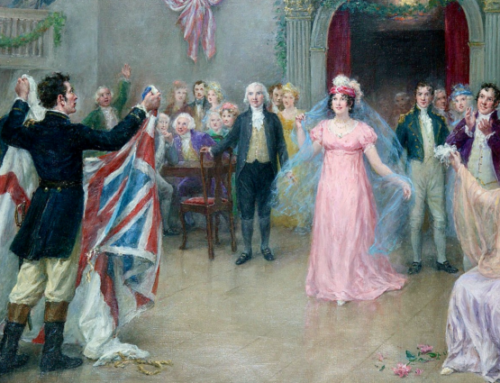
The featured image is “Drawing shows the ruins of the U.S. Capitol following British attempts to burn the building,” and is in the public domain, courtesy of Wikimedia Commons.



Great review. Look forward to reading the book. Kendall’s book on the symbols of the American political tradition is a must-read for anyone calling himself a conservative. And I appreciate you pointing out Jaffa’s role in sweeping him under the rug (and what’s wrong with being a neo-Confederate or Calhounist?) Begorrrah, the damage done by the Jaffaites and their gnostic Lincoln myth.
Nothing wrong with Calhoun.. Kendall just didn’t view Calhoun as correct in his interpretation of the Founding.. I agree with Kendall.
Excellent informative essay. Take credit for selling one copy (mine) of Heaven Can Indeed Fall
Thanks. I am sure you will enjoy it as I did.
Tom, This is a fine review. If Mr. Roth is your first sale, count me as the second. Woody
A fine review about a book about a very important, and much neglected, thinker.
I heard Jaffa rail against Kendall as a “Calhounian”. And I, like Tom, took courses with Kendall’s closest associate, George Carey. In Carey’s class on American Political Theory, we read Calhoun and heard Carey lecture about him, the gist of which was that Calhoun was the most important alternative to the regime that the Federalist Papers advocated. The exact opposite of what Jaffa claimed.
It is also interesting to note that Straussian almost always refused to engage in the ideas of Kendall and rarely even cite Kendall or Carey in footnotes. Better to ignore than honest engagement.
It is always splendid when a review informs the reader of the book under review