
Not a dogmatic theologian or philosopher, Howard Pyle was drawn to engaging the mysteries through parable and picture. One of the ways in which he expressed and directed his grief was through his own imagination. That is what one finds in “The Garden Behind the Moon.”
 The year was 1889. The thirty-six-year-old artist and illustrator Howard Pyle had burst on the artistic scene in the 1870s with illustrations in popular journals such as Harper’s Weekly. His book career took off in 1883 with The Merry Adventures of Robin Hood, which was hailed as a work of genius at the time and soon labeled a classic. Other books followed. In 1888, Otto of the Silver Hand had appeared to acclaim as well, marking a new development in the children’s literature of the day with its realistic historical approach to the difficulties and sorrows of his medieval setting.
An established figure, Pyle nevertheless was always in striving to grow as an artist. Because of his fascination with the world of pirates, he wanted to see the Caribbean in order to learn how to depict the trees and plants, water, sunlight, and other characteristics of the places where hidden treasure might be laid and buckles might be swashed. Thus, he arranged for a trip to Jamaica with his wife, Anne, then pregnant with the couple’s third child, while the two oldest, Sellers (seven) and Phoebe (three), stayed with a grandmother back in Wilmington, Delaware.
The trip, so restful for Anne and exhilarating for Howard, was cut short when word came that Sellers had died suddenly. Of course, by the time the cablegram arrived and the couple had managed to return by boat, the funeral for their son had already taken place.
Heartbroken, Pyle and Anne continued their lives with a shadow over them as well as light cascading in. That year, Anne gave birth to Theodore. Four more children (three boys and a girl) would be given to the couple. Those who have experienced loss, especially loss of a child, know that though other children are a comfort, each child is irreplaceable and grief becomes a companion throughout life—even if Christian hope bids us look to a reunion beyond this life. As the writer Peter DeVries put it in the final lines of The Blood of the Lamb, the novel he wrote after the death of his daughter, “Again the throb of compassion rather than the breath of consolation: the recognition of how long, how long is the mourner’s bench upon which we sit, arms linked in undeluded friendship, all of us, brief links, ourselves, in the eternal pity.”
If consolation is not always given in this life for such losses, the development of compassion is something for which one can give thanks. So, too, the capacity for wonder as well as pain in the face of the dark mysteries of human existence. Pyle had always been fascinated by the mystery of death, and its prominent place after his child’s death provoked his wonderings further.
Though he grew up in the Society of Friends, popularly known as the Quakers, their penchant for plainness never really satisfied a visual artist—even if at various times Pyle followed them in using the older intimate second-person pronouns “thee” and “thou” and, more importantly, believed his artistic gifts must be useful to as many people as possible. His inspiration when it came to the mysterious came much more from the Bible itself and the works of the 18th-century Swedish mathematician, scientist, mystical philosopher, and visionary Emmanuel Swedenborg. Biographer Henry Pitz said, “Swedenborg half satisfied him and half tormented him, half exalted and half mystified him.” What kept Pyle reading were the descriptions of Swedenborg’s visions, which painted mental pictures for him of the spiritual world in images familiar yet mysterious to us.
Not a dogmatic theologian or philosopher, Pyle was drawn to engaging the mysteries through parable and picture. One of the ways in which he expressed and directed his grief was through his own imagination. That is what one finds in The Garden Behind the Moon: A Real Story of the Moon Angel, which he wrote and published in 1889, the year of both Sellers’s death and Theodore’s birth.
The story begins with a king and queen who have all that they desire save a child. One hears the voice of the father mourning the loss of a seven-year-old boy in the narrator’s observation, “For so it is always dull and silent in a house where there are no children.” The queen’s sorrow is observed one day as she walks in the garden by the Moon-Angel, a creature whose true identity we never quite learn from the book. The narrator tells us only that “so many people know” him “by a different name and are so afraid of him, they know not why.” Nevertheless, the Moon-Angel hears the Queen’s desire for a child and announces to her that she shall bear a daughter.
Alas, when the time comes for this dearly-desired girl, the Princess Aurelia, the Queen dies on the same day, “for the Moon-Angel never brings something into the house but he takes something away with him.” The girl herself, beautiful as can be, is herself in a kind of living death, neither smiling, speaking, playing, romping, or teasing. “Everybody said that she had no wits,” the narrator tells us, but Aurelia’s story will be put on hold until much later. For the bulk of the book, we hear of the child David, who is known as “the Moon Calf,” for the apparently silly nature the boy has.
Oddity that he is, David finds friendship with the odd cobbler Hans Krout, who is also known to be “moonstruck.” Krout tells David about the moon-path, which appears over the water in the evening, and allows those who travel it to walk to the moon. Though David’s first attempt nearly ends in his death, he tries it again and is aided by the Master Cobbler, who is really the Moon-Angel.
David arrives on the moon and is invited into the house belonging to the Man-in-the-moon. There, he is given the task of polishing stars with lamb’s wool. There, too, he looks out the window of the house to see various scenes from the world below as the moon moves in its course. After some time, David discovers the garden behind the house where dwell children between three and twelve years of age who have died. Instructed to take the back stairs, David enters the garden.
A girl named Phyllis lives in the garden, and David falls in love in the way a boy does. After spending some time in the garden, David is told he must leave. But, he is given the possibility of living in the moon garden for three days a month until he turns twelve, at which point he must never return. Devastated that he will be exiled from the garden, he is told by the beautiful lady who cares for the children in the garden that he may be able to see Phyllis again past his twelfth birthday if he fulfills a series of tasks.
First, David must go behind the Moon-Angel. Second, he must fulfill a task assigned particularly to him: “‘It is,’ said the lady, ‘to find the Wonder-Box and the Know-All Book, which lies in the Iron Castle of the Iron Man, and to bring it back to the brown earth again.” This second task, David is told, “is what you were really sent here to do.”
The rest of the book is an adventure story, with episodes alluding to or imitating biblical stories, Greek myths, and various fables. The reader might guess how a young man named David’s confrontation with the giant Iron Man ends. Does David succeed? In order not to spoil the ending, we can only say that the people of the town still consider him a simpleton, a view encouraged by his choice to spend so much time playing with the little ones of the town. What of Phyllis? Or the Princess Aurelia—forgotten since the first chapter of the book? Let us say only that the ending does not disappoint the reader.
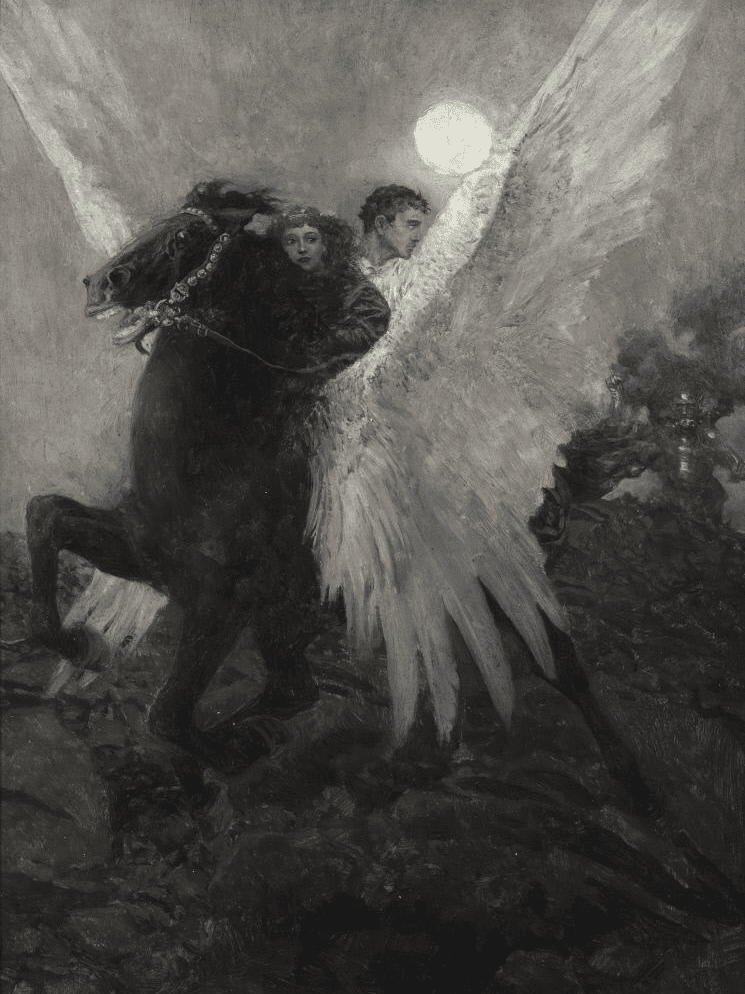
Like Swedenborg’s visions that frustrated Pyle, Pyle’s tale in The Garden Behind the Moon is a book of visions, accompanied by his own illustrations of them, that do not perhaps always make sense to the rational mind. The play of grief on the imagination has dark elements but also wondrous elements. The play of children in a garden represents the hopes for a boy whose play in his parents’ house has been taken away. Pyle wrote at the beginning of the volume, “To the Little Boy in the Moon-garden this book is dedicated by His Father.” The adult David’s growth and heroism, along with the images of a young man on a winged horse and facing a loving woman, all represent the quashed hopes of a father for a son who will never experience them.
Or do they represent the hope that remains that God brings to fulfillment the lives snuffed out in childhood in some way unknown to us? Younger children, who don’t necessarily demand a plot with all holes filled, will likely find the images and somewhat episodic character of the story attractive. So, too, will those adults who have become like little children and enjoy the play of the imagination in parables, pictures, and dreams even as grief’s waves threaten.
When we learn of David’s task of shining stars with lamb’s wool, the narrator acknowledges that readers might find this claim nonsense. His response fits well with his book as a whole: “Well, maybe it is all nonsense, but sometimes there is more solid truth in a little nonsense than in a whole peck of potatoes.”
Dr. Deavel will be giving a public seminar titled “Knights, Heroes, and Patriots: Howard Pyle and the Shaping of the American Moral Imagination” at the Russell Kirk Center for Cultural Renewal in Mecosta, Michigan, on June 20, 2026. See here for tickets and more information.
__________
The Imaginative Conservative applies the principle of appreciation to the discussion of culture and politics—we approach dialogue with magnanimity rather than with mere civility. Will you help us remain a refreshing oasis in the increasingly contentious arena of modern discourse? Please consider donating now.
The featured image is”Fast flew the black winged horse,” illustration for The Garden Behind the Moon. Black and white oil on illustration board, and is in the public domain, courtesy of Wikimedia Commons.



Leave A Comment