
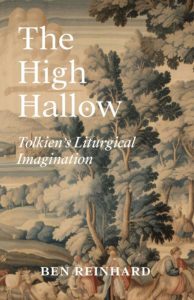
Though several scholars had considered J.R.R. Tolkien’s Catholicism, none of them had looked specifically at Tolkien’s understanding of liturgy and how that liturgy shaped not only Tolkien’s soul but his very art. At last, Ben Reinhard has done so in his brilliant book, “The High Hallow.”
The High Hallow: Tolkien’s Liturgical Imagination, by Ben Reinhard (184 pages, Emmaus Road Publishing, 2025)
 Though I’ve been reading J.R.R. Tolkien since turning 10 in late 1977, I really didn’t understand Tolkien scholarship until turning 13 in 1980 and getting a copy for Christmas that year of Unfinished Tales. Anyone familiar with this book knows that Christopher Tolkien edited it and added extensive notes and commentary. To say that I was intrigued and devoured that gift would be a gross understatement. As I’ve mentioned elsewhere, I was already obsessed with the idea of research—inspired by my older brother Todd and a set of World Book Encyclopedias—and Unfinished Tales opened up not only new vistas of Middle-earth to me but it also opened up new vistas of our current world. Christopher made me want to know more and more. I got that chance during my junior year in college in Professor Sayre’s “Philosophy and Fantasy” class. I gleefully wrote my semester-long project on Tolkien’s Catholicism.
Despite Tolkien being my avocation rather than my vocation, I have done my absolute best since that fall of 1988 college course to stay up on Tolkien scholarship. Some years it’s easier than others.
Over the last year, I’ve been happily overwhelmed by new Tolkien books from Beppe Pezzini, Joe Loconte, Michael Drout, and Graham McAleer. But wait… I’m missing something critical and to my detriment! To my severe detriment. But, not for a lack of trying. A year or so ago I actually (and accidentally) purchased not one but two copies of The High Hallow: Tolkien’s Liturgical Imagination by my friend, Ben Reinhard. Somehow, though, I read Pezzini, Loconte, Drout, and McAleer, but not Reinhard. Finally, over Easter weekend, I read The High Hallow. No, let me rephrase that. I devoured The High Hallow. I loved every moment of it. What a brilliant book written by a wise and brilliant man.
Though several scholars have considered Tolkien’s Catholicism, none of them have looked specifically at Tolkien’s understanding of liturgy and how that liturgy shaped not only Tolkien’s soul but his very art. As Reinhard notes, “An imagination formed by the liturgy will bear… a liturgical ‘shape’—being simultaneously commemorative (looking back) and eschatological (looking forward).” Though many readers may not know it, Tolkien’s own liturgical imagination embraced both and makes Middle-earth feel like home for many, many readers. Raised first by a Catholic convert mother and then, after her tragic death, by Father Francis Morgan and the Birmingham Oratory, Tolkien lived and breathed the liturgy and the very life of the church. “Tolkien’s life and imagination were fundamentally grounded in the liturgy,” Reinhard persuasively claims. “His joys and sorrows, art and imagination—indeed, every human activity—could be grounded in and interpreted through the prayer of the Church.”
Reinhard notes that through Tolkien’s life and letters, we see not only a deep devotion to the Virgin Mary (Marian figures permeate Tolkien’s legendarium) but also to the Mass. He wanted his sons to know the Mass by heart, and he even, at age sixty, helped young children pay attention and understand the Mass. “This, then, was Tolkien’s life in liturgy,” Reinhard continues. “The Mass was, in many ways, the governing principle of his life; it anchored his schedule, molded his devotion, and nourished his family.” Further, it “was a source of order, joy, consolation—and, occasionally pain.”
The downside to this, Reinhard argues, came with Vatican II—an event that deeply depressed Tolkien:
Every surviving reference by Tolkien to the postconciliar liturgy is plainly negative; some border on the openly hostile. By late 1963, Tolkien was already expressing reservations about what the Council would achieve; the liturgical fruits of the Council only confirmed his fears. Those who knew Tolkien in the 1960s and 1970s… give unanimous and unbroken witness to his hostility to the new liturgy and associated changes in Catholic devotion and practice.
As Reinhard notes, however, even Tolkien’s anger with the new Mass reveals how deeply he felt about the Mass and how much it had shaped his very soul and being.
In true Christian humanist fashion, Reinhard sees the Mass and the liturgy (Greek for public performance) not as a break in the Western Tradition, but in a fulfillment and continuity. The pagan mythmakers may have gotten much wrong—maybe more wrong than right—but they understood the gravity of the divine. That imagined by the ancients “is not far removed from the glory of God, which fills heaven and earth; the awe attendant on the ancient sacrifices finds its fulfillment in the sacrifice of the Mass.”
Not surprisingly, then, Tolkien does not see an immense gulf between the pagan and the Christian, but rather a baptism and fulfillment of pagan things. This is as true in language as it is in culture and customs. This is especially true of what is known as “faerie.” Faerie, after all, is as deeply pagan and mysterious as it is liturgical and sacramental, a realm of overwhelming and, at times, perilous grace.
Though I find myself in immediate agreement with everything Reinhard writes, I must also admit that I find several insights startling new and, frankly, wondrous. I had known about Tolkien’s connection to John Henry Cardinal Newman, of course, given that Father Francis Morgan, Tolkien’s adopted father, had been Newman’s personal secretary, but I knew absolutely nothing about Tolkien’s abiding friendship with the extraordinary French theologian and priest, Louis Bouyer. Bouyer, critically, believed in continuity from pagan worship to the Mass as well, and Reinhard considers Tolkien’s own mythology a type of manifestation of Bouyer’s thought.
Let me note again: Ben Reinhard has provided a brilliant book on Tolkien—not just one new release on the great man, but a work of art worthy of Tolkien himself. With The High Hallow, one sees, yet again, Tolkien’s genius, but in a new light and from a new perspective. Yes, many scholars have demonstrated Tolkien’s Catholicism time and again, but only Reinhard has had the gumption, the sense, and the artful inclination to see, specifically, the manifestation of the Catholic liturgy in his mythology. Frankly, I will never see the Elves, or Gondor, or Frodo and Sam’s rather Lenten quest the same way again.
So, be like Brad after Easter rather than Brad before Easter. And, don’t wait until next Easter to do what I did. Right now, at the beginning of June, order and devour The High Hallow. You’ll be glad you did.
__________
The Imaginative Conservative applies the principle of appreciation to the discussion of culture and politics—we approach dialogue with magnanimity rather than with mere civility. Will you help us remain a refreshing oasis in the increasingly contentious arena of modern discourse? Please consider donating now.
The featured image is “In Verdure Clad” (1886), by Benjamin Williams Leader, and is in the public domain, courtesy of Wikimedia Commons.



Leave A Comment