
“The Chosen” addresses and transfigures the duality we love in our popular mythology: a man who is also God. Repeatedly, it raises questions about how we imagine the humanity of Jesus. What was it like when Peter and Andrew pulled in that massive haul of fish after catching nothing all night? How do you picture the wedding feast at Cana?
 This past weekend, I took our daughter Julia to see The Batman. She had been cooped up with us (somehow avoiding illness) as we underwent our second, mild case of Covid, and she needed an outing, as did I after nearly a week indoors. During my years as a movie critic in Dallas, I usually knew well in advance which movies were coming out, but I had no idea that still another version of Batman (this time with a definite article in front) was on the way. New ones proliferate as though a superhero were a prime Shakespearean role like Hamlet or Macbeth that measures different actors in the same generation. We have had Michael Keaton, Christian Bale, and now Robert Pattinson as Batman and edgier actors like Jack Nicholson, Heath Ledger, and Joaquin Phoenix as The Joker. Likewise, there seems to be a new Spider-Man every few months. The last one we saw had two previous Spider-Men in it in addition to the current one, their appearance courtesy of the “multiverse” (that paradise of special effects).
For a long time, American popular mythology has centered on figures with a dual identity: a conventional persona (Clark Kent, Bruce Wayne, Peter Parker) and another extraordinary self—perhaps realer than the disguise, perhaps not—but possessing powers that exceed the limits of human capacity and strain the law. Heroes of Greek mythology, especially Herakles, occupied a similar dangerous zone between the ordinary powers of men and the superpowers of gods, but they did not have this duality that seems to appeal to the contemporary imagination. Gods could disguise themselves as mortals (Athena as Mentor, for example), and heroes could temporarily disguise themselves in rags, as Odysseus does to fool the suitors, but the idea of a permanent, carefully maintained duality did not appeal to the ancient world.
By contrast, we love the hero or monster hidden underneath the ordinary appearance. Robert Louis Stevenson’s Dr. Jekyll and Mr. Hyde anticipated theories of the unconscious that began to emerge with Freud. The mild-mannered neighbor could be a superhero or a serial killer. An early version of the superhero was Edgar Rice Burroughs’ Tarzan (which means “White Skin” in ape language), a Darwin-inspired figure first introduced into pulp fiction in 1912. Having grown up among great apes, he discovers that he is in fact John Clayton, Viscount Greystoke, and he eventually combines the urbane elegance of an English aristocrat with the fearlessness and physical prowess that allowed him as a youth to kill the evil ape Kerchak and become king of the tribe. When circumstances demand it, Greystoke can shed his tuxedo and take to the trees.
If our everyday persona sits precariously over primordial forces that civilization does its best to restrain, the underlying self already has powers that have to be hidden from the quotidian world. It’s chilling to recognize how easily an adolescent strain of fantasy—the nerd who conceals his hidden strength—metamorphoses into figures like James Holmes, who killed twelve people at a theater in Aurora, Colorado, ten years ago at a midnight showing of The Dark Knight Rises. There was conflicting testimony about whether Holmes was obsessed with Batman, but it is clear that the character (and even more so, a villain like the Riddler or the Joker) dips into shadowy places of the psyche where law is easily suspended and vengeance becomes the dominant force—very much the theme of this latest movie. The Batman (or perhaps Bruce Wayne) delivers a little homily against vengeance at the end.
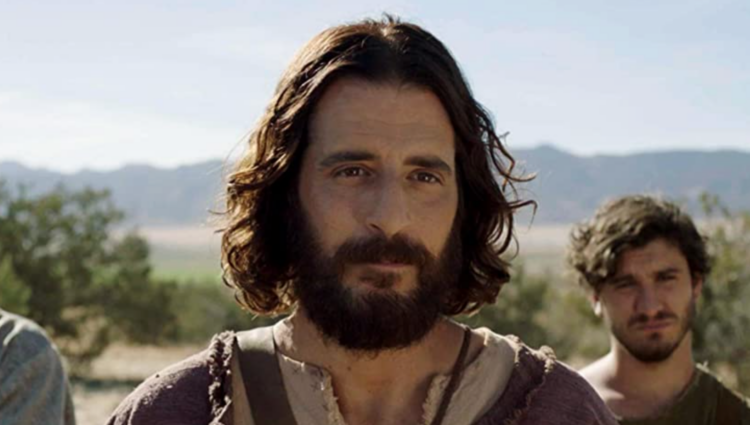
It’s interesting to speculate about why massive destruction draws crowds in these enormously popular films about superheroes. The Batman made $134 million on its first weekend (including the two tickets I paid for). I can’t help but contrast The Batman, both in its appeal and in its economics—a price tag of $250 million spent to generate scenes of mass mayhem, enormous architectural collapses, hurtling chase scenes, and the destruction of Gotham City by flood—with the online series, The Chosen. Strange to say, my wife and I had never watched a single episode of the series until we were at the Legatus Summit in Florida back in late January. Jonathan Roumie, who plays Jesus, was featured in one of the plenary sessions, where he answered questions in an interview format with a friend of his. We learned a good bit about the remarkable crowdfunding that has made the series possible.
Without overplaying the point, The Chosen addresses and transfigures the duality we love in our popular mythology: a man who is also God. Repeatedly, it raises questions about how we imagine the humanity of Jesus. What was it like when Peter and Andrew pulled in that massive haul of fish after catching nothing all night? How do you picture the wedding feast at Cana?
Since Lent began last week, we have watched an episode almost every night. So far, we have been impressed by the simplicity and artistic ingenuity that goes into the series. In the early episodes, Matthew the tax collector, for example, is hilariously fastidious. (The actor owes quite a bit to Tony Shaloub as Monk in the early 2000’s.) Nicodemus emerges as a central, respected figure both steeped in tradition and open to God’s unexpected agency; as a Pharisee, his authority provides a counterbalance of validation to the upsetting claims of John the Baptist, and even more to the emerging figure of Jesus himself. The episodes are quiet, and the special effects are quiet as well—unexpected abundance, healings, acts of faith. Yet they are much more memorable and deeply affecting than spectacles of destruction that mean nothing and that disappear from the mind as soon as the noise dies away.
Republished with gracious permission from Wyoming Catholic College.
The Imaginative Conservative applies the principle of appreciation to the discussion of culture and politics—we approach dialogue with magnanimity rather than with mere civility. Will you help us remain a refreshing oasis in the increasingly contentious arena of modern discourse? Please consider donating now.
The featured image is courtesy of IMDb.





My family and I have been watching one episode per week and have absolutely loved it. Our four year-old asks each day when it’s goin to be time to watch The Chosen.