
George Herbert and Nicholas Ferrar illustrate the way forward for Christians in troubled times. They followed the “Benedict Option,” if you like. While their own church and country was torn apart by decades of religious strife, immorality, violence, greed and corruption, they simply got on with living an authentic Christian life.
 On our recent pilgrimage to England, we took the opportunity to visit some important locations that are not on the usual tourist/pilgrimage trail. The focus of the pilgrimage was the English martyrs and Catholic literary figures.
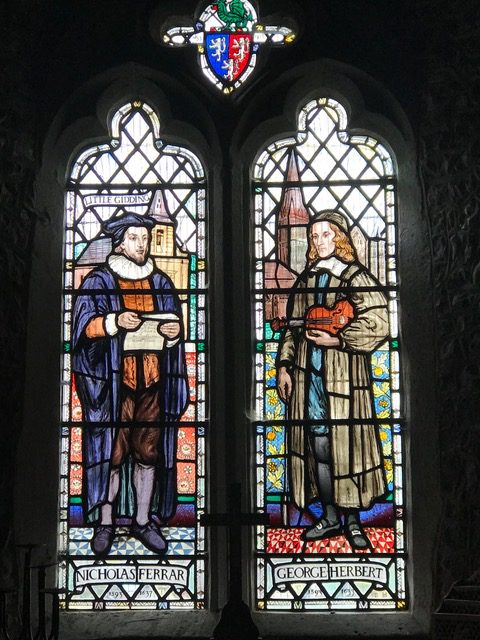
Some of the Catholic literary figures were Anglicans of course: T.S. Eliot and C.S. Lewis never managed to make the Tiber Swim Team. There was another pair linked with T.S. Eliot who also remained in the other flock, but whose hearts (like Eliot’s and Lewis’) belonged to the one flock and the one shepherd. They are George Herbert and his friend Nicholas Ferrar.
Following a link with T.S. Eliot’s poem Little Gidding, our pilgrims visited the two tiny country churches of both Little Gidding and Bemerton— Herbert’s parish and burial place.
The poet George Herbert was born into an aristocratic family in Wales in 1593—at the end of the reign of Elizabeth Tudor. He gained a place at Trinity College, Cambridge where he met Nicholas Ferrar. The young scholar attracted the attention of King James I and served in Parliament, but after the King’s death in 1625, Herbert returned to his first calling, was ordained priest in the Church of England and served as a country priest in the parishes of Fugglestone and Bemerton near Salisbury. He died at the age of thirty-nine of consumption, having penned what is arguably the finest devotional poetry in the English language.
Before he went to Bemerton, however, Herbert was appointed to the parish of Leighton Bromswold in Cambridgeshire—just two miles from the tiny parish of Little Gidding, where his college friend Nicholas Ferrar had settled and established an informal religious community with his wife, children, and his brother’s family. Herbert used his own funds to restore Leighton Bromswold church, and to this day the interior of the church serves as an example of the most elegant ecclesiastical design and furnishings of the seventeenth century.
Fans of T.S.Eliot will notice the name Little Gidding as the title of the fourth of his Four Quartets. Eliot’s own poetry was much influenced not only by the seventeenth-century metaphysical poets, but also by that group of Anglican theologians called “The Caroline Divines.” To understand their importance, one needs to position them in the context of their times. The Protestant police state of Elizabeth I and James was ended. James’ son Charles was on the throne and was married to a Catholic. His own absolutist position as monarch was linked with his desire for religious freedom; however, the Puritans suspected (quite rightly) that Charles’ pleas for religious freedom were motivated by a desire for more religious tolerance toward Catholics. Charles would be executed by the victorious thugs of Oliver Cromwell, and after six years his son Charles II would be restored to the throne.
Charles I’s archbishop of Canterbury, William Laud, was a leader of the high church party. He would eventually be executed by Puritan forces under Cromwell. Laud led the reforms favored by Charles—reforms that led the Church of England away from extreme Protestantism to a via media—seeking to retain Anglicanism’s independence while valuing historic Catholic doctrines, devotions, and ritualistic worship. Laud and the Caroline divines are therefore the precursors of the Anglo-Catholic movement and that form of high-church Anglicanism that values the episcopacy, ritualism, tradition, and a high aesthetic.
Eliot rooted his own Anglo-Catholicism in the lives and writings of the Caroline divines: the sermons of Lancelot Andrewes and Jeremy Taylor and the poetry of Herbert. Eliot was also intrigued by the life and witness of Herbert’s friend, Nicholas Ferrar. The members of Ferrar’s religious community at Little Gidding were accused by the Puritans of being papists, and King Charles I, while a fugitive, made a clandestine visit to Little Gidding—thus Eliot’s line in the poem “If you came at night like a broken king.” Eliot visited the tiny church at Little Gidding twice, and Ferrar’s attempt to live an authentic Christian life in tumultuous times clearly had a major impact on Eliot—braving two world wars, a fractured family life, and personal traumas.
Herbert’s life in Bemerton was a mirror of his friend Ferrar’s in Little Gidding. George Herbert settled in the Rectory house across from the tiny church of St Andrew. He served as a simple country parson for just three years before his death. During that time he gained a reputation for leading a godly domestic religious community with his wife and servants. He ministered faithfully to the poor in his parish, wrote poetry in English, Latin and Greek, shared in the musical traditions of nearby Salisbury Cathedral and so built up the spiritual life of his parish.
Herbert and Ferrar illustrate the way forward for Christians in troubled times. They followed the “Benedict Option,” if you like. While their own church and country was torn apart by decades of religious strife, immorality, violence, greed and corruption, they simply got on with living an authentic Christian life.
Monarchs were overthrown, and enemies imprisoned, tortured, beheaded, and worse. In the face of the terror and uncertainty, Ferrar and Herbert simply did what they could with what they had where they were. They followed the way of wisdom—not seeking worldly power and influence, but focusing instead on their families, their prayer life and the reality of what was local. Ferrar went out to Little Gidding. Herbert to Bemerton. Years later Newman would walk in their footsteps by leaving Oxford for Littlemore.
When faced with corruption in the church, immorality in the culture, heresy, apostasy, and atheism in the culture, one can go down the path of blame and complain, or one can choose the path of activism and engagement in the culture wars, or one can follow the third way, the way exemplified by Ferrar and Herbert and many other saints down the ages: One can simply get down on one’s knees, then roll up one’s sleeves and do what one can with what one has where one is. At the time, this course may seem unproductive—a failure even. However, God plays a long game, and those who are faithful are never a failure. The seeds of truth, beauty, and goodness eventually bear a rich harvest.
The Imaginative Conservative applies the principle of appreciation to the discussion of culture and politics—we approach dialogue with magnanimity rather than with mere civility. Will you help us remain a refreshing oasis in the increasingly contentious arena of modern discourse? Please consider donating now.
The featured image is a photograph of the stained-glass window from Herbert’s church: St Andrew’s, Bemerton, courtesy of the author.





Thank you your essay of HOPE in these dark times! Patricia Erzinger
Thank you, Father, for this insightful, informative, and encouraging essay. Many years ago now, my wife and I visited Little Gidding on our second trip to our Old Home. Somehow at the time I missed the fact that Leighton Bromswold was close by. (That will necessitate yet another trip.) This was before I crossed the Tiber, leaving my wife, unfortunately for family peace, still on the other side.
As for Herbert, I read him at least once a week, alternating between him and Eliot’s Four Quartets–among others. For all the distance of time, he is one of the most accessible and spiritually rewarding poets in English, more so, for me, than Eliot.