
It would be possible to read Franz Kafka’s “Metamorphosis” as a pro-life narrative that invites us to see the dignity of the human person beneath the ugly surface. But such a reading would violate the true spirit of the work which, as the author confesses, is animated by narcissistic self-pity and is an outpouring of the writer’s refusal to be alive to the goodness, truth, and beauty of life itself.
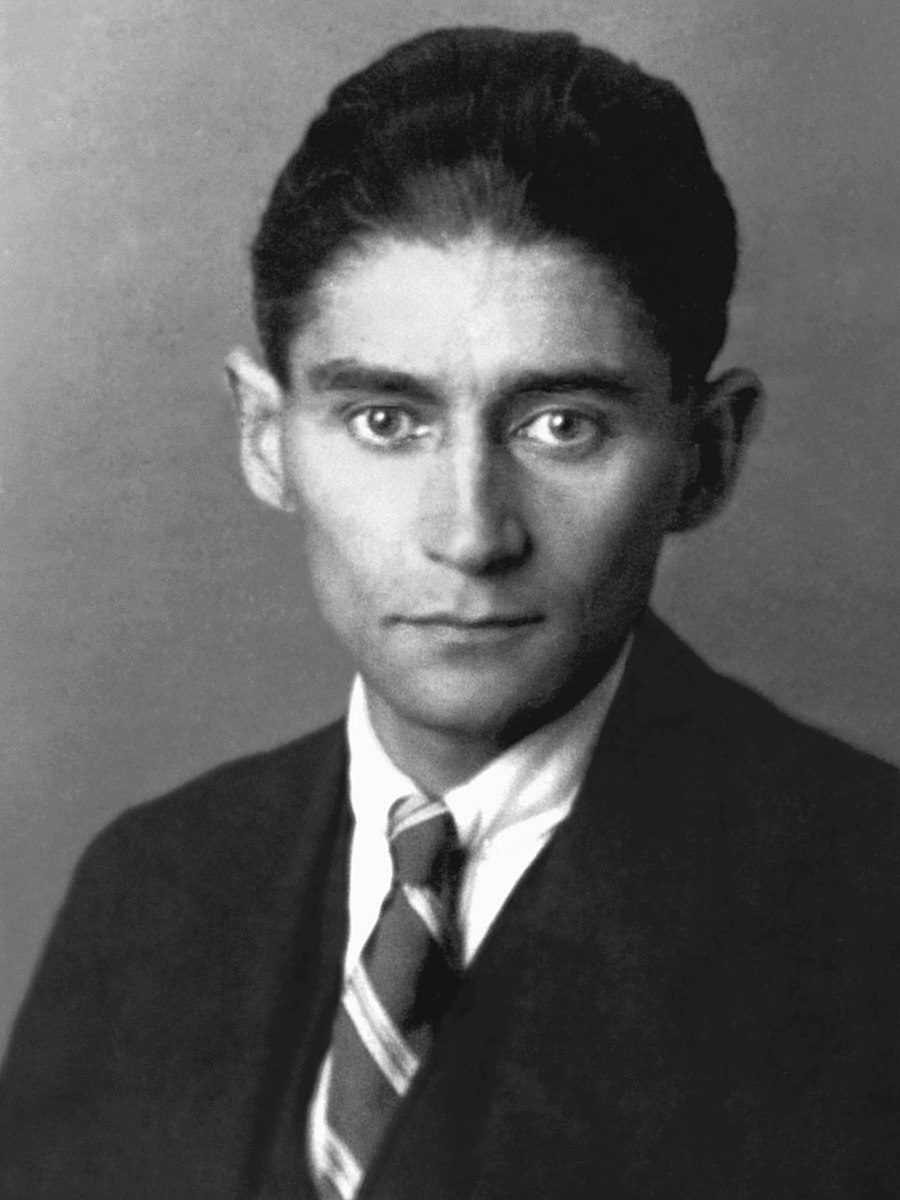
Franz Kafka
For several years, many years ago, I taught a senior class on Twentieth Century Literature at Ave Maria University. The texts I taught regularly were novels, such as The Man Who was Thursday, Brideshead Revisited and That Hideous Strength by Chesterton, Waugh and Lewis respectively, as well as the poetry of World War One and Eliot’s Waste Land. At some point, several colleagues pressured me to include Kafka and Joyce on the syllabus. Their reasoning was that literature seniors going on to graduate school would be ill-equipped unless they had been taught these two authors. I understood the point but resented the fact that ninety per cent of the class, who had no intention of going to graduate school, would miss out on other and better texts so that the ten per cent could dance to the deconstructionist tune of the post-rational academy.
It was, therefore, with an element of resistance and resentment that I taught Kafka’s Metamorphosis and Joyce’s Portrait of the Artist.
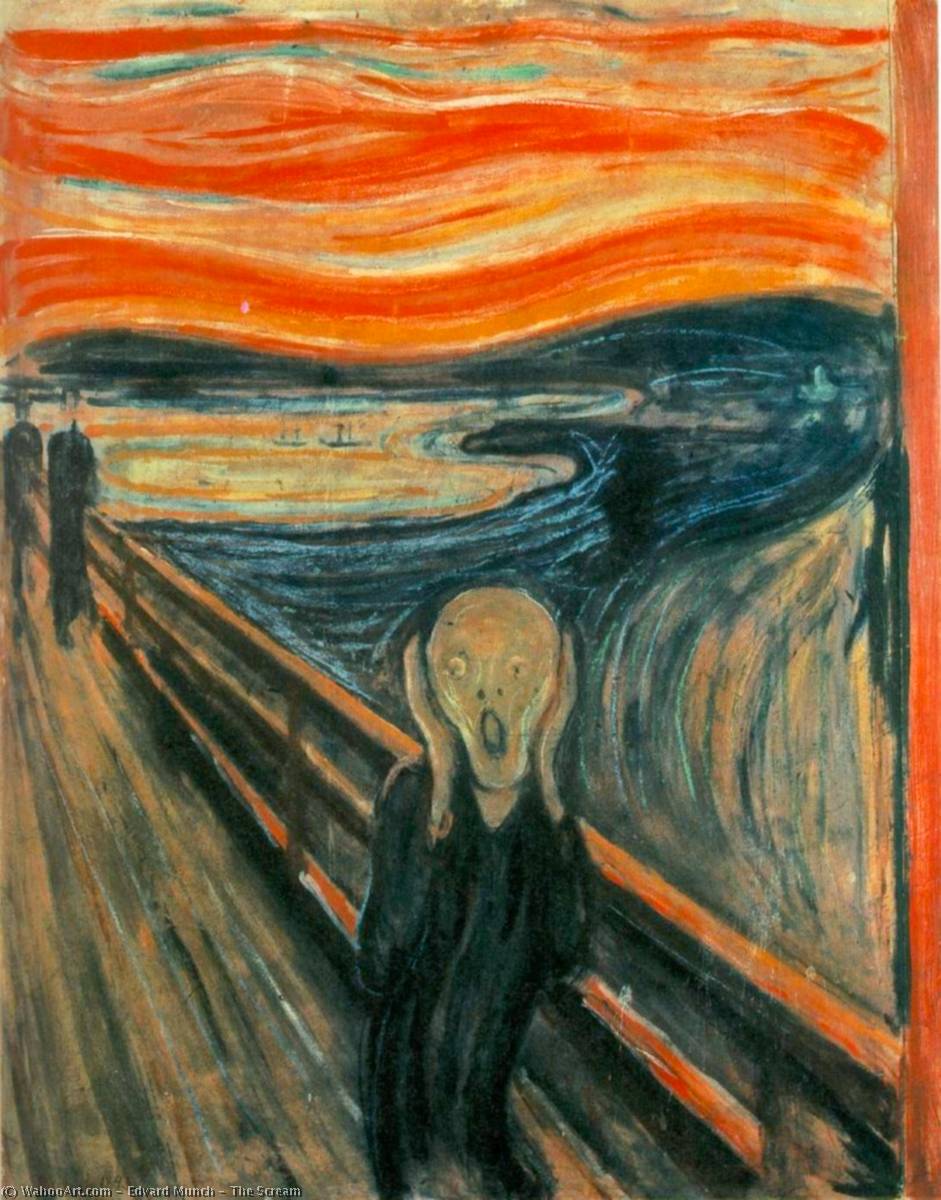
Edvard Munch’s “The Scream”
As for Kafka, it is clear that his view of the gifts he’d been given was perverse. In 1922, seven years after the publication of The Metamorphosis, he wrote that being a writer was “the reward for service to the devil”. It was a “descent to the dark powers”: “And what is devilish in it seems to me quite clear. It is the vanity and the craving for enjoyment….” The fruits of such vanity and service to the devil was that “a writer … dies (or he does not live) and continually cries over himself”. It would appear, therefore, by his own admission, that Kafka’s work was the fruit of prideful self-pity, for which he seemed to hate himself. This is apparent, with respect to The Metamorphosis, in the novella’s quasi-autobiographical tone. It is generally accepted, for instance, that Samsa, the protagonist’s name, is a cryptogram for Kafka, and that it is also a phonetic juxtaposition of the Czech words sám (alone) and jsem (I am). If this is so, the whole work might be seen as the literary equivalent of Edvard Munch’s proto-expressionist masterpiece, The Scream, an icon of modern man’s alienation and angst.
As for the novella’s title, it is a loose translation of the work’s original German title Die Verwandlung, which means “the transformation”. The rendering of this as “the metamorphosis” is understandable in terms of poetic license considering that the story concerns the changing of a human person into a giant monstrous insect of some sort. It has been suggested by the critic Kurt Weinberg, however, that the transformation was a “negative transfiguration, the inversion of the Transfiguration of Christ, the Passion of an abortive Christ figure…. If this is the case,” Weinberg continued, “then instead of Metamorphosis… Die Verwandlung would have to be translated, in the spirit of Kafka, faithfully and ironically, as The Transfiguration… indeed, even as The Transubstantiation.”
Exploring this perverse and subversive theological aspect a little more closely, we would have to say that the transformation or negative transfiguration is not merely a transubstantiation but an inverted transubstantiation, the very opposite of the miraculous transubstantiation that happens, according to Catholic belief, at the altar during Mass. The miracle of transubstantiation involves the changing of the substance of the bread and wine into the Real Presence, the real substance, of Christ, under the appearance of bread and wine, the latter now being accidental properties of the real substance. The transformation of Gregor Samsa is the very opposite of this. Samsa’s substance does not change. He is unchanged. He is still a human person under the appearance of being a monstrous insect. It is this theological element that gives the work its power. If Samsa had really become a cockroach or some such creature, he would have ceased to exist as a human person. He would not have had human cognition or emotions, nor could he describe his experience to himself or to the reader. It is only insofar as he retains his humanity that the story speaks to us in terms of Samsa’s tragic predicament, which is evident most poignantly when he is moved by his sister’s playing of the violin. “Was he an animal, that music could move him so?”
It would be possible, were we to ignore the author’s intention, to read The Metamorphosis as a pro-life narrative which invites us to see the dignity of the human person beneath the ugly surface. Such a reading would violate the true spirit of the work which, as the author confesses, is animated by narcissistic self-pity and is an outpouring of the writer’s refusal to be alive to the goodness, truth, and beauty of life itself.
It is intriguing to compare the surrealistic darkness of Kafka’s Metamorphosis with the surrealistic darkness of Chesterton’s Man Who was Thursday, which had been published seven years earlier. Such a comparison was made by C. S. Lewis: “While both give a powerful picture of the loneliness and bewilderment which each one of us encounters in his (apparently) single-handed struggle with the universe, Chesterton, attributing to the universe a more complicated disguise, and admitting the exhilaration as well as the terror of the struggle, has got in rather more, is more balanced: in that sense, more classical, more permanent.”
In the light of Lewis’s comments it is interesting to note that Kafka was familiar with The Man Who was Thursday. Discussing both Orthodoxy and The Man Who was Thursday, Kafka remarked that Chesterton “is so gay, that one might almost believe that he had found God… in such a godless time one must be gay. It is a duty.”
Was Kafka being serious when he said this? Was he being honest or was he exhibiting the dark, ironic and cynical humour that characterizes his own works? Either way, Chesterton recognized the devil and laughed in his face with the jollity of a jongleur de Dieu. He did his duty. According to his own criterion, could it be said that Kafka had done his? Had he laughed at the devil or was he in the devil’s service? Perhaps we should hesitate to accuse him of the latter but the humour that his works evoke is not of the healthy variety. It’s almost as though it resonates with the infernal laughter of the devil himself.
The Imaginative Conservative applies the principle of appreciation to the discussion of culture and politics—we approach dialogue with magnanimity rather than with mere civility. Will you help us remain a refreshing oasis in the increasingly contentious arena of modern discourse? Please consider donating now.
The featured image is an undated drawing of “The Scream” by Edward Munch and is in the public domain. The embedded image is the painting”The Scream” by Edward Munch and is made available under the Creative Commons CC0 1.0 Universal Public Domain Dedication, courtesy of Wikimedia Commons. The photograph of Franz Kafka is in the public domain, courtesy of Wikimedia Commons.



Very interesting.
I admit I kind of like Kafka and Chesterton. I’m not saying I agree with Kafka, but I guess I feel like he explores that kind of self-loathing and alienation pretty effectively. Or something.
Edmund Wilson was probably the most influential critic of the first half of the 20th century and a promoter of “high modernism.” He championed the work of T.S. Eliot, and of his friends Ernest Hemingway and F. Scott Fitzgerald. But not Kafka. The frenzy of attention his work received was unjustified by literary merit or philosophical probity. So why all the fuss? Because Kafka gave expression to the defeatist intellectuals’ own feelings of impotent self-contempt. They promoted Kafka as a sort of atheist theologian and martyr. Like themselves, Kafka turned his face away from a God who could have created such an aesthetically ugly and morally corrupt world. As for the religious implication of his works, wrote Wilson, “they seem to me to be practically nil.” Perhaps Pearce was right in resisting exposing students to Kafka’s corrosive influence.
Excellent article. I have never read Kafka but after reading this article I am not going to read. In my opinion Chesterton wrote better stories than Kafka playing in his style The Man was Thursday (all novel is a nightmare) and we look in the Father Brown’s stories “The invisible man” when the characters think that the metal creatures have eaten to Isidore Smythe. Firstly Chesterton is more rationalist and he does not let be dominated by the pessimism. The Father Castellani baptized the Kafka’s fiction as inferno literature. With the Cezch literature we commit mistake the period of 1919-1938 is a left wing an antichristian literature and we dedicate to praise the anticatholic writers of this country i think in Kafka, or Karel Capek when we must speak about Jaroslav Durych, and Jakub Demel. Changing of topic at last i have read The Shakespeare’s novel that i wanted to read “The Shakespeare’s censor” by Federico Trillo-Figueroa although the price of the tax custom is really expensive and you can not understand because the novel it is into spanish i would like to send you. Yours sincerely. PD. I am liking a lot your book The faith of our fathers, when i come back to my house on september i Will follow with the reading.
I too taught Kafka’s “Metamorphosis” for many years. I was always interested in what my students thought. Over the years, their responses changed from pity to contempt, and that interested me, as one’s responses to literature always says more about the reader than the writer. I don’t know what they’d think now, since it’s been many years since I taught, but I suspect they’d see the wretched thing as a victim of sexism, racism, colonialism, or some other ism. It seems that ism is the only language anyone speaks nowadays.