
From police procedurals to fantasy extravaganzas, genre fiction often struggles to balance the appeal of its subject matter with the demands of storytelling. Smaller, self-contained novels that artfully suggest a world beyond their pages are usually more successful than broad, sweeping epics that try to cram in every single thing.
 According to The Hollywood Reporter, The Rings of Power, Amazon’s new Lord of the Rings series, will cost just under half a billion dollars. This massive investment naturally raises questions about the show’s quality. Critics already complain that Amazon’s extravagant production abuses J.R.R. Tolkien’s source material, is too reliant on CGI, or is simply “too woke.”
The Rings of Power will almost certainly be bad, but not primarily because it takes liberties with Tolkien’s characters or features a black woman as a dwarf princess. It will be bad because it has the same problem that plagues most science fiction and fantasy. A show that encompasses thousands of years and the rise and fall of several kingdoms is, by definition, incapable of telling a human-scale, or even hobbit-scale, story. Genre fiction has always struggled with the excesses of world-building. The Rings of Power is set to be just the latest instance of maps, legends, and lore crowding out character and pacing.
Tolkien’s own career is a study in the importance of storytelling over myth-making. The Silmarillion, his lengthy compendium of the folklore and legends of Middle Earth, is an interesting resource for obsessives and completists. It is also terrifically dense and almost completely lacking in memorable characters. Despite the success of The Hobbit, Tolkien’s publisher (rightly) rejected The Silmarillion for being too obscure. He encouraged Tolkien to write a sequel to his first bookinstead, a project that would eventually become The Lord of the Rings.
Speaking of hobbits, they’re completely absent from The Silmarillion. The book is all about gods, heroes, and quasi-divine elves, who are subdivided into a confusing array of overlapping kin groups. These figures are compelling as supporting characters in The Hobbit and The Lord of the Rings, where they lend richness and depth to the story. But Tolkien’s best-loved books are anchored by the decidedly unheroic hobbits, who give readers a human(ish) perspective on the story of Middle Earth.
Hollywood, having strip-mined Tolkien’s better-known works for content, has moved on to The Silmarillion and other secondary sources for The Rings of Power. No amount of money can transform Tolkien’s overstuffed imaginarium into compelling television. The source material is simply impervious to the conventions of good storytelling.
Other works of fantasy and science fiction have similar problems. Tolkien has spawned a legion of lesser imitators who were so fixated on creating their own Middle Earths they forgot to write memorable characters. Frank Herbert’s Dune is a great, self-contained pastiche of fantasy and sci-fi. His sprawling follow-ups are self-indulgent and borderline incomprehensible (and the less said about his son’s staggering array of novels from the Dune universe, the better).
Movies and television suffer from the same shortcomings. To a nine-year-old, “The Clone Wars” sounds terrifically interesting when mentioned by Obi-wan Kenobi in A New Hope. It’s a wonderfully corny phrase that hints at a larger universe beyond Tatooine, delivered by an overqualified stage actor who lends gravitas to the proceedings. The effect is ruined when a brief aside became the basis for a messy, CGI-dominated prequel movie.
From police procedurals to fantasy extravaganzas, genre fiction often struggles to balance the appeal of its subject matter with the demands of storytelling. Smaller, self-contained novels that artfully suggest a world beyond their pages are usually more successful than broad, sweeping epics that try to cram in every single thing. The Caine Mutiny, Herman Wouk’s taut account of an ill-fated minesweeper patrol in the Pacific during World War Two, is much more compelling than War and Remembrance, a follow up novel that attempts to capture the scope of the conflict from Pearl Harbor to Auschwitz.
There is, of course, a market for books that spend disproportionate space describing the real or imagined world their characters inhabit. These authors sacrifice storytelling at the altar of “lore,” a shallow, self-satisfied command of names and events that banishes mystery from the text and constrains the reader’s imagination, for meaning has already been established, usually in excruciating detail, by a busybody writer.
These books will eventually be supplanted by YouTube explainers and Wikipedia entries, which are more efficient at delivering factoids than novels bound by the conventions of storytelling and character development. In the meantime, aspiring fantasy writers should consider the master’s example. If Tolkien, an Oxford professor conversant in dead languages and Anglo-Saxon mythology, couldn’t make The Silmarillion compelling, what hope is there for your legendarium?
Republished with gracious permission from The American Conservative (July 2022).
The Imaginative Conservative applies the principle of appreciation to the discussion of culture and politics as we approach dialogue with magnanimity rather than with mere civility. Will you help us remain a refreshing oasis in the increasingly contentious arena of modern discourse? Please consider donating now.
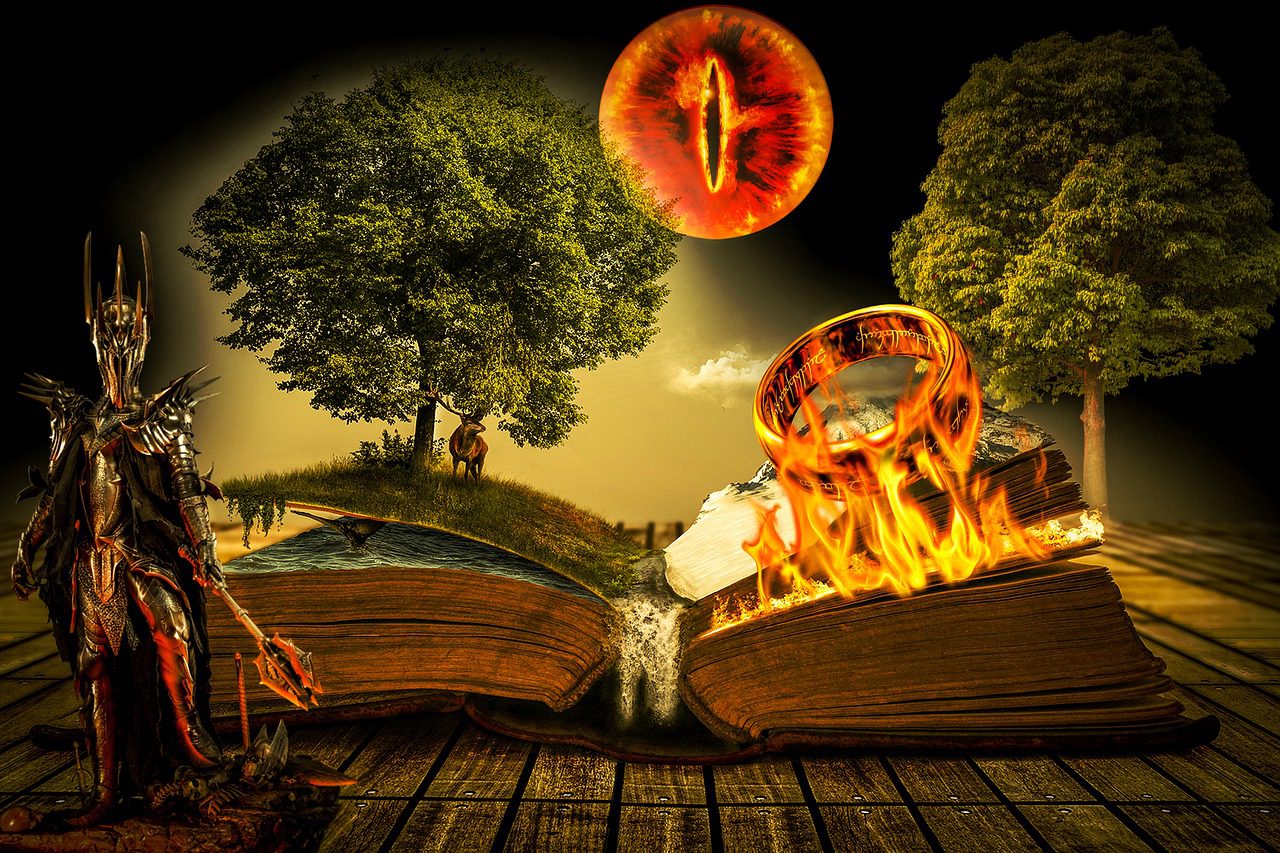
The featured image is courtesy of Pixabay.





After those stinky Hobbit movies, why did the Tolkien Estate agree to this?
While I agree that Amazon’s Lord of the Rings series is likely to be dreadful, I cannot agree with Mr. Collins that The Silmarilion is merely “an interesting resource for obsessives and completists.” Like Tolkien, I much prefer history “true or feigned” and the Simarillion provides that in abundance – as well as many compelling characters – in spite of Mr. Collins assertion to the contrary. But I suppose he means characters of the more modern and less mythical sort, so no matter. And yet in a way he is right – The Caine Mutiny is a better story than War and Remembrance and Tolkien’s story-telling skill may be on better display in The Lord of the Rings than in The Silmarillion, but his myth-making skill is – in my opinion – the foundational quality that undergirds all his work and makes it so special, so engaging – giving the reader a palpable feeling of reality.
I agree about The Silmarillion. I almost enjoy it more than The Lord of the Rings. It reads like a Norse saga or The Kalevala (which I grew up on). Of course, it is not for everyone, and some characters are more like archetypes than actual people, but it’s a good read all the same!
I think it’s a serious error to claim the Silmarillion has no compelling characters. Even though their stories might not have been fleshed out fully by Tolkien before he died, characters like Feanor, Beren, Luthien and Turin are as interesting as any in the Hobbit or the Lord of the Rings.
I imagine that like with most film adaptions of good literature the adaption will fail because the screenwriters do not fully understand, appreciate, and respect the source material.
I agree with both sides: the article and the comments. Let’s just say my wife won’t enjoy the Amazon shows, but i might find them interesting.
I’m pretty sure Amazon won’t make bank on the shows – Lord of the Rings, this is not…
A high fantasy TV show based on Tolkien’s Elven legends iin The Silmarillion could be amazing. It would take great writers and producers to pull it off though.
The Caine Mutiny is an interesting example. The movie is great, but if you removed the love story about the main character (who was really just a bystander to the events of the film) no one would notice. Bogart himself said the film was weakened by the “crappy love story” which had nothing to do with the plot.
“No amount of money can transform Tolkien’s overstuffed imaginarium into compelling television. The source material is simply impervious to the conventions of good storytelling.”…..perhaps an imaginative conservative can…..
The Silmarillion is indeed dense, but much of the writing compelling as are many of the stories. I found having the stories read to me through recorded books my break through. Hobbits aren’t the only interesting characters and the opportunity to tell a compelling story about good and evil is probably too hard to resist. Jackson’s films give us hope, but the dollars involved have likely doomed this project.