
Ludwig van Beethoven’s Variations on “God save the King” and Variations on “Rule Britannia” for piano were published in 1803. Pianist Angela Hewitt remarks:
Concerning the 7 Variations on ‘God save the King’, WoO78, Beethoven made the comment that he wanted to ‘show the English what a blessing they have’ with that tune…. It makes a great theme for variations, and Beethoven has a lot of fun with it. If ever you needed proof of humour in his music, here it is.
Of the Variations on “God Save the King,” musicologist Norman Lebrecht notes,
Despite the rich revenues it generated for publishers, the popularity of Beethoven’s composition faded and is missed the cut for inclusion in the final catalogue of his works, hence the WithoutOpus number attached. In modern times it is seldom performed in major halls and has been commercially recorded no more than two dozen times, which I find a little surprising. Most of the extant recordings are by pianists of little renown.
And of the Variations on “Rule Britannia,” Mr. Lebrecht says:
This rousing exhortation was first heard in Alfred, a masque by Thomas Arne about Alfred the Great, the king who burned the cakes. It was performed to celebrate the accession of George II, with the aim of underlining this German ruler’s patriotic credentials, and it obtained popular appeal in 1745, at the same time as God Save the King was established as the national hymn. Beethoven found it musically less fertile and wrote half-length variations, although the tune returned to him unprompted with he was composing his Piano Sonata No. 24, Op. 78, “À Thérèse”. You will find it there in the second movement.
Enjoy!
The Imaginative Conservative applies the principle of appreciation to the discussion of culture and politics—we approach dialogue with magnanimity rather than with mere civility. Will you help us remain a refreshing oasis in the increasingly contentious arena of modern discourse? Please consider donating now.
We hope you will join us in The Imaginative Conservative community. The Imaginative Conservative is an online journal for those who seek the True, the Good and the Beautiful. We address culture, liberal learning, politics, political economy, literature, the arts, and the American Republic in the tradition of Russell Kirk, T.S. Eliot, Edmund Burke, Irving Babbitt, Wilhelm Roepke, Robert Nisbet, Richard Weaver, M.E. Bradford, Eric Voegelin, Christopher Dawson, Paul Elmer More, and other leaders of Imaginative Conservatism. Some conservatives may look at the state of Western culture and the American Republic and see a huge dark cloud which seems ready to unleash a storm that may well wash away what we most treasure of our inherited ways. Others focus on the silver lining which may be found in the next generation of traditional conservatives who have been inspired by Dr. Kirk and his like. We hope that The Imaginative Conservative answers T.S. Eliot’s call to “redeem the time, redeem the dream.” The Imaginative Conservative offers to our families, our communities, and the Republic, a conservatism of hope, grace, charity, gratitude, and prayer.
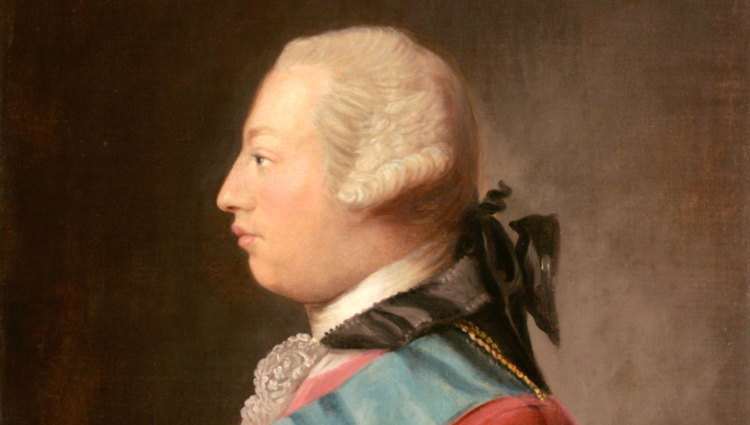
The featured image (detail) is a portrait of George III of the United Kingdom (1762) by Allan Ramsay, and is in the public domain, courtesy of Wikimedia Commons.




When I play that last variation on God Save the King, I get up from the piano feeling so good, like I just conquered the world!