
As with many other charges brought against him, the claim that Shakespeare was somehow prejudiced against women is quite frankly absurd. A quick look at the Bard’s portrayal of the feminine half of the species will suffice to clear his name. Here I will look at the weak and the wicked among Shakespeare’s women.
 Shakespeare abuse is as popular in the third millennium as racial abuse was in the Third Reich. It’s almost a requirement if one is to make the grade in the academy and is a necessity if one wants to make the cast of one of the iconoclastic (post)modern productions of his plays.
You name it and Shakespeare has been accused of it. Racism. Anti-Semitism. Imperialism. Fascism. “Gender insensitivity”. And, of course, sexism. We mustn’t forget sexism. In addition to all the other accusations heaped on the Bard’s hapless head is the charge of misogyny. He has a male chauvinist attitude towards women.
As with the other aforementioned charges brought against him, the claim that Shakespeare was somehow prejudiced against women is quite frankly absurd. A quick look at the Bard’s portrayal of the feminine half of the species will suffice to clear his name.
Broadly speaking, Shakespeare’s women fall into three categories. There are the weak, the wicked and the saints.
We’ll begin with the weak.
Juliet has the weakness of a child who is ill-prepared for the passions and temptations of the adult world. To make matters worse und ultimately disastrous, she is unprotected from such passions and temptations through parental neglect and abuse. Shakespeare accentuates her innocence and vulnerability by making her only thirteen-years-old, a mere child, the same age as was his own daughter Susanna at the time he was writing the play.
Ophelia’s weakness is evident in her willingness to act against her conscience, serving as the bait that her father uses in an effort to trap Hamlet, her beloved. She becomes a reluctant pawn in her father’s Machiavellian machinations, betraying the man she loves at her wicked father’s behest. It is clear that Hamlet is aware of this fact, which explains his anger. The fact that she is pretending to be piously reading a prayer book when Hamlet arrives, at her father’s cynical suggestion, would have added insult to Hamlet’s injury. Perceiving her role in her father’s schemes, Hamlet reacts with rage: “Get thee to a nunnery!” Her only hope is to escape from the worldly wickedness of King Claudius’ court and her father’s scheming on the king’s behalf. In the event, the combination of her estrangement from Hamlet, coupled with Hamlet’s killing of her father, causes her to lose her mind to the madness that leads to her death. The weakness of her will is, therefore, made manifest in the subsequent weakness of her mind.
The tragedy surrounding the deaths of Juliet and Ophelia is connected to the callous neglect of their respective fathers. In the case of Desdemona, however, the opposite is true. She deserts her loving father to pursue an ill-advised marriage with the jealous and abusive Othello. Her weakness is made manifest in her willingness to believe Othello’s tall tales of his heroism in foreign lands, being swept off her feet by his ostentatious show of gallantry, and is accentuated by her flirtatious pursuit of the handsome hero. “These violent delights have violent ends,” says Friar Laurence in Romeo and Juliet. As with the “star-cross’d lovers” in that other play, Ophelia is too rash and reckless to heed the voice of temperance or the cautionary words of prudence.
If the tragic figures of Juliet, Ophelia and Desdemona seem to prove the truth of Hamlet’s claim that “frailty, thy name is woman”, other women in Shakespeare’s plays show a deadly and overpowering strength, the femme formidable becoming the femme fatale.
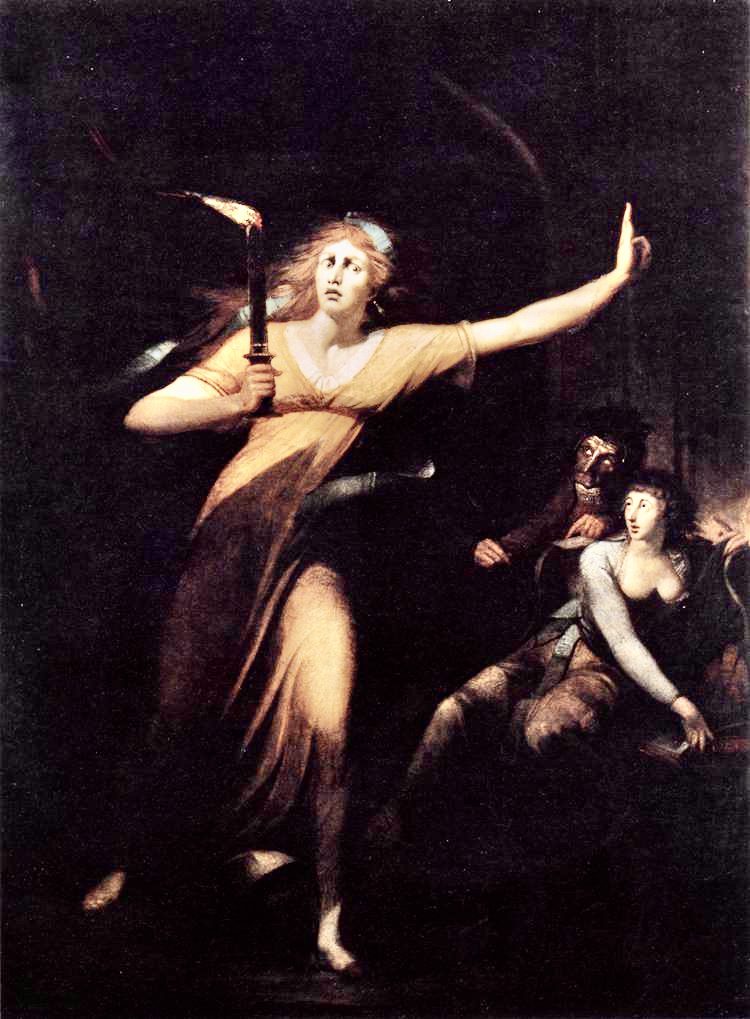
Perhaps the most famous or infamous of Shakespeare’s wicked women is the indomitable Lady Macbeth. She is so wicked that she almost serves as a female diabolus. As the devil might be said to be the anti-Christ, so Lady Macbeth is the anti-Virgin. Nowhere is this more evident than in her boastful claim that she would crush the brains of her own nursing children in order to pursue her ambitious lust for power. The applicability to our own deplorable times is all too evident. Self-empowerment and partial birth abortion go hand in surgical glove.
Although Lady Macbeth’s domineering presence overpowers her husband’s reservations with respect to their murderous scheme, she is ultimately shown to be weaker and therefore less wicked than her husband in the sense that she cannot entirely banish the still small voice of conscience. In the end, it is this niggling nagging presence that drives her mad.
Two of King Lear’s three daughters, Regan and Goneril, rival Lady Macbeth with respect to the wicked lengths they are prepared to go to further their quest for self-empowerment. As with Lady Macbeth, they discover, too late, that the manic pursuit of self-empowerment is self-destructive.
And then there is Cleopatra, the ultimate femme fatale, not only on Shakespeare’s stage but on that other stage which is the drama of human history. Antony and Cleopatra follow exactly the same self-destructive path as the ”star-cross’d lovers” Romeo and Juliet but they are far worse because they do not have the excuse of youthful naiveté and the youthful folly that is all too often its consequence. Antony and Cleopatra have no such excuse. They are both well-seasoned in life and “love” but they fail to allow their experience to season their recklessness. They know that their lust for each other will cause all hell to break loose but they are happy to let everything, including themselves, to go to hell.
As Lady Macbeth would dash the brains of the nursing children at her breast, Cleopatra takes the serpent and places it on her breast. “Peace, peace!” she exclaims at the moment of self-slaughter. “Dost thou not see my baby at my breast, that sucks the nurse asleep?”
Shakespeare shows us in his depiction of these wicked women that wickedness is the greatest weakness of all. Its kiss is a curse, which is as deadly as the poison that passes from the lips of Romeo to Juliet at their first fatal meeting; or as deadly as the kiss of the serpent at Cleopatra’s despairing breast.
Ultimately, however, Shakespeare is not showing us the fullness of femininity in his depiction of these seven deadly sinners, Juliet, Ophelia, Desdemona, Lady Macbeth, Regan, Goneril and Cleopatra. He is not even showing us the half of it; or, if he is showing us the half of it, he is not showing us the better half of it. If we look beyond the gutter to the stars and to the heaven beyond the stars, we will see what Shakespeare sees. We will see beyond femininity’s dark underbelly to its glorious call to holiness. Next week, we will admire those of Shakespeare’s women who answer this call. We will join him in the singing of a song of praise to the heroines who are also saints.
The Imaginative Conservative applies the principle of appreciation to the discussion of culture and politics—we approach dialogue with magnanimity rather than with mere civility. Will you help us remain a refreshing oasis in the increasingly contentious arena of modern discourse? Please consider donating now.
The featured image is “The Sleepwalking Lady Macbeth” (1784) by Johann Heinrich Füssli, and is in the public domain, courtesy of Wikimedia Commons.




” femininity’s dark underbelly”. There’s a conversation for you.
There is another evil female character in the Shakespeare’s plays Tamora the goth in Titus Andronicus, other might be the Cymbeline’s Wife, other could be the wife of Henry VI.
Desdemona is my favorite woman in a Shakespeare tragedy. She’s so perfectly written! I’ve seen some productions that are completely wrong about her. Othello too. She’s too innocent to see the danger she’s in, and he’s too afraid that he’s made a mistake to see that he’s being lied to. My favorite Shakespeare play by far.
“Since Shakespeare had such equally evil men in his works, I can only conclude that he was the world’s worst misogynistic feminists to have ever walked this earth.”
~source: quote by one of the few remaining equal opportunity Ivy League academics
What about the absent women, ie the mothers! Where are they? Midsummer night, tempest, merchant of venice, etc.
See today’s essay.
That Shakespeare’s women are not all alike is certainly true, but I would argue that his treatment has more to do with identifying an alternative to selfish, self absorbed behavior that he would call sin. His women, like his men, can choose to satisfy their own desires or they can choose to live a life of sacrificial love for another, remaining faithful even through trials. The 116th sonnet is a useful definition of Shakespeare’s conception of that kind of love, and it’s his women, not his men, that abide by that definition.
A very interesting look at some of Shakespeare’s most prominent women. It seems too me that any discussion of this type is incomplete if it does not include Katherina from “Taming of the Shrew” the one play in ALL the canon that tackles the topic of misogyny and the female experience and perspective..
I have really enjoyed your two essays on Shakespeare’s women. They sum up the wonderful insights of this great man. I would urge you to be open to the actual man behind the mask, Edward de Vere. Not the official candidate whose daughter, Susannah, was not ever taught to read, but the extraordinarily complex individual discovered by Thomas Looney and written about by so many scholars. Here is a man whose plays reflect his biography and his suffering makes him both great and good.