
That the Holy Family were homeless on that chilly December night is part of the received Nativity narrative. The image of the poor mother and child, and the panicked father seeking an emergency delivery room appeals to the parenting instincts in all of us. But is the story true?
Having received some pushback in these columns for my Grinch-like defenestration of the Little Drummer Boy, I must continue my de-mythologization of Christmas by examining the delightful addition of the grumpy innkeeper of Bethlehem to the cast of the traditional Christmas play.
I should add that I am, by no means, wishing to put a damper on Christmas. Adding charming details to the Christmas story has been a tradition itself since the second century. The accretions are a happy part of the season and I don’t wish to throw them out anymore than I wish to ban tinsel from the tree. However, I believe Christmas is enhanced by understanding the true historical detail as much as possible.
Why is this important? Because the magical and mythical elements of Christmas can weigh down the story to such an extent that it becomes all too easy for the whole story of Christ’s nativity to be written off as no more than a charming fairy tale, a pleasant parable or a meaningful message.
This contributes to the modernist’s inclination to then dismiss the entire Gospel narrative as a fictionalized and fabulous confection of the early church—no more than a Jewish story dressed in the costume of a Greek myth, the tale of of a wandering Jewish country preacher who became a martyred hero before he got promoted (like a Roman aristocrat) to Son of God status.
In other words, while the elaborations and Christmas customs are lovely, inspirational, and frequently personally moving, the history matters.
One of the developments of the story which has added extra meaning and poignancy is the tradition that the Holy Family were homeless people—political refugees even.
That the Holy Family were homeless on that chilly December night is part of the received Nativity narrative. The image of the poor mother and child, and the panicked father seeking an emergency delivery room appeals to the parenting instincts in all of us, and in an age in which compassion for the homeless, the refugee, and the disenfranchised is a top agenda item for caring Christians, the homeless holy family fulfills the need for a pious preaching point at Christmas.
The assumption that the Holy Family was homeless seems to have ancient roots. The early-second-century Protoevangelium of James was the first of many non-canonical infancy narratives that attempted to flesh out the bare bones of St. Matthew’s and St Luke’s stories of Christ’s birth.
The author of the Protoevangelium conflates St. Luke’s and St. Matthew’s accounts and adds extra elements that may well have originated from the early apostolic traditions of the Jerusalem church. Here we are told the story of the conception and birth of the Virgin Mary, her presentation in the temple, and her betrothal to St Joseph.
The Annunciation story is re-told as is St. Luke’s account of the journey to Bethlehem. It is here that the homelessness of the Holy Family first appears, for the author of the Protoevangelium tells us not only that Mary was riding a donkey, but that while they were on their way, she suddenly had to give birth, and that Joseph, who was accompanied by his son (supporting the tradition that St. Joseph was an older widower with children from a first marriage), found a cave in which she might deliver the child.
Where then is the Bethlehem inn with the “no vacancy” sign? Where the lovable curmudgeonly innkeeper who ushers them to the outbuildings? Alas, there is no inn, and neither is there the customary “lowly cattle stall.” The older tradition is that Christ was born in a cave. Not only is this the detail in The Protoevangelium, but Justin Martyr and Origen also writing in the second/third centuries affirm the birthplace as a cave.
So was it a stable or a cave? In fact it was both, for in the ancient Middle East the villagers’ homes were often built in front of caves where they stabled their animals. The combination of farmhouse and stable is well known, not only in the Middle East, but in older communities in Europe.
When visiting Switzerland I remember seeing old Swiss farmhouses—half of which was family dwelling, half the barn. Likewise, when visiting Palestine today one can still see Bedouin tents or simple two-room houses standing in front of hillside caves that are used for storage or stabling.
Kenneth Bailey lived and worked in the Holy Land for decades. In his book Jesus Through Middle Eastern Eyes, he explains the layout of a typical home in Palestine in Jesus’ time. It would have been a single room built in front of a cave. Most often there would have been an extra room used as a “prophet’s room” or guest room. This extra room was built on the flat roof or as an extension to the basic single-room accommodation.
The Greek word kataluma is the word usually translated in St Luke’s gospel as “inn”. However, this word is more often used to refer to an extra room in a house. For example, it is used later in the gospel to refer to the Upper Room where the Last Supper is held. (Lk.22:11) The word pandocheion is a more common Greek word for public hostelry or inn. Kenneth Bailey observes, “If Luke expected his readers to think Joseph was turned away from an “inn” he would have used the word pandocheion, which clearly meant a commercial inn.”[1]
Considering the Middle Eastern tradition of hospitality to travelers—and especially their strong family loyalties, it is unthinkable that Joseph and his young wife would have been homeless in Bethlehem on Christmas night. It is more likely that they arrived at the home of a relative to find that the guest room (kataluma) was already occupied so they were given the next best place—the warm and cozy stable cave situated behind the family’s main dwelling place.
And what about the manger bed? The Palestinian homes with a stable/cave annexe usually had a stone half-wall between the stable-cave and the main room. Carved into the top of the stone half-wall was the feeding trough for the animals. This would have made a perfect cradle for the child—a place for him in the center of the home of his extended family. Thus English Bible scholar R.T. France concludes, “Jesus was not born in social exclusion, nor in any more squalid a setting than most people regarded as normal living conditions. Not in a cold, droughty, unwelcoming ‘stable’ but in a warm, if rather crowded, family home. His cradle was unconventional, but not uncomfortable.”[2]
Fr. Longenecker’s most recent book The Secret of the Bethlehem Shepherds is published by Sophia Institute Press.
[1] Kenneth Bailey, Jesus Through Middle Eastern Eyes, IVP Academic, Downers Grove, IL, 2008, p.32
[2] R.T. France, The Birth of Jesus, in Handbook for the Study of the Historical Jesus, v. 3, Brill, Boston, 2011.p.2375.
The Imaginative Conservative applies the principle of appreciation to the discussion of culture and politics—we approach dialogue with magnanimity rather than with mere civility. Will you help us remain a refreshing oasis in the increasingly contentious arena of modern discourse? Please consider donating now.
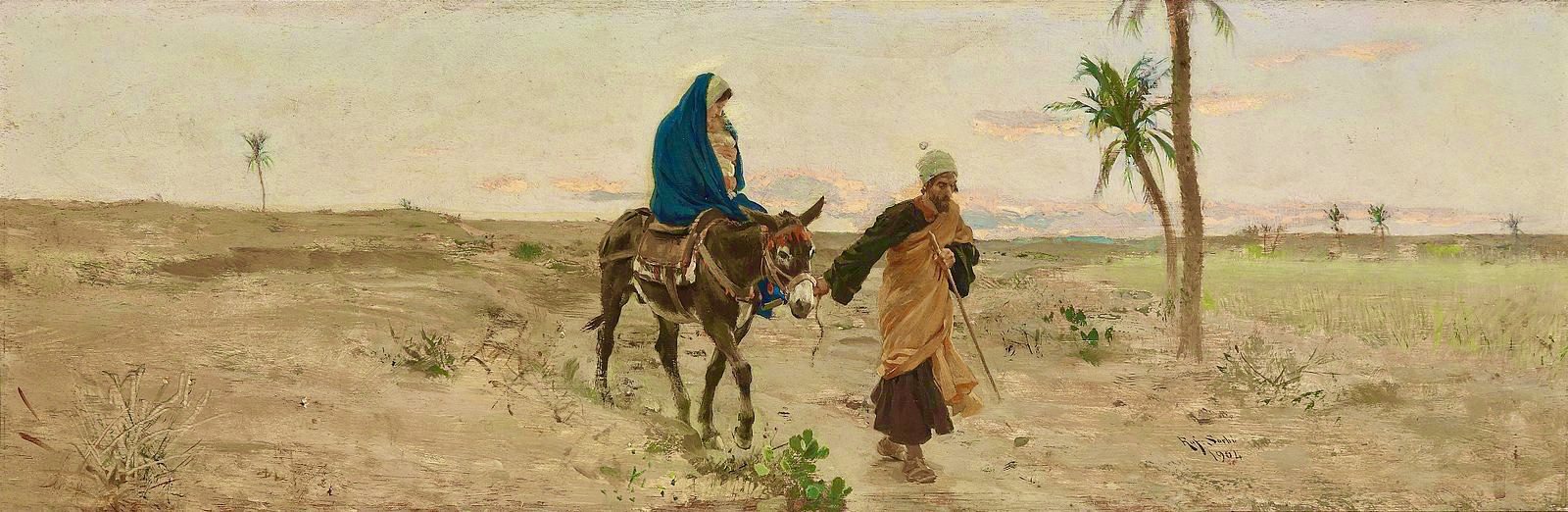
The featured image is “The Flight into Egypt” (1904) by Raffaello Sorbi, and is in the public domain, courtesy of Wikimedia Commons.


This is really informative and turns around some of the sentimental assumptions about the Nativity. Many thanks, Fr. L.
Very interesting. What about angels appearing to the shepherds to herald Christ’s birth, singing ” Venite Adoremus”, and “Peace on earth. Good will to men.”? Serious question.
Steve, I am not sure what you are asking. Are you questioning whether angels really did appear? I believe they did, but I also think the perception of the angelic appearance probably morphed in the re-telling of the tale as various members of the audience attempted to imagine what it was like. Similarly, the artistic representations of a sky thronged with winged beings playing harps is not likely to be an accurate representation.
Fr. You now have (at least) one more onion to peel back for us. Who were the Magi?
I must refer you to my book The Mystery of the Magi…https://dwightlongenecker.com/shop/the-mystery-of-the-magi/
Thank -you for responding to my question. I’ll try to be clearer. Luke 2:13 “and suddenly there was with the angel a multitude of the heavenly host praising God and saying Peace on earth good will to men”. The image I have of angels singing at the nativity connects me to God. From that moment, whether angels are still singing, men have been ceaselessly. As one example, “A Christmas Carol” by Charles Ives is, to me, sublime. The experience of singing or just hearing that song connects me to God. It disturbs me to think that I can’t trust all that. That it’s all just a mirage.
I’m afraid I don’t see what you’re getting at. The angels appeared to the shepherds. They experienced the apparition within their own cultural and mental context. When they related the story the people who heard it processed the story furnishing their own mental images of what it must have been like. You have done the same thing two thousand years later. I’m not saying the angelic apparition was a mirage or a figment of their imagination, only that their supernatural experience and our visualization of it cannot be the same. I hope that helps.
Aha! A stripping away of the sentimentality. I like it! It makes Jesus and his birth even more real. But, I admit, I like the sentimentality just a little bit, too, and now I can separate the sentimentality from the truth. Very good. Thank you!
Thank-you. That is helpful. I enjoyed the insights you shared on the the place of Jesus’ birth, too.
I’m just now reading The Life of Mary as seen By the Mystics compiled by Raphael Brown. While we don’t have to believe in private revelation these are credible sources and give us some perspective on the Nativity narratives. You may enjoy this book.