
“Those days have come and gone,” says Indiana Jones at one point in the newly-released film, “Indiana Jones and the Dial of Destiny.” And they sure have, for our hero has been emasculated on the altar of political correctness in this film, with an immoral, money-grubbing, narcissistic, feminist character usurping his place.
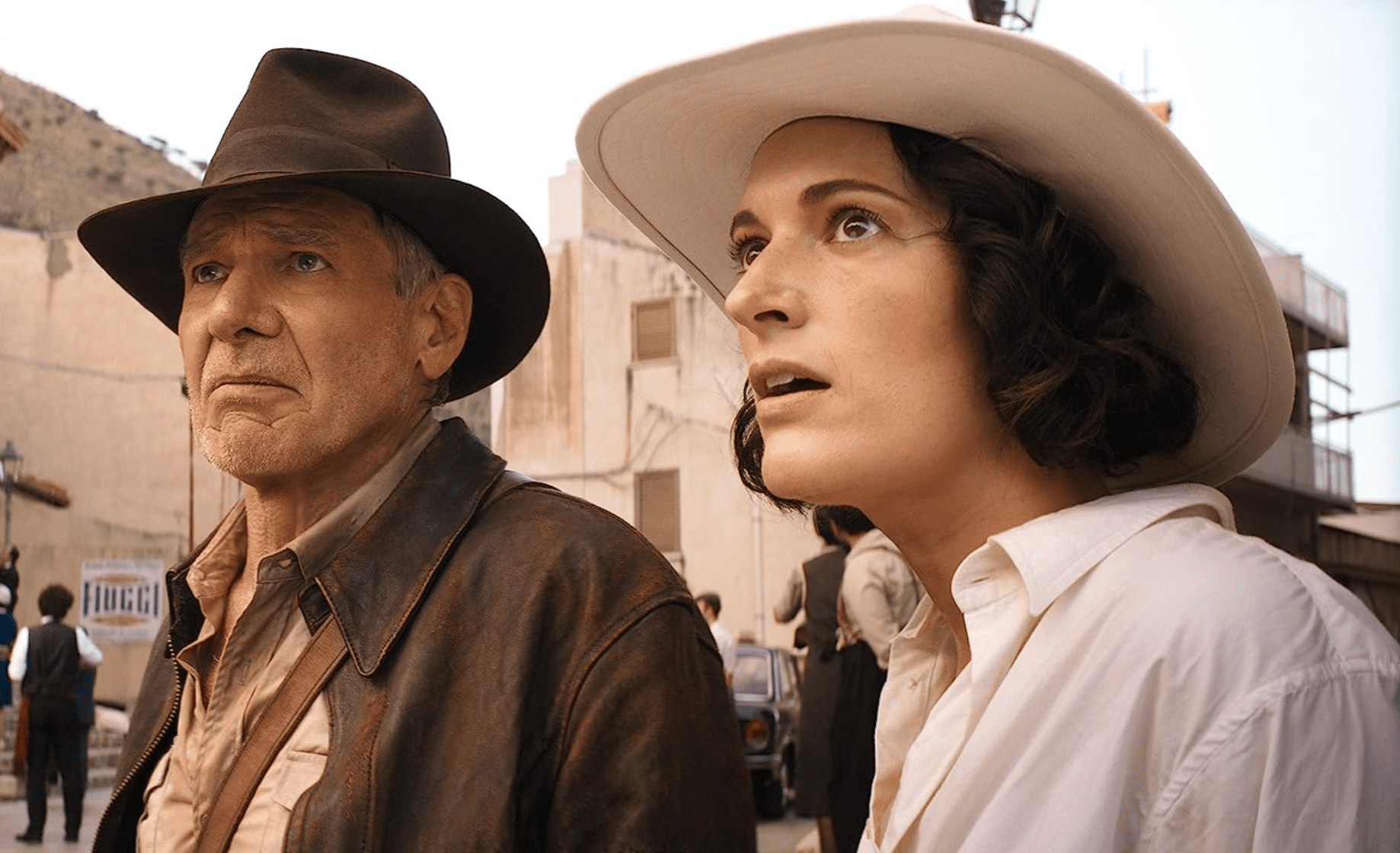 “Those days have come and gone,” says Indiana Jones (Harrison Ford) at one point in the newly-released Indiana Jones and the Dial of Destiny. And they sure have. There was no need, no demand for a fifth Indiana Jones movie. Indeed, there was little need or demand for 2008’s Indiana Jones and the Kingdom of the Crystal Skull. After all, Indy had literally ridden off into the sunset at the end of 1989’s Indiana Jones and the Last Crusade, the scene and title suggesting that the trilogy of films, which began with 1981’s Raiders of the Lost Ark and continued with 1984’s Indiana Jones and the Temple of Doom, had come to a fitting conclusion.
But at least Crystal Skull had the brilliant Steven Spielberg as its director, as well the creator of the eponymous character, George Lucas, as producer and storywriter. This time around, Spielberg and Lucas are hardly involved, with Director James Mangold heading a team of writers who have created a feeble story full of plot-holes and tropes, involving time travel via the ancient Greek philosopher Archimedes’ amazing invention, the Antikythera mechanism, a sort of astronomical clock—the “Dial of Destiny” of the film’s name. Drawing on the plots of the first four films, Indy must keep the so-called MacGuffin out of the hands of the bad guys.
Though the movie is primarily set in 1969, Mangold begins the film with a flashback to 1944, when Indy and his archaeologist friend, Basil Shaw are trying to stop the Nazis from hauling away a trainload of historical artifacts. In this 20-minute sequence, the director has employed de-aging technology to make Ford look like the 30/40-something-year-old Indy of the original trilogy. It is generally well-done, though Ford’s old-man voice is not always perfectly synced to his lip movements when he speaks. Too, at times one can tell that Indy’s body is that of an 80-year-old man with a young head attached, in other moments that the body is that of a stunt double; Ford is/was an amazing physical actor, whose distinctive body movements—along with his facial expressions—are/were a key to his portrayal of Indiana Jones.
Mangold cuts from the end of the train sequence to a dumpy New York City apartment, where the Indy of 1969 has fallen asleep in his boxers while watching television. He’s a cranky, disheveled, old man now, the glint gone from his eye and the spring from his step. His son has died in Vietnam, his wife has separated from him as a result of their shared grief. Still a professor of archaeology, his students—who once adored him, as we saw in Raiders and Last Crusade—are now bored by him. We are (mis)treated to a lame retirement party thrown by his colleagues… depressing, but thankfully brief.
It simply must be said that it’s no fun to look at the eighty-year-old Harrison Ford—at least not in an action role, for which he is no longer suited. It’s akin to watching one’s favorite baseball player from the 1980s take the field with his modern-day team and try to hit and field with young players. It’s just ridiculous and depressing. We want to remember our heroes in their heyday, or something close to it. Lucas originally described the character of Indiana Jones as an athlete just past his prime. This was a brilliant choice, and it added to the characterization of the archaeologist-adventurer as someone who was strong and agile but who was not a superman, prone to the occasional misjudgment in planning and prowess, and who could be bested by enemies who were clearly physically superior; the immense, bald German mechanic of Raiders being a perfect example. “I’m making this up as I go,” Indy famously said in Raiders.
But now Indy is barely better than helpless. Disillusioned, fragile, and flummoxed, he is also shown in one scene to be afraid of large bugs. Yet a staple of the character of Indiana Jones is his famously being afraid only of snakes! His weakness is emphasized by the the character of Helena Shaw (Phoebe Waller-Bridge), Indy’s goddaughter and daughter of his friend Basil. A youngish brunette, British woman—one in a line of such characters created by Disney executive and feminist Kathleen Kennedy so that she can apparently live vicariously in movies that she produces—Helena is completely unlikable. She is portrayed as an immoral thief, money-grubber, narcissist, and sex addict, who constantly puts her godfather down as an old, out-of-touch has-been. Some of the terrible old-age jokes don’t even make sense: “I like the hat,” Helena says to Indy at one point. “It makes you look at least two years younger.” This, despite the fact that we were earlier treated to a scene of the child Helena lovingly bringing Indy the same hat, which he had forgotten as he got in his car to leave her father’s house.
Yes, Dial of Destiny is yet another film that Hollywood can use to spread the message that old white men are over-the-hill bunglers who need the direction of enlightened, feminist women. In her destruction of Indy as a heroic character, Helena is joined by a partner in crime, the young teenage Egyptian boy, Teddy, who is so annoying and unlikable that when he is captured by the Nazis and Helena worries to Indy that he might be killed, we the audience actually hope so.
To bring home the point that Helena is the real hero of the movie, Mangold has the bad guys shoot Indy during the film’s final sequence, and and he lies injured and mostly helpless for the last 25 minutes or so of the film. It is rumored that Waller-Bridge’s role was designed to be even larger in the film, with her perhaps even taking over the role of Indy somehow, until elements of the script leaked out, and internet backlash forced at least some toning-down of the movie’s feminism. Yet what remains is bad enough. Violating one of the essential ingredients of the action movie, it is not the presumed main character who kills the main villain, but—you guessed it—the female (co-?)star, a true Mary Sue.
Mads Mikkelsen as the chief Nazi, Jürgen Voller, is good, but in his wish to obtain the Dial so as to recreate Nazi Germany, he seems more deluded than threatening. And this despite director Mangold’s attempt to give him a couple of intimidating henchmen who shoot to death minor characters throughout the film. In another example of bad scriptwriting, these bad guys unrealistically show up at several points during the film to engage in yet another boring chase scene, all of which lack the panache and fine orchestration of the ones Spielberg crafted in the earlier movies.
Appearances of characters we know and love from previous films—Sallah (John Rhys-Davies) and Marion (Karen Allen)—fail to generate feelings of warm nostalgia but simply serve to depress us even more. These great actors are now depressingly old and frail. Sallah has gone from living with his large family in a sprawling, sunlit home in Cairo, as we see in Raiders, to living in another dingy New York apartment. And Marion is no longer the feisty, hard-drinking owner of a bar in the rough mountains of Nepal, but a quiet senior citizen bringing in groceries to Indy’s dank apartment. Again, this is not how we want to remember such beloved characters.
Cinematography is also a problem in Dial of Destiny. Many of the scenes—the opening Nazi train sequence, the pointless underwater diving scene, the underground search for Archimedes’ tomb—are so strangely dark that it is difficult to see what is happening. Was this odd choice a reaction to Crystal Skull‘s overly bright cinematography? Even the great film composer John Williams apparently isn’t inspired enough to do his best here, notably re-using several musical cues (beyond the famous “Raiders March” and other themes, I mean). Notably, the newly-written “Helena’s Theme” is much ado about nothing, like her character.
One last note: This is the first Indiana Jones movie in which Indy never has a gun holstered on his belt—either his Smith & Wesson or his Webley revolver. What more telling indication could there be that the main hero of the series has been emasculated on the altar of political correctness?
Rest in peace, Indiana Jones.
The Imaginative Conservative applies the principle of appreciation to the discussion of culture and politics as we approach dialogue with magnanimity rather than with mere civility. Will you help us remain a refreshing oasis in the increasingly contentious arena of modern discourse? Please consider donating now.
The featured image is courtesy of IMDb.




While i still found moments of enjoyment in this film…this article is spot on. 100% truth. The more i thought about The Flash i realized how much i enjoyed it (and how it DOES NOT deserve it’s box office failure) and the more i thought about Dial of Destiny the more depressed i became. In 1989 the two biggest films of the year were Batman and ‘the Last Crusade…and here we are all these summers later and they’re the two biggest flops. Times hace changed, but not for the better. Sad time indeed. RIP nostalgia and the good days of old.
Dungeons and Dragons has been the only winner this year.
O tempora! O mores! Say it ain’t so!
Regardless of all the somewhat ‘usual’ action we have come to expect, whether it impressed you this go around or not, I was moved by the attention to Indiana’s underlying pain concerning the loss of his son and his separation from his wife, Marian. He asks in the end who would he being going back to his old life for, and they gave us a beautiful scene between these two people, who realized they cannot live without each other. I thought this, at least, was a much stronger conclusion to this series than Indiana’s riding into the sunset on his horse.
Harrison Ford IS Indiana Jones — attempts at replacement can only fail. If they try, the enemy has to change — a lot of Nazi’s have been killed in the making of these films. How about dealing with the current-day enemy — the CCP!
Do we really want the Indiana Jones series to be about the “pain” of his character? I think we want action. “Last Crusade” and “Crystal Skull” touched on such emotional family issues… perhaps too much so. “Raiders of the Lost Ark,” a perfect movie, was perfect in this sense too, with just a dash of emotion in regard to Indy and Marion’s previous relationship, and yet with no hint that it is the hero who is crying inside (shudder).
This must be the most accurate review of the movie I’ve seen. I wish more could see things in this type of critical view and that Kathleen would’ve stepped off her high stool before massacring the remains of a once glorious franchise.
Appreciated this excellent review. The time spent reading it pales in comparison to the time I’ve saved not seeing the movie.
In the previous Spielberg did not know to take the chance the communist. I can believe in the ark, the Shankara’s stones, the saint grail but not in the aliens. When you destroy to your heros it is a signal that the movie is horrible. It is horrible as the female character hit a poor old Man. If this is feminism i reject totally. I had liked other villain the nazis are very exploted a group od islamic terrorists, satanists other thing. This movie it is not Odessa.
While I appreciate the criticisms, I disagree on some aspects. I’ve seen the film twice, and I believe that by the end of the movie Helena Shaw has seen the pitfalls of acting in the way she did in the lead-up to the film and during the events of the film itself. Additionally, we in the audience (or at least my perspective) appreciate and recognize that Indy is the protagonist and the film, and the story is from his point of view. With this in mind, Helena is a foil to Indy and is able to learn from him. Again from the audience’s perspective, this would indicate that we are supposed to see Helena as over the top with her actions.
Even so, I did understand and respect your thoughts on Indy not carrying a revolver. He was a Boy Scout (and from what I can find an Eagle Scout). He should have been prepared!
Thanks,
Samuel
Thank you for this very civil comment and incisive critique of my review.
Thank you for a clear review of another LucasFilms destruction of a once storied franchise. The overt movement to destroy anything traditional, noble, righteous, etc., unabashedly continues at Disney. Your review is spot on; of course, you could write many more pieces about so much more that was wrong in the movie.
I would like to add just a couple of observations, which you have probable already thought about:
(1) In the previous Indiana Jones’ movies, the MacGuffins (the Ark, Sankara stones, the Holy Grail) were each presented with a sense they possessed sentience (much like the “ring” in Tolkien’s saga), capable of rewarding those acting with purity of heart and punishing those acting with evil intent. In Dial of Destiny, the MacGuffin is nothing but a machine, which does not reward or punish – like the movie itself, it’s lifeless.
(2) In the struggle between reality and fiction, Samuel Taylor Coleridge believed we should indulge a “willing suspension of disbelief for the moment, which constitutes poetic faith.” Well, my mind can’t go that far when it comes to Phoebe Waller-Bridge as an action hero. She is a stick figure fashion model. Yet, the movie makers want us to believe she can jump (in heels) between building rooftops and has the strength in those spindly arms to whip any male opponent. Not believable by any measure of suspension in my mind. In contrast to PWB, I can’t help but think of the diminutive Linda Hamilton in Terminator 2, who we saw relentlessly working out in her cell to become buff. But when it was time to make a break for it, the slight Sarah Connor wisely used the element of surprise AND A CLUB to defeat a man twice her size. Believable.
Thanks again for your insightful review.
I think this is the last Indiana Jones movie at least have a good ending.
Yep that sums it up. Almost like most Hollywood movies, shows, and ads are intent on getting everyone to hate white males. Oy vey
Sad that Indy has fallen to such a low estate. I’m trying to erase this movie from my memory and retain the Indy of yesteryear. Anyway, I appreciate this excellent review. I’m happy to have my own opinion of the film validated.
Yes, the film was a corporate-committee-concocted slog. Dull to watch, a nearly null set. But I have a different take in Indiana and especially Harrison Ford. Every time he was on-screen, young or old, he made me smile. I am not a huge fan of any of the Indy movies except as popcorn accompaniment, but Ford always made them fun. In Dial D for Destiny, he carried the movie on his 80 year old shoulders, courageously displayed his aging body, complained crankily about the creaks in his cartilage, his wit withered and crotchety with age, and showed us that an old man who naturally spends much time thinking about death and loss can still find and kindle a few remaining sparks of willpower, cleverness, grit and charm, and build a bright blaze. There wasn’t much in the script for Ford to work with, but what joy to see him not only roar, but laugh and love and once again, against all odds, find his treasure in the end.