
 I don’t really care for C.S. Lewis’ Chronicles of Narnia. I sympathize with the allegory Lewis was trying to present throughout the series, but I felt that it was too overt in places, and took away from the overall narrative. To me, it was distracting.
But even though I didn’t personally enjoy the Chronicles of Narnia, I can still recognize that the books are a great literary achievement, and I can understand and appreciate other people’s love for them.
For many people today, however, this is an impossible task. We live in a relativistic society that believes “beauty is in the eye of the beholder,” and that canonizes people’s personal preferences and tastes. If you say something is “good,” it means that it’s “good to you,” and that’s all that can be said on the matter.
According to professor and author Anthony Esolen, being able to deem something good, even if you don’t care for it, is a mark of a society with objective standards. In a Facebook post the other day he wrote:
“One of the arguments I put forth in favor of the notion that aesthetic judgments are not merely arbitrary is that we often judge a work to be great, even when we don’t like it, or we judge a work to be merely middling, even though we like it a lot. That is, we recognize an excellence we do not relish, and usually consider it to be a deficiency in us, or we admit a weakness in ourselves or an affective inclination, and yet manage to keep it separate from our evaluation of what so inclines us.”
Esolen’s post is most likely (consciously or unconsciously) drawing upon a point made by Lewis in his book The Abolition of Man:
“Those who know the Tao [Lewis’ term for objective reality] can hold that to call children delightful or old men venerable is not simply to record a psychological fact about our own parental or filial emotions at the moment, but to recognize a quality which demands a certain response from us whether we make it or not. I myself do not enjoy the society of small children: because I speak from within the Tao I recognize this as a defect in myself — just as a man may have to recognize that he is tone deaf or colour blind. And because our approvals and disapprovals are thus recognitions of objective value or responses to an objective order, therefore emotional states can be in harmony with reason (when we feel liking for what ought to be approved) or out of harmony with reason (when we perceive that liking is due but cannot feel it). No emotion is, in itself, a judgement; in that sense all emotions and sentiments are alogical. But they can be reasonable or unreasonable as they conform to Reason or fail to conform.”
Lewis recognized that one should be able to enjoy the company of small children, even though he himself did not. He was able to acknowledge his lack of enjoyment as a fault in himself. (I expect some readers may bristle at this.)
I think the same logic should be applied to food and drink. Personally, though I have tried many times, I do not care for the taste of watermelon or pineapple. But I consider this a “defect” in myself; not something to be celebrated. I understand that most people find these fruits delicious, and do not think them crazy for doing so.
In his Facebook post, Esolen then asked his readers to name the artists, thinkers, and works they consider great, even though they don’t care for them. He also provided a list of his own that would fall into this category:
What works or artists or thinkers do you acknowledge as great, even though you don’t care for them? I don’t mean here that you DISAGREE with them. I mean instead that they don’t move you even when you do agree with them. They leave you cold. Sometimes I want to throw a brick at Mark Twain’s head, but he never leaves me cold.
Great, then, but I don’t like them — and I recognize my deficiency:
Walker Percy
Faust
Wagner
Hemingway
Citizen Kane
Dryden
Doctor Zhivago (the novel, not the movie; I love the movie)
The Four Quartets
Paul Claudel
Wuthering Heights
If pressed, I would include the following artists, thinkers, and works among those that I think deserve to be considered “great,” even though I’m not a big fan:
The Divine Comedy
Treasure Island
Little Women
The Secret Garden
The short stories of Flannery O’Connor
Mark Twain
Paul Cézanne
The fiction of G.K. Chesterton (for the same reason I don’t like Chronicles)
The Old Man and the Sea
Mary Poppins (the book, not the movie)
I’d be curious to hear your responses to Esolen’s question: What works or artists or thinkers do you acknowledge as great, even though you don’t care for them?
Republished with gracious permission from Intellectual Takeout (January 2024).
The Imaginative Conservative applies the principle of appreciation to the discussion of culture and politics—we approach dialogue with magnanimity rather than with mere civility. Will you help us remain a refreshing oasis in the increasingly contentious arena of modern discourse? Please consider donating now.
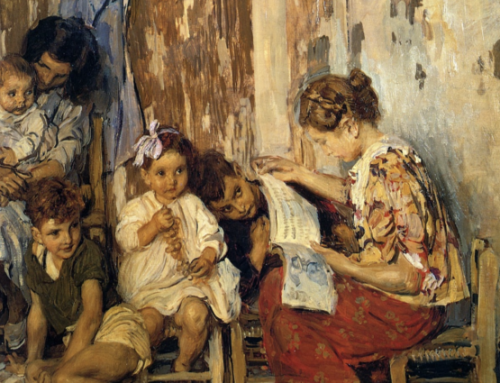
The featured image is ” A Reading Group” by Vladimir Makovsky, and is in the public domain, courtesy of Wikimedia Commons.




I’m so relieved to know that I’m not the only person who doesn’t like “The Chronicles of Narnia.” I read it twice, thinking maybe I missed something the first time around, but the second reading proved as fruitless as the first. I’d never dissuade anyone from reading it, but I simply don’t like it, and for the same reason Tolkien didn’t like it — Lewis “mixes mythologies.” Other “great works” I didn’t like include “The Grapes of Wrath,” “Ulysses,” most Beethoven, “The Power and the Glory,” the second half of “The Brothers Karamazov,” “A Farewell to Arms,” the Oz books (much as it pains me to admit it), as well as a number listed in the article. No one can like everything, I guess, even if one admits that the fault, dear Brutus, is in ourselves.
Wonderful article….have always thought Chesterton’s use of paradox and word-play to be a bit much, and long stretches of Dante leave me cold, though I agree with the animating spirit behind both of these authors, and would openly acknowledge their greatness.
I seem to have difficulty with Lewis, though “Out of the Silent Planet” was okay I guess.
And to be honest, even though I’m Catholic, many of the greats of Catholic literature didn’t entirely hit me. (Although I do in fact like the fiction of Chesterton, what I’ve read of it.) I’m not sure why but many great Catholic authors are kind of morose in a way that I can recognize is deep and meaningful, but does leave me a bit cold. Possibly this is why among Catholics writers I veer more toward Chesterton, who can be kind of goofy, and RA Lafferty who has a kind of zany off-kilter thing going.
I actually thought I’d be able to name many many things I think are great, but don’t work for me, yet I’m blanking a bit. Grapes of Wrath, mentioned above, is odd because my first response was it’s great and I liked it but I realize now I was thinking of the film. The book, oddly, did not work as well for me.
Reading Dante’s “Paradiso,” I just didn’t think the whole idea came off. I realize that coming from a mere pigmy like myself this comment means nothing, but there you have it.
More and more the Classical period of music (the Haydn-Mozart era) means less and less to me. Much of it (certainly not all) is redolent to me of that boring Enlightenment “reasonableness” and mediocrity of affect. The Baroque has so much more spiritual grandeur, and so does Beethoven. But the late 18th century doesn’t speak to me so much just now.
Speaking of “likes,” I don’t like essays that fail to nail down their points with specific examples. “Too overt in places”: too overt in which places? I have my own thoughts and, like most readers, will want to see if they jibe with the author’s. Then we can make better sense of the author’s claims. If in fact Lewis is being too heavy-handed in his allusions, does that hand tip the scales against greatness? The author, notwithstanding his talk of likes and dislikes, appears to be making an aesthetic judgment here.. He raises a good question, but curious readers will want to know more, and the assertions demand evidence, not merely opinion. The author is talking about more than superficial taste in style or his own aesthetic immaturity. An overly wooden, too didactic way with narrative would be a flaw to be reckoned with.