
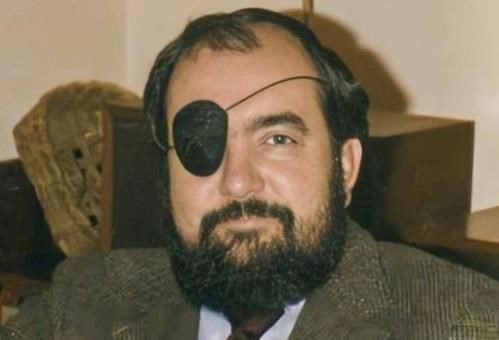
 I was deeply saddened to learn of the death of the greatest of “pirate scholars,” Donald S. Lutz. As it turns out, he had actually passed away back in January of this year, but I only found out about it a week or so ago. I’ve loved the man’s work for a long time, and I was trying to make sure that I owned everything he had published. I guess you could say I’m somewhat of a completist. I typed Lutz’s name into Hillsdale College Mossey Library’s search engine, and the tenth item listed was: “In Memoriam: Donald S. Lutz (1943–2024).”
At the moment, I’m writing a long (circa 100,000 words) book on the history of the Declaration of Independence to commemorate its 250th anniversary in 2026. Since signing the contract back in late May, I’ve completely immersed myself in all things Founding, Thomas Jefferson, 1776, and the Declaration. I even get to teach a course on the American Founding every other year at Hillsdale, and, as my students well know, I start with the work of Donald S. Lutz as my touchstone, my personal Founding fountainhead!
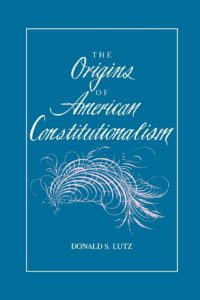 As it was, given that I had just re-read my favorite of his books, The Origins of American Constitutionalism, I was just about to email him to thank him for everything he had done for me. Crazily, that can never happen now, as Don has left us behind in this world of sorrows.
Of course, you may very well be wondering why I called him a pirate scholar in my opening sentence of this essay. Please believe me, this title has nothing to do with plagiarism. Donald S. Lutz was an original—in his person and in his scholarship. Indeed, he was always and everywhere his own man. Just like yours truly, Don was blind in one eye. Unlike I, however (my eye is a little wobbly, but, otherwise, I can pass as a two-eyed guy), Don proudly wore a pirate patch over his bad eye. He wore that patch everywhere, and, frankly, it defined his uniqueness as well as his proud personhood. Hence, he’s the greatest of pirate scholars! We even talked about how one of our greatest fears was losing sight in our one good eye. Most of you, thank the Good Lord, never have to worry about such a thing. As it should be.
Don and I had other things in common. We had both attended Catholic colleges—he, Georgetown University and I, the University of Notre Dame. It was a a friendly rivalry. We both had earned our Ph.Ds at Indiana University-Bloomington, he in political science and I in history. Again, a friendly rivalry.
Don was born in 1943, and, thus, 24 years older than I. For whatever reason, though, he took a liking to me and served as a critical mentor. So much so, that I would very proudly call myself a student of Don Lutz.
We met at Winston Elliott’s astounding seminars in the late 1990s and early 2000s. These seminars were run by Winston, manned by a number of academics, and given for teachers at any level. None of this was based on “how to teach” but always on “what to teach.” I don’t mean that we indoctrinated the teachers. Rather, we welcomed them as equals in the quest for all that is good, true, and beautiful. These seminars were some of the most important in my academic and intellectual formation, and I cherish those times like few others in my professional life. Through them, I not only got to know Winston, but also his lovely and brilliant wife, Barbara, John Willson, Michael Jordan, Gleaves Whitney, Don Lutz, Ross Lence, Ben Lockerd, Cicero Bruce, and other extraordinary scholars. We listened to each others’ lectures during the days and then ate, drank, and talked (sometimes seriously arguing) late into the night. (Probably the most intense debate ever was whether or not Miss Kitty from Gunsmoke was a prostitute.)
Again, for whatever reason, Don took it upon himself to mentor me. He came to all my lectures, and he critiqued (in a beautiful way) every one of them. He and I laughed about everything we had in common, but we also joked about our differences. Don was a die-hard Aristotelian, and I was, for what it’s worth, a rather devout Platonist. For whatever esoteric reason, we thought this was hilarious. Yeah, we were nerds, no doubt about it.
But, I also remember attending Don’s lectures. They were crazily brilliant. As in, overwhelmingly so. Whether he was talking about the significance of documents and covenants in the colonial period or whether he was lecturing on the philosophy of Eric Voegelin, I was utterly captivated. To this day, my own lecture on Eric Voegelin’s philosophy to my seminar on Christian Humanism proudly states, “lecture written by Donald S. Lutz and Bradley J. Birzer.” As I’ve grown older, I have had the privilege of going beyond Don’s original 50-minute lecture on Voegelin (not in an arrogant way, but simply in having continued to read Voegelin as I’ve aged), but my initial love and knowledge of the great Austrian political philosopher comes directly from Don.
So, regrets. I never really got to tell Don how much he meant to me. Somehow, though, I would guess he now knows it, being in the heavenly realm. But, to be sure, I could never write my book on the Declaration of Independence, without the spirit of Don hovering over it.
Don, thank you. Thank you for being a brilliant and original scholar. Thank you for being a devout Catholic, deeply rooted in Catholicism’s intellectual tradition (Don also had a great affection for Eastern Orthodoxy, it must be noted). Thank you for being so original in your academic thought and for teaching me so much about the American colonial period and the American Founding. Thank you, especially, for actually caring about me—yes, me—young, arrogant, on fire, naïve, restless—as if I wasn’t any of those things but rather an equal. Please know, your memory is cherished.
Here’s hoping you don’t have to wear the eye patch in eternity. But, may you always be the great pirate scholar.
The Imaginative Conservative applies the principle of appreciation to the discussion of culture and politics—we approach dialogue with magnanimity rather than with mere civility. Will you help us remain a refreshing oasis in the increasingly contentious arena of modern discourse? Please consider donating now.



A deeply felt tribute. It sends me searching for all things written by Don Lutz.
Sorry to hear of Mr. Lutz’s passing as he was an outstanding scholar, and your friend. I have in my library both his The Origins of American Constitutionalism, and Colonial Origins of the American Constitution for which he was editor and wrote the Introductory Essay. In the former volume, I can’t but agree with his conclusion where he speaks to the limitations of the Supreme Court,
“…the Supreme Court is asked to decide important cases bearing upon how Americans as members of a people relate to each other. The justices must find in their partial document a basis of preserving continuing American commitments-there are no pat answers in the Constitution. Not only is the Court using part of what contains the Founder’s intentions, the political process since 1789 has changed, as has the reading of those words as Americans have gone about completing their foundation as a people.
It is a mistake to suppose that that is a job solely or primarily for the Supreme Court. The Court helps the citizenry avoid the mistakes a majority can sometimes make, but ultimately the operation of the entire political system as defined by the Constitution is designed to prevent majority tyranny. Let the Court do its jobs as well as it can, and let the rest of the citizens do theirs, in part by using the political system and not leaving it to the Court to complete the American’s founding as a people.”
Just so.