
The word for truth in Greek means the absence of forgetting—the sudden recollection, the vivid recovery. In the great tradition of the West, when those who study it retrieve immense and priceless knowledge from forgetfulness, we find the hope of renewal.
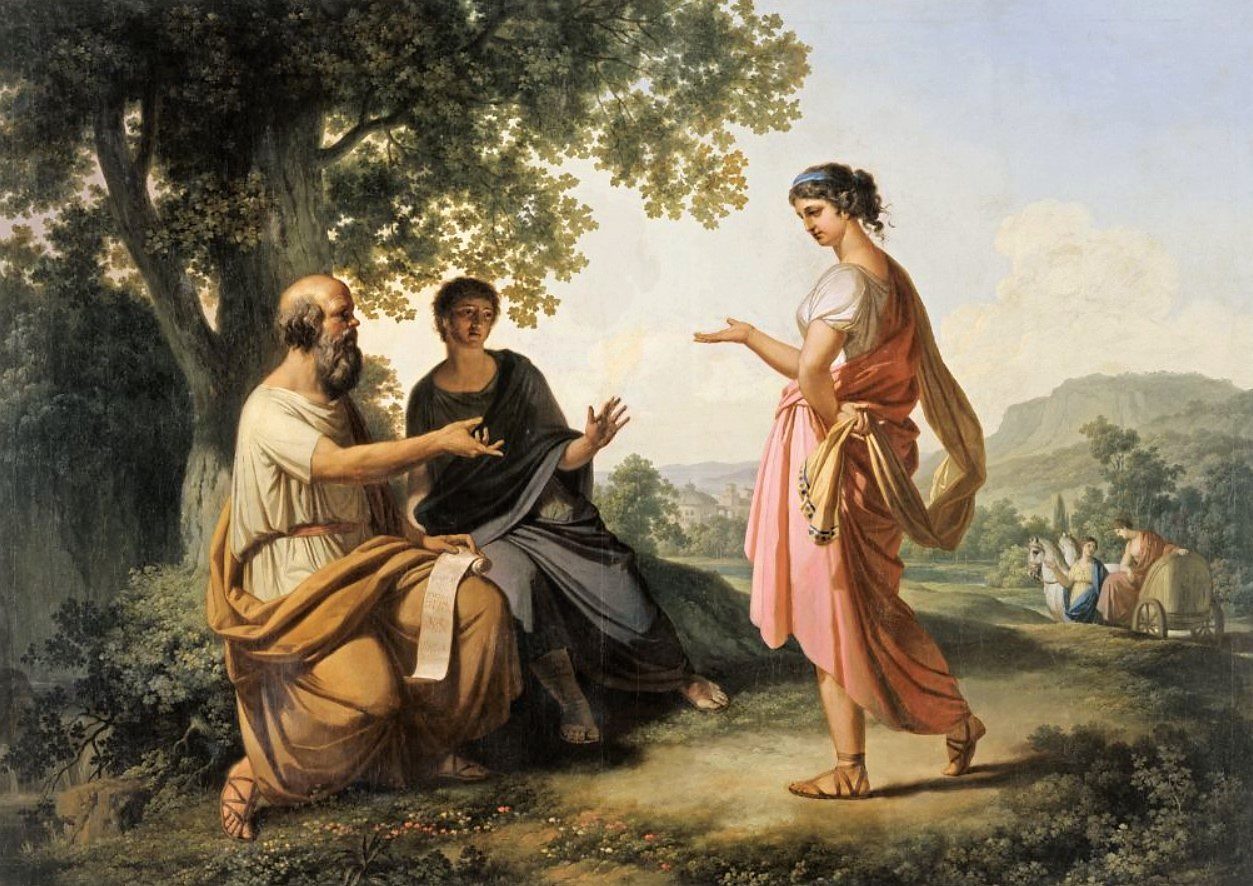 As we approach Thanksgiving this year, the coronavirus phenomenon helps us value rightly what we might otherwise take for granted—simply being in the classroom, for example, after the experience of three remote sessions. The discussion in my freshman Humanities class on Wednesday was about the second half of Plato’s Symposium, starting with Socrates’ great account of his dialogue about love with Diotima of Mantinea. The students were startled to discover that, as Diotima tells Socrates, “All of us are pregnant, both in body and soul” (a couple of minutes of high hilarity). Socrates goes on to recount Diotima’s argument that we desire to “give birth… in something beautiful,” which is ultimately a longing for immortality in its many forms, from literal children to everlasting fame in the songs of men to participation in the form of beauty itself.
One passage in this part of the dialogue always moves me more than any other. “What we call studying,” Diotima tells the young Socrates, “exists because knowledge is leaving us, because forgetting is the departure of knowledge, while studying puts back a fresh piece of knowledge, so that it seems to be the same.” This is our actual condition in time—forgetting (lēthē), not only in the old, in whom it is most visible, but in everyone. It is interesting trying to explain this point to students fifty years younger than I am. How many times have I opened a book I have always meant to read only to discover my own underlining and my annotations in the margins? What we know is always slipping away and being replaced, renewed by “studying,” which could also mean “taking care” or “paying attention.” A fresh piece of knowledge only “seems to be the same” as the knowledge lost to forgetfulness.
We replace what we have forgotten or lost. “And in that way,” Diotima says, “everything mortal is preserved, not, like the divine, by always being the same in every way, but because what is departing and aging leaves behind something new, something such as it had been. By this device, what is mortal shares in immortality, whether it is a body or anything else, while the immortal has another way.” Leaving behind something new means that the truth is not in fact timeless. The word for truth in Greek is alētheia—that is, lēthē (forgetting) with the privative a- before it to indicate absence or loss. A-lētheia is, so to speak, the absence of forgetting—the sudden recollection, the vivid recovery. Knowledge is fresh when it is being retrieved from forgetfulness.
As with so much in Plato, the implications ramify. Certainly, as we feel so keenly these days, the great tradition of the West is mortal and in danger of being forgotten. What we do at Wyoming Catholic College is to study what the great figures of the past have left behind, precisely because they were aging and departing. Just in this one course in one semester of our four-year curriculum, the freshmen study the Homeric poems, the Greek tragedies, and three Platonic dialogues, these major ways of retrieving immense and priceless knowledge from forgetfulness, and I hope they feel the sense of these lines of Hopkins, which they know by heart: “And though the last lights off the black west went / O morning at the brown brink eastward springs.”
In the Western tradition, which once again lives in these students, we find the hope of renewal, “Because the Holy Ghost over the bent / World broods with warm breast and with ah! bright wings.” We trust, in teaching them, that they will find ways to save the Church from all that weakens it. We trust them, too, to think deeply into America, whose very principles are being forgotten, and in all things, in Hopkins’s words, to find the “dearest freshness deep down things.”
Republished with gracious permission from Wyoming Catholic College‘s weekly newsletter.
This essay was first published here in November 2020.
The Imaginative Conservative applies the principle of appreciation to the discussion of culture and politics—we approach dialogue with magnanimity rather than with mere civility. Will you help us remain a refreshing oasis in the increasingly contentious arena of modern discourse? Please consider donating now.
The featured image is “Socrates and Diotima” (1810) by Franz Caucig (1762–1828) and is in the public domain, courtesy of Wikimedia Commons. It has been brightened for clarity.





Leave A Comment