
 Many great writers have affirmed Shakespeare’s Catholicism. G.K. Chesterton asserted that “convergent common sense” pointed to the belief that the Bard of Avon was a Catholic and that such common sense was “supported by the few external and political facts we know”. Over a hundred years earlier, the French writer, François René de Chateaubriand, insisted that “if Shakespeare was anything at all, he was a Catholic”. Thomas Carlyle wrote that the “Elizabethan era with its Shakespeare, as the outcome and flowerage of all which had preceded it, is itself attributable to the Catholicism of the Middle Ages”. Carlyle’s great Victorian contemporary, John Henry Newman, was even more emphatic about the Catholic dimension, stating that Shakespeare “has so little of a Protestant about him that Catholics have been able, without extravagance, to claim him as their own”. Hilaire Belloc, echoing the verdict of Newman, insisted that “the plays of Shakespeare were written by a man plainly Catholic in habit of mind”.
Adding to this chorus of affirmation for Shakespeare’s Catholicism by such great writers is the formidable voice of the great Swedish playwright, August Strindberg. In an essay entitled “Shakespeare’s Worldview”, translated from the Swedish for the present author by Göran Elfors, Strindberg defends Shakespeare’s faith from those of his contemporaries who had sought to claim him to be an atheist. This important essay has never been published in English, to my knowledge, which means that Strindberg’s words on Shakespeare’s faith are essentially unknown beyond the bounds of Strindberg scholarship in Sweden.
Written in 1907, five years before his death, the essay dates from the final period of Strindberg’s life, after he had rejected the atheism, relativism, and occultism of his earlier years. It reflects instead his rapprochement with the Christianity of his youth.
Strindberg quotes and discusses many of Shakespeare’s plays in the course of the essay, namely, in order of their appearance: King Lear, Hamlet, The Tempest, Macbeth, Timon of Athens, Henry VI Part 1, Richard III and Henry VIII.
”Was Shakespeare a free-thinker,” Strindberg asks, ”or an atheist?”
”No,” he replies to his own rhetorical question, ”he was a pious believing Catholic, with moments of deep doubt and desolation, when God had gone hiding from him.”
To illustrate Shakespeare’s Catholicism as a young man, Strindberg compares the characters of the Earl of Richmond and Richard III. ”Shakespeare wrote Richard III at the age of thirty,” Strindberg writes. ”It is thus a work of youth.” It is likely, in fact, that the play was written as early as 1592, and probably no later than 1593— that is when Shakespeare was twenty-eight or twenty-nine years old and thus even younger. Strindberg calls Richmond, ”the handsome hero of the play”, and quotes the famous lines that Shakespeare gives to him:
God and our good cause fight upon our side.
The prayers of holy saints and wrongèd souls,
Like high-reared bulwarks, stand before our forces.
He then quotes Richmond’s words of judgment upon Richard III:
One that hath ever been God’s enemy.
Then if you fight against God’s enemy,
God will, in justice, ward you as his soldiers…
God and Saint George! Richmond and victory!
”And when Richard the Evil has fallen,” Strindberg writes, ”Richmond ends the drama with thanksgiving and prayer to God that the war is over:
O now let Richmond and Elizabeth…
By God’s fair ordinance conjoin together,
And let their heirs – God, if his will be so –
Enrich the time to come with smooth-faced peace….
Abate the edge of traitors, gracious Lord…
That she may long live here, God say ’Amen’.”
It is, however, Hamlet that takes centre stage in Strindberg’s essay, a play which evidently had haunted Strindberg’s own dramatic imagination. He quotes Hamlet’s ejaculatory prayer when he sees the Ghost of his father: ”Angels and ministers of grace defend us!”
”Then comes the Father,” Strindberg continues, ”directly from purgatory”:
My hour is almost come
When I to sulph’rous and tormenting flames
Must render up myself.
”This shows that Shakespeare was a Catholic,” Strindberg asserts, ”as he believed in purgatory, which the Protestants deny.”
There then follows an intriguing defence of the doctrine of purgatory, suggesting a sympathy for the beliefs of Catholicism which few ascribe to Strindberg:
This emotional need of a process of purification, before entering the assembly of the holies, is something beautiful, and a Catholic is not surprised to find the glorious hero and excellent man in such a situation. And the Father himself calms his son by telling him that it is a necessary state of passage even for the righteous, as he was snatched away through a hasty death, before having time to atone for his sins of weakness:
Doomed for a certain term to walk the night,
And for the day confined to fast in fires
Till the foul crimes done in my days of nature
Are burnt and purged away.
The presence of purgatory in Hamlet is taken by Strindberg as evidence of the Bard’s Catholicism because it is out of context with the historical setting of the play and with the politics and religion of Shakespeare’s England. ”The time when the play takes place is ancient,” he writes, which is to say pagan, whereas ”Shakespeare’s time was godless”. With respect to the latter, we must disagree with Strindberg, strictly speaking. Elizabethan England was not ”godless” but quirkily and idiosyncratically Christian. The official religion of England and the only religion sanctioned and legally tolerated by the state was the Church of England, which had been established by Henry VIII more than sixty years before Hamlet was written. This state religion was certainly not Catholic but nor was it Protestant in any systematically doctrinal sense. It was, de facto if not necessarily de jure, a cynical compromise in which political expediency held sway over theological doctrine. Religion had become a mere branch of the secular government. It was, therefore, machiavellian and, ispso facto, ”godless”. Within the context of Strindberg’s argument, however, it is not so much England’s ”godlessness” as the English government’s anti-Catholicism which made the presence of purgatory so pronounced as an anomaly suggestive and indicative of Shakespeare’s Catholicism. For Strindberg, this was proof enough, a convincing refutation of contemporary misreaders of the plays who ”have tried to make Shakespeare a man of the Renaissance, a heathen, and a freethinker apprentice of Giordano Bruno”.
”Furthermore,” Strindberg adds, ”Hamlet swears by Saint Patrick, the saint of Ireland!” He might also have added, had he known, as Shakespeare evidently did, that ”Saint Patrick’s Purgatory” was one of the most famous pilgrimages in Christendom, documented widely since at least the twelfth century, connecting the saint with the doctrine of purgatory in the minds of Catholics.
Strindberg then confronts Hamlet’s professed gloom and despondency, as expressed so eloquently in the most famous of soliloquies, with the intensity and profundity of a fellow playwright:
This doubt of everything, of God and his goodness, breaks out in his soliloquy, and anyone who has had a similar experience will ascribe the whole wavering of Hamlet to the fact that he has let go of the anchor which is God. Without such an anchor, the godless man behaves erratically, thrown between thoughts of revenge and convenient forgiveness.
And yet, ”at the very height of his despondency, he asks Ophelia to remember him in her prayers” and ”furthermore, he swears by the Holy Virgin, who was not popular during the reign of Queen Elizabeth”.
Strindberg is also at great pains to rescue the Bard from those who claimed that he was a philosophical materialist, citing as evidence Hamlet’s soliloquy in act four and his overt proclamation of faith in the final act, which ”shatters all godless doubts”:
and that should teach us
There’s a divinity that shapes our ends.
Such divinity enables ”the poet (Hamlet) to discover the finger of Providence in the small everyday things: There’s a special providence in the fall of a sparrow.”
”Horatio,” Strindberg adds, is, at Hamlet’s death, ”as pious as Hamlet became”, citing the prayer that Horatio prays over Hamlet’s corpse: And flights of angels sing thee to thy rest!
Strindberg then succumbs to a triumphalist vaunt against his atheist opponents: ”That is Christendom, Messieurs Heathens!” Had he known that Horatio’s words were a paraphrased translation of the Latin words prayed at the graveside following the Latin Requiem Mass, which had been banned in Shakespeare’s England, his triumphalist vaunting would have gained all the more potency.
Although Strindberg was convinced of Shakespeare’s Catholicism, he was never personally convinced of the claims of the Catholic Church. He was not a convert to the Faith, but he did return to Christianity and was reconciled, after a fashion, with the Lutheran church in which he’d been raised and according to the rites of which he would be buried. Strindberg’s principal aim in writing his essay on Shakespeare’s worldview was not primarily to rescue Shakespeare for the Catholic Church as his desire to rescue Shakespeare from the atheists, amongst whom he had numbered himself in his younger years:
To us, the faith that Shakespeare confessed ought to be unimportant, but one thing is important: that he be released from the grasp of the atheists, of the new heathens, who have stolen Shakespeare, as they have stolen Goethe. Schiller they could not steal, so they are forced to ignore him or demean him.
In our own day, we find Shakespeare besieged by a legion of atheists in various guises who are seeking to claim the Bard as one of their own. He is textually abused by queer theorists and nihilists who want to pervert the meaning of his works into the monstrous image of their own deplorable selves. In our age, as in Strindberg’s, the Bard of Avon is in need of champions who will defend him from these defiling dragons.
The Imaginative Conservative applies the principle of appreciation to the discussion of culture and politics—we approach dialogue with magnanimity rather than with mere civility. Will you help us remain a refreshing oasis in the increasingly contentious arena of modern discourse? Please consider donating now.
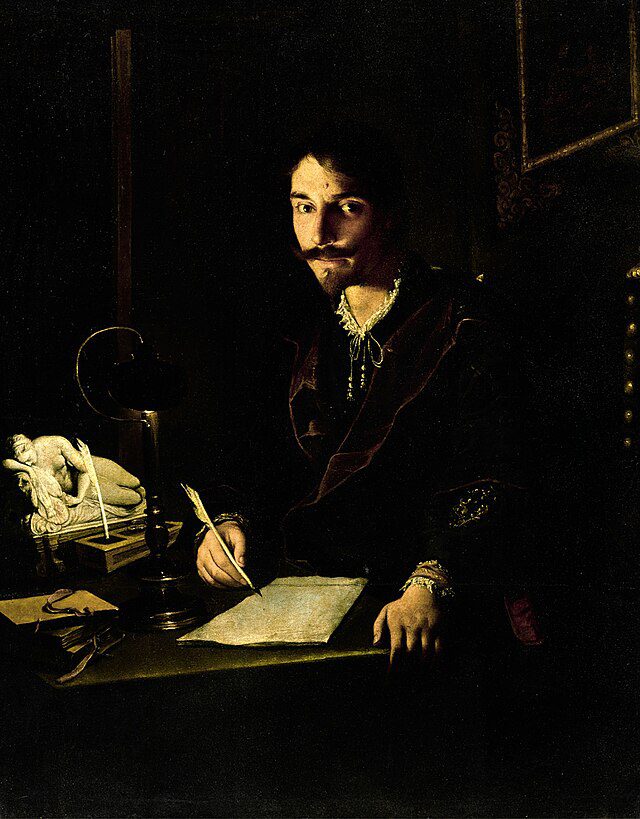
The featured image is “Man Writing by Candlelight” (1630s), by Pietro Paolini, and is in the public domain, courtesy of Wikimedia Commons.



If it turns out that William Shakespeare was a Roman Catholic, or that either or both of his parents were recusant Catholics, I doubt any Christian of good will would mind the fact. Good for him. It would help explain some of his richness as an artist. But I do not think that the evidence points to this conclusion (necessarily). Any observation Strindberg includes in his essay on the Bard can also be explained by pointing to the lingering (and often quite intentional) usages, ideas, and beliefs of the medieval Faith which were retained by/in the Church of England. The facts prevent a story told in black and white. For better or for worse, Anglican Christianity in Shakespeare’s day was a hotch-potch of beliefs and practices. There were plenty of Englishmen who were Protestant only in terms of their jurisdictional relationship to the Pope. The most brilliant friend I have once wrote a dissertation for a decent university on “Anti-Papal Catholicism” in the Church of England; Elizabeth I was adamant that the C of E would feature a faith “Catholic and Reformed;” and it is crystal clear that the Catholic Faith (reformed, as they believed) was that religion for which the Stuarts aimed, especially after 1625.
Mr. Pearce writes generously that “Elizabethan England was not “godless,” then less generously that the Anglican Church “was, de facto if not necessarily de jure, a cynical compromise in which political expediency held sway over theological doctrine. Religion had become a mere branch of the secular government. It was, therefore, Machiavellian and, ispso facto, ‘godless’.” There is much to criticize in Anglicanism, and we Anglicans should never rest in the belief that God does not care whether Rome and Canterbury are divided. But Anglican Christianity’s greatest spokesmen–several of whom produced theological work praised by Popes–were neither cynical nor compromising nor indifferent about Christian truth and tradition. Shakespeare would have known Richard Hooker (d. 1600), who insisted that the C of E was “not a compromise for the sake of peace but a comprehension for the sake of truth.” This Church was not Machiavellian. It was not godless. It may have been and still is schismatic. It may appear fairly nutty at times. But it has always been dedicated to believing and practicing “the Faith once for all delivered to the saints.” None of Strindberg’s arguments for the Bard’s “Catholicism” preclude the received notion that he was a pretty good Anglican. His genius was that he was able to put himself back in time (sometimes anachronistically but nonetheless brilliantly), so that a Hamlet or a Richard spoke as one of his time, long before the Reformation. Strindberg was evidently unaware of a major tradition within the Church of England — what is usually called “Catholic Anglicanism.” Had he been more familiar with this strand of Anglicanism alive and well in Shakespeare’s time, he would have been more cautious in his conclusions, I believe. … Were there today a Catholic playwright of Shakespeare’s genius, it would be very interesting to see WHAT or WHICH Roman Catholic Church the bard would depict, consciously or unconsciously, in his oeuvre: Would we glean in the poetry and dialogues a traditionalist or a “post-Vatican II” innovator, and orthodox believer or a left-progressivist? I ask this question because, like the Elizabethan Church in England, it is sometimes difficult to discern what Catholics believe.
“I swear that I am just what I seem to be. I’ll faithfully serve a master who puts his trust in me, I’ll love those who are honorable, and I’ll associate with those who are wise and don’t say much. I fear God, fight when I have to, and don’t eat fish.“
One indicator of Shakespeare’s preference for the Catholic Church is the shift in his writings after Catholic James I became king after the death of Elizabeth I, who had been a Protestant. Shakespeare no longer needed to hide his Catholicism.