
The most important element in European foreign relations throughout the 1920s and during the early 1930s was the desire at all costs to avoid another war. There was among European statesmen a widespread conviction that another war would be infinitely more destructive than the Great War had been, and any alternative seemed preferable.
1. Hitler’s War
 The First World War revealed that Germany was the most powerful state in Europe. In the east, the German army defeated the Russians; in the west, the Germans would have fought the French and British to no worse than a stalemate were it not for the intervention of American troops. From the earliest days of his political career, Adolf Hitler dreamed of reversing this humiliating and, for him, unwarranted German defeat. Once in power he was determined to rescind the Treaty of Versailles and to forge a vast German empire in central and eastern Europe. Hitler believed that only a war of conquest would win for Germany the territory and security it required, and that the German people, as a superior race, deserved. War was an essential component of Nazi ideology from the outset, especially since from Hitler’s point of view, as from that of many veterans, the First World War had never ended. “People told us that the War was over,” reflected one German soldier:
That made us laugh. We ourselves are the War. Its flame burns strongly in us. It envelops our whole being and fascinates us with the enticing urge to destroy. We… marched onto the battlefields of the postwar world just as we had gone into battle on the Western front: singing, reckless, and filled with the joy of adventure as we marched to the attack; silent, deadly, remorseless in battle. [1]
The unremitting savagery and the astronomical casualty rates of the Great War had produced a generation inured to suffering, cruelty, and violence. Contempt for life came to seem acceptable, even normal. Such attitudes were not limited to Germany alone. Statesmen and citizens in many European nations, including those that had been victorious, became less hesitant to resort to violence than they had before the war. Hitler found ideal recruits for the Nazi movement among disillusioned veterans, aspiring to power in order to mobilize the economic, material, and human resources of Germany for a war of conquest. The Second World War was thus incontrovertibly Adolf Hitler’s war. He wanted it. He planned for it. He chose the moment to start it, and for three years he controlled its course and very nearly won it.
During his first two years as chancellor, between 1933 and 1935, Hitler pursued a cautious foreign policy so as not to alarm France or Great Britain, prompting one or both to move against him before he had consolidated his power and before he had completed his secret program to rearm and expand the military. Nevertheless, Hitler’s foreign policy had one paramount objective from the beginning: to make Germany again the preeminent nation in Europe.To accomplish this task required, first, the repudiation of the Treaty of Versailles; second, the conquest and colonization of central and eastern Europe; third, the defeat of Bolshevism, and fourth the domination, exploitation, and in some instances extermination of so-called inferior races, such as the Slavs and the Jews. In his conduct of foreign affairs, Hitler demonstrated the same blend of opportunism and singleness of purpose that had brought him to power. Nazi propaganda effectively transformed his desire for conquest into a noble and desperate fight to save European civilization, portraying Hitler as the savior rather than scourge of Europe.
II. Pacifism & Aggression
During the 1920s, diplomats and statesmen had sought myriad ways to keep the peace, for pacifism was also a response to the Great War. The League of Nations provided an international forum in which nations could discuss their grievances and to which they could submit their disputes for arbitration and peaceful resolution. At the Washington Naval Conference held in 1921 and 1922, the United States, Great Britain, France, Italy, and Japan agreed not to construct new battleships or heavy cruisers for ten years. Avoiding a naval arms race, negotiators hoped, would go a long way toward ensuring peace. In the Locarno Pact of 1925, Germany, France, and Belgium promised not to alter their existing borders. In effect, this treaty meant that Germany had to accept both the loss of Alsace and Lorraine and the permanent demilitarization of the Rhineland. Significantly, the Germans did not think it necessary to give similar assurances about their eastern borders with Czechoslovakia and Poland, an omission that Hitler later exploited.
Two final gestures designed to preserve the peace followed in 1926 and 1928. In 1926, as part of the Locarno agreements, member states voted to admit Germany to the League of Nations. In 1928, most nations, and all of the major powers, signed the Kellogg-Briand Pact, which renounced war as an instrument of foreign policy and as the solution to international disputes. To many the world over, the Kellogg-Briand Pact marked the end of war and the dawning of a new era of lasting peace. But with no clause to enforce its prohibition against war, the Kellogg-Briand Pact was destined to be ineffective in moments of crisis.
Yet, between 1925 and 1930, a sense of cooperation and hope dominated international relations as it had since at no time before the outbreak of the Great War. Economic recovery from the conflict further eased international tensions. As evidence of this spirit of reconciliation, the French and the British agreed to withdraw troops from the Rhineland in 1930, five years ahead of the timetable that the Treaty of Versailles had prescribed.
The most important element in European foreign relations throughout the 1920s and during the early 1930s was the desire at all costs to avoid another war. There was among European statesmen a widespread conviction that another war would be infinitely more destructive than the Great War had been, and any alternative seemed preferable. Anti-war sentiment also infused public opinion; many pacifists rejected even wars fought in self-defense. Guilt about the Treaty of Versailles, particularly evident in Great Britain, reinforced this sense of pacifism. By the 1930s, many in England thought unjust the terms of the treaty that the Allies had imposed on Germany. They were right, but Hitler took full advantage of these guilty feelings. Perhaps more accurately, the British permitted him to exploit their misgivings to characterize his actions merely as efforts to rectify the injustices that the Treaty of Versailles had perpetuated.
Pacifism also arose from the rampant fear of communism—a fear that it is impossible to overestimate. Since Hitler had cast himself as the most unrelenting opponent of communism, he received support from many who otherwise opposed German imperialism, but who preferred the Nazis to the Communists if forced to choose. A comparatively small but influential group scattered throughout Europe and the United States admired Hitler for the sense of purpose, dignity, and strength that he had instilled in the German people, as well as for the impressive way in which he had solved the economic and political crisis that had engulfed Germany at the time he came to power.
Sensing the mood in Europe, Hitler announced in March 1935 that Germany would no longer honor the terms of the Treaty of Versailles. He then set about enlarging and strengthening the Germany military. In violation of the disarmament clauses of the treaty, Hitler restored conscription and began openly to rebuild the German navy and air force, which he had been doing in secret from years. His action brought no violent protest from either the governments of Great Britain or France. In fact, later in 1935, the British signed a naval agreement with Germany that established ratios of warships between the two countries, thereby implicitly recognizing and accepting Hitler’s violation of the treaty.
Neither the leaders of the Conservative nor the Labour Parties in England supported a policy of rearmament even after it became apparent that Hitler had embarked on a systematic program to rebuild the German military. Even had they been amenable, they were hardly in a position to afford such a program. The Great War had nearly bankrupted England. The only prominent voice raised against the follies of pacifism and the unchecked aggression of the Nazis was that of Winston Churchill. Churchill warned that unless Great Britain opposed Hitler’s actions and at least matched Hitler’s military expenditures, the British would lose their air and naval supremacy and become the helpless victims of Hitler’s extortion. The British government, Churchill insisted, should make no diplomatic concessions to Hitler, for doing so Churchill was convinced would only encourage further belligerence. Most British statesmen regarded Churchill at best as an eccentric. At worst, they thought him unreliable and perhaps incompetent. He was best remembered during the 1930s for the disastrous campaign in the Dardanelles that he planned in 1915 while First Lord of the Admiralty and for his mediocre performance as Chancellor of the Exchequer between 1924 and 1929. Because of his poor reputation and unimpressive resumé, Churchill was kept out of office for a long time and his views ignored.
The French also refused to oppose Hitler, at least not without support from their British allies. Had French leaders displayed the same intransigence toward Nazi Germany that they had shown toward the struggling Weimar Republic, Hitler would have been compelled to moderate his rhetoric and his belligerence. But when, on March 7, 1936, Hitler ordered German troops into the Rhineland in violation both of the Treaty of Versailles and the Locarno Pact, the French did not challenge this maneuver. Had they done so, Hitler had issued orders to his commanding officers to retreat. He did not want to provoke a military confrontation. Meanwhile, British officials, such as Neville Chamberlain, viewed Hitler’s actions with no great concern. He was not, after all, expanding the borders of Germany but merely sending troops to the German frontier, which it was his right to do. The French saw the German reoccupation of the Rhineland as a grave threat to national security, but made no move to expel the 22,000 troops that Hitler had deployed.
Internal political dissent also weakened French resolve. In the weeks after Hitler sent troops into the Rhineland, the worst general strike in its history paralyzed France, which seemed to many on the brink of civil war. The coalition government of socialist Prime Minister Léon Blum eased tensions by enacting overdue reform legislation, but at the cost of alienating many French nationalists who now openly embraced the Nazis as the only viable alternative to socialism and communism. Hitler had correctly surmised that the British and French lacked both the means and the will to oppose his ambitions. Haunted by the bloody memories of the First World War, British and French leaders now went to great lengths to avoid initiating a similar catastrophe. Public opinion in both countries revealed no enthusiasm for a confrontation with Hitler. English and French citizens alike praised and rewarded leaders who had managed to avoid war.
III. The Policy of Appeasement
The British were unprepared for war and the French, although boasting the largest army on the continent, were willing to fight only a defensive war, a reversal of the disastrous strategy of the First World War when most French generals thought only to fight on the offensive. Both the British and the French governments were thus eager to offer concessions to Hitler when he began to break treaties and to make threats. Together French and British statesmen championed what came to be known as the policy of appeasement. Neville Chamberlain, the Prime Minister of Great Britain, and Édouard Daladier, the Prime Minister of France, hoped that Hitler would be satisfied by their willingness to negotiate and would compromise with them. But appeasement rested on the willful illusion that Hitler was a reasonable statesman and an honorable gentlemen who wanted only sensible revisions to the Treaty of Versailles.
In addition to the belief that they could placate and thereby control Hitler, many French and British statesmen accepted the notion, which Nazi propagandists had disseminated, that Hitler was the most reliable and steadfast enemy of communism in Europe. Hitler’s evident determination to rid the world of the communist menace seemed to give him a political outlook in common with the Western powers. The British and French governments feared the ambitions of Josef Stalin, whose power they consistently over estimated. If they were to move against Germany, they worried lest their preoccupation would free Stalin to pursue his own imperialist desires in eastern Europe and Asia. Such developments French and British diplomats and statesman found even more intolerable than a German-dominated Europe.
Rather than confronting Hitler and taking their chances with Stalin, Chamberlain and Daladier decided to appease Hitler, that is, they gave him what he demanded in the hope that he would be satisfied and want no more. In addition, Chamberlain and Daladier reasoned that the policy of appeasement would enable them perhaps to make common cause with Hitler, to transform him into a responsible member of the international community and a faithful ally against Stalin and the Soviet Union. Their thinking on this matter was logical, or at least it was not entirely illogical, just as was their desire to avoid another destructive war. Notwithstanding these prudent judgments, appeasement proved a miserable failure that in the end yielded only disaster and tragedy.
In practice, appeasement meant that Chamberlain and Daladier threw their allies in central and eastern Europe to the wolves in the hope that the wolves’ appetite would be sated before they got to Britain and France. But wolves are wolves no matter if Chamberlain and Daladier pretended that they were sheep, and the hunger of wolves is not easily satisfied. Hitler had not attended Eton and Oxford. He was not an English gentleman who adhered to principled diplomacy and honest statecraft. He never moderated his aspirations. Instead, he enlarged them, with dreadful consequences. Despite the efforts of their leaders, the British and the French in the end had to fight the war against Germany and its allies that they so desperately tried to avoid.
IV. The Munich Conference: Appeasement in Action
On November 5, 1937, Hitler gathered the chiefs of the German armed forces to explain his long-range plans. He began by insisting that the 85 million Germans required “living space,” or else Germany faced extinction. The land that they needed lay in eastern Europe, and since history had shown that expansion could be accomplished only through violence, Hitler said that war was inevitable. The only remaining questions, he told the generals, were when and under what conditions war would begin. More than two years earlier, Hitler had embarked on a program of territorial expansion. On January 13, 1935, as the result of a plebiscite conducted under the auspices of the League of Nations in accordance with the terms of the Treaty of Versailles, more than ninety percent of voters in the Saar Basin opted for reunion with Germany rather than incorporation into France. The return of the Saar Basin to Germany, which was completed on March 1, 1936, less than a week before troops marched into the Rhineland, began the enlargement of German territory during Hitler’s regime.
By the end of 1937, Hitler’s primary aim was to bring Austria and Czechoslovakia under German rule. He concealed his purpose, declaring that he wished only to uphold the commitment to national self-determination by incorporating into Germany those who, against their will, had been separated from their rightful homeland. The deception worked. Two weeks after his address to the German High Command, Hitler met with the British Foreign Secretary, Edward F.L. Wood, Lord Halifax, who reassured him, with the prevarication so often characteristic of diplomatic language, that the British government was not committed to the status quo in eastern Europe, and thus would not object if Hitler were to devise a peaceful solution to what Lord Halifax referred to as the “nationality problem.” Hitler understood what Halifax had left unspoken: the British would not intervene if he moved against Austria.
In March 1938, German troops invaded Austria. By threatening an assault, Hitler coerced the resignation of Chancellor Kurt von Schuschnigg. On the pretense of deterring violence and maintaining order after Schuschnigg’s government collapsed, Hitler ordered in German troops anyway. A few days earlier, French and British diplomats had informed Schuschnigg that their governments were unwilling to risk war with Germany; he could thus expect no help from them in the event of German action. On March 13, 1938, Arthur Seyss-Inquart, the new leader of the Austrian government and a Nazi puppet, declared Austria a province of Germany. Many Austrians, probably most, welcomed Hitler as a conquering hero who promised to restore the former glory of Germanic peoples. Throughout the country, Austrians celebrated news of annexation by ringing church bells, cheering and waving swastika banners and Nazi flags as German troops pass, and, as was to be expected, humiliating and attacking Jews.
The Anschluss immediately enabled Hitler to pressure the government of Czechoslovakia into recognizing the independence of a region called Sudetenland, so that the 3.25 million Germans living there could, like the Austrians, be reunited with the Third Reich. Historically, Sudetenland had never been part of Germany, rendering Hitler’s embrace of national self-determination politically dubious. It had, rather, been part of the Austro-Hungarian Empire. Since the Allies were in no mood to recompense Germany after the Great War, the Treaty of St. Germain-en-Laye, signed with Austria in September 1919, incorporated Sudetenland into the new state of Czechoslovakia. The importance of Sudetenland for Hitler was two-fold. In addition to having a large German-speaking population, Sudetenland was, first, a heavily industrialized and fortified region, and, second, Sudetenland lay directly in the German path to eastern Europe.
Unlike the Austrians, the Czechs wanted no political or economic union with Germany. Realizing that the country by itself could not withstand a full-scale German attack, the government of Czechoslovakia, the only remaining parliamentary regime in eastern Europe, pleaded with France and Great Britain for military assistance. Given these circumstances, many German generals opposed Hitler’s designs. They feared that the army was not yet prepared for war, should the British and French decide to join forces with the Czechs, who were willing and able to fight but who could not prevail without help. Hitler dismissed his generals’ apprehensions and ignored their counsel, believing that he could accomplish his objectives without recourse to arms. He was right.
Throughout the spring of 1938, Nazi agent provocateurs fomented unrest among the Sudeten Germans. Whenever the Czech government made concessions, the Sudeten Germans demanded even more privileges. When Czech leaders at last demurred, civil disturbances continued and grew. Hitler, meanwhile, declared that the ongoing Czech “persecution” of the Sudeten Germans was “intolerable.” He threatened intervention on their behalf if Czech officials did not heed their appeals or could not restore order. How far Hitler was prepared to carry his threats we shall never know, for he was spared the necessity of having to make a decision.
In late September 1938, Chamberlain and Daladier agreed to meet with Hitler and Mussolini in Munich to decide the fate of Czechoslovakia.[2] Together they fashioned the Munich Agreement, which called for the immediate evacuation of Czech troops from Sudetenland and their replacement by German forces. As both principle and interest required, Britain and France then pledged to guarantee the territorial integrity of a truncated Czechoslovakia. The conditions of honor satisfied, Chamberlain and Daladier hoped that their concessions would be enough to curtail Hitler’s territorial demands. Chamberlain at least seems to have believed that Hitler’s claim to Sudetenland carried some legitimacy. Sudetenland, he argued, had historically been home to a large German-speaking population. Perhaps Hitler was right; perhaps the Czech government was oppressing the Sudeten Germans, just as Nazi propaganda alleged. Perhaps, too, Hitler was only trying to incorporate into his nation Germans living outside of Germany, thus carrying the cherished liberal initiative of national self-determination to its logical conclusion.
Chamberlain could not imagine that the disagreements with Germany over the fate of Sudetenland were beyond diplomatic resolution to men of reasonable judgment and good will. He was certain that he could persuade Hitler to cooperate and thereby to spare Europe another terrible war. In any event, even in the face of continued German aggression, neither the British nor the French were willing to risk a war to save Czechoslovakia. Prepared to fight, but unable to defeat Germany alone, the Czech leaders and the Czech people had no alternative but to yield to the solution that the Great Powers had devised.
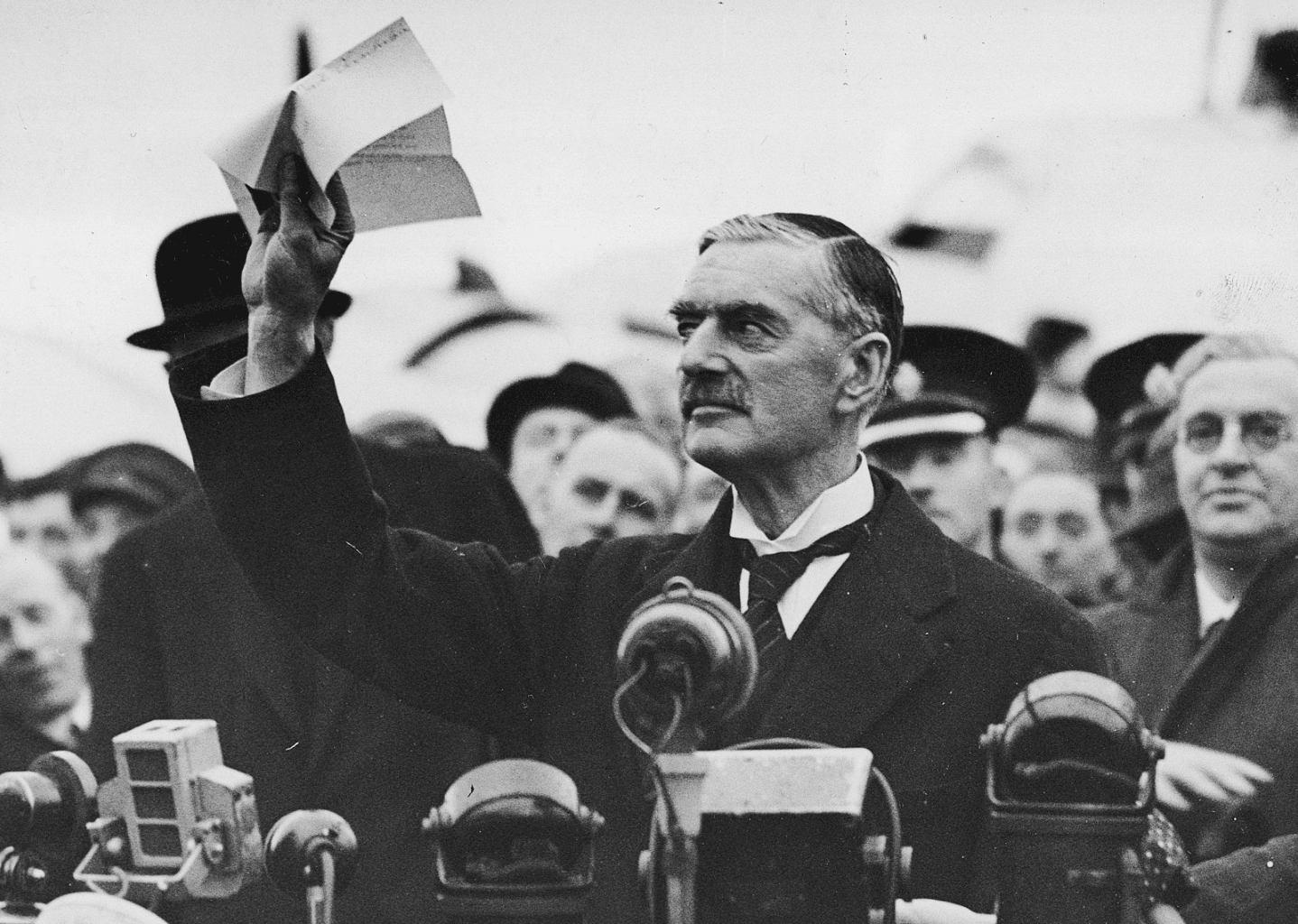
Critics of Chamberlain and Daladier have long insisted that the Munich Agreement was a terrible blunder. Describing it as a “total and unmitigated defeat,” Churchill famously protested that Hitler, “instead of snatching the victuals from the table, has been content to have them served to him course by course.”[3] But Chamberlain viewed the matter differently, and, at the time, so did most of the English people. Both Chamberlain and Daladier won gratitude from their citizens for keeping the peace. When he returned home to an enthusiastic welcome, Chamberlain waved the Munich Agreement before the cheering multitudes who had gathered at the airport, assuring them that he had “achieved peace in our time.”
Churchill’s interpretation proved more astute. The Munich Agreement told Hitler everything he needed to know about the public opinion, political attitudes, and military readiness of Great Britain and France. Hitler regarded the concessions that Chamberlain and Daladier had so willingly made as indications of weakness, which, of course, they were. After completing negotiations, Hitler was jubilant. His confidence was boundless, as was his contempt for the Western parliamentary regimes and democratic government. He was convinced that appeasement freed him not only to annex Sudetenland but also to dominate eastern Europe, providing him with the confirmation he had sought that the British and French did not have the will or the means to oppose him.
As Churchill surmised, Hitler never intended to honor the Munich Agreement for any longer than was expedient. Churchill further observed that “we seem to be very near the bleak choice between War and Shame. My feeling is that we shall choose Shame, and then have War thrown in a little later on even more adverse terms than at present.”[4] From the outset, Churchill suspected, Hitler had planned not just to incorporate Sudetenland into the German Reich but also to dismantle Czechoslovakia itself. As if on cue, Nazi agents began to encourage the Slovak minority, led by a fascist and anti-Semitic Roman Catholic priest named Josef Tiso, to demand independence from Czechoslovakia. On the pretext of safeguarding the right of the Slovakian people to national independence and self-determination, Hitler ordered German troops to invade Czechoslovakia and to occupy Prague. In March, 1939, Czech independence, which the British and French had solemnly guaranteed, came to an end. The invasion and partition of Czechoslovakia could not have rendered Hitler’s intentions more explicit.
V. The Nazi-Soviet Nonaggression Pact (August 23, 1939)
Like almost everyone else, Josef Stalin at first misunderstood and underestimated Hitler. By 1934, Stalin seems at least to have begun to realize his mistake. When, on October 25, 1936, Germany signed an agreement with Italy creating the Berlin-Rome Axis, and then a month later, on November 25, concluded the Anti-Comintern Pact with Japan, Stalin could have entertained few illusions. The Berlin-Rome Axis united Italy and Germany against France and Great Britain. The Anti-Comintern Pact, ostensibly directed against communism, was in reality the inclusion of Japan in the German-Italian alliance. Together these agreements left the Soviet Union diplomatically and militarily isolated.
Stalin had already taken some measures to anticipate and counteract these developments. In September 1934, he authorized Soviet membership in the League of Nations, which he had previously denounced as an instrument of French and British foreign policy. In May 1935, the Soviets signed mutual defense treaties with both France and Czechoslovakia, although these treaties required the Russians to aid the Czechs only if the French did. French abandonment of Czechoslovakia at the Munich Conference absolved the Soviets of any obligations. Finally, in the summer of 1935, Stalin instructed the communist parties in other countries to enter into working alliances, known as Popular Fronts, with socialists and liberals as a means to prevent Fascists and Nazis from coming to power.
After the Munich Conference and Hitler’s invasion of Czechoslovakia, Stalin grew increasingly suspicious not of Hitler but of the West. Characteristically, he began to think that appeasement was a deliberate plot against him and the Soviet Union on the part of the British and French to buy their own safety by deflecting Hitler’s ambitions from western to eastern Europe. He was not entirely wrong in that assessment. There was, of course, no conspiracy to encourage Hitler to start a war with the Soviet Union, although the British and French would not have minded had Hitler and Stalin destroyed one another. Among politicians in both countries, there were those who thought it would be better for Europe and the world, and certainly better for Great Britain and France, if Hitler and Stalin did fight it out, even if Hitler won. Hitler’s expansionist dreams had always lay more in eastern than in western Europe. He would have moved in that direction without prompting from the British and French. Nevertheless, Stalin now acknowledged that the Soviet Union was in trouble, a recognition that only deepened when, in early 1939, Soviet and Japanese troops skirmished along the Mongolian border.
After the Munich Conference, Stalin abandoned all efforts to build alliances with Great Britain and France. Like Hitler, he understood that the British and French desired to avoid a confrontation with Germany, and that there was little hope of reviving the Triple Entente that had united to defeat Germany in the First World War. To extricate himself from this predicament, Stalin decided that he must not join with but rather must outwit the leaders of the Western European nations.
On August 23, 1939, Stalin signed a nonaggression pact with Hitler that was known alternately as the Ribbentrop-Molotov Treaty or the Nazi-Soviet Nonaggression Pact. The announced provisions of the treaty stated that Germany and the Soviet Union would not attack one other, either independently or in conjunction with any other nation. Both consented neither to join nor to support any third power that threatened the other, and pledged to consult with one another on questions of common interest in an effort to resolve any outstanding differences through negotiation. The pact was supposed to remain in effect for ten years, with the automatic extension for another five years unless either party gave notice of termination one year before it was to expire. If Great Britain and France refused to confront Hitler in eastern Europe, then Stalin concluded the Soviet Union could not depend on their support in the event of a German or a Japanese attack. On the contrary, he was sure that the Western Powers wanted to destroy the Soviet Union and were enticing Hitler to do their dirty work.
When Soviet and Nazi officials unveiled the treaty on August 27, 1939, the news stunned to world, since, after all, the Nazis and the Communists were sworn enemies intent on annihilating one another. On August 31, Vyacheslav Molotov, the Soviet Foreign Minister, declared: ‘‘Today we are no longer opponents, a turning point in the history of Europe—and not only Europe.”[5] To Hitler, the agreement was another of those unanticipated gifts that he had come to regard as signs of heaven’s special favor. An accord with the Soviets further diminished the possibility that Great Britain and France would risk war over German designs in eastern Europe, and, for the time being, also kept the Soviets themselves from opposing Germany. Stalin had lost what little faith he had in the West. What illusions he still entertained about Hitler we may never know with certainty.
Did Stalin, who trusted no one, who, in fact, displayed a paranoid suspicion of almost everyone, even those in his inner circle, really believe that Hitler would honor this agreement when he had on multiple occasions revealed his duplicity? Alternately, did Stalin think that Hitler intended to attack the Soviet Union sooner or later, and was he buying time for the Soviet Union to prepare for an inevitable war, as Soviet propagandists suggested after the fact? Was Stalin organizing a preemptive strike, planning a Soviet invasion of Germany, as some historians have asserted? Were Stalin’s objectives more predictable and mundane: the acquisition of territory? A secret protocol appended to the Nazi-Soviet Pact divided eastern Europe into German and Soviet spheres of influence. According to these provisions, the treaty entitled Stalin to Polish territory east of the Narew, Vistula, and San rivers and provided for Soviet control of Finland, Latvia, Estonia, Lithuania, and Bessarabia. Did Stalin think that these territories would serve as a buffer zone between Germany and the Soviet Union? Did he assume that the Soviet Union could share eastern Europe with Nazi Germany in perpetuity, that a peaceful and equitable division of the spoils of war was possible?
Such questions continue to arouse discussion, debate, and disagreement among historians. If, as some historians maintain, Stalin was convinced that a war against Germany was unavoidable, then he vastly underestimated the time it would take for the Nazis to subdue Poland, neutralize France, and prepare to invade Russia. It seems more plausible that Stalin, for reasons best known to him, refused to believe that Hitler would attack Russia, and tried repeatedly to convince Hitler of his friendship. The relationship between Hitler and Stalin is among the strangest and most important in the political, diplomatic, and military history of the Second World War, and perhaps of the entire twentieth century.
By 1940, evidence of a coming German invasion was incontrovertible. Nearly 200 German divisions were massing along the border in eastern Poland–a border that Stalin’s conquest had opportunely provided–and the Luftwaffe was flying hundreds of reconnaissance missions over western Russia. Churchill, by then the Prime Minister, tried to warn Stalin about Hitler’s preparations, but because Stalin disliked Churchill, mistrusted the West, and admired Hitler and Germany, he disregarded Churchill’s repeated and increasingly desperate communiques. Meanwhile, Stalin himself tried to demonstrate his loyalty to Hitler and his intent to respect their agreement. Stalin made it clear that he did not want, and would not start, a war with Germany. When Generals Semyon Timoshenko and Georgy Zhukov asked for permission to fortify the Russian border and to make basic defensive preparations, Stalin denied their request. On June 18, 1941, fewer than three days before the Nazi invasion, a meeting between Stalin and Zhukov ended in a shouting match before Stalin slammed the door in Zhukov’s face. ‘‘Have you come to scare us with war, or do you want a war because you don’t have enough medals?” Stalin bellowed. “If you’re going to provoke the Germans on the frontier by moving troops there without our permission, then heads will roll, mark my words!’’ [6]
Stalin’s abject gestures toward Hitler and his contempt for the recommendations of his own generals suggest that Stalin was not as much deceived by Nazi propaganda as he had deceived himself about Hitler’s character and Hitler’s plans. He trusted Hitler because he wanted to trust Hitler. He wished to honor their friendship and their alliance, even after Soviet intelligence proved beyond all reasonable doubt that a German invasion of Russia was imminent. Consider, too, that many Soviet officials and diplomats feared Stalin’s wrath and hoped at the same time to advance their careers. Such men contributed to the deception by telling Stalin what he wanted to hear. When German troops flooded across the Russian border on June 22, 1941, the Red Army was not prepared to meet or repel them. Disbelieving and uncomprehending, Stalin fell into a stupor and did not reappear for ten days. Rather pathetically, Molotov lamented to Werner von Schulenburg, the German ambassador to the Soviet Union, ‘‘Without any reason Germany has attacked a country with which it had concluded a pact of non-aggression and friendship…. Surely we have not deserved this.” [7]
VI. The Beginning
Hitler, not Stalin, Chamberlain, or Daladier, was the master of the events that unfolded during the summer and fall of 1939. Hitler understood that if Stalin had wanted war or been prepared to fight one, he would never have signed a nonaggression pact. Stalin’s willingness to negotiate and compromise assured Hitler that Stalin, like the leaders of the Western nations, also would not oppose him in eastern Europe. He moved quickly to take advantage of the opportunity.
From Hitler’s point of view, the Nazi-Soviet Pact, like the Munich Accords, was a diplomatic coup. Hitler intended to conquer the Soviet Union in his own time. Signing a non-aggression pact with the Soviets indicated to Hitler that the moment had arrived for war to begin. At dawn on September 1, 1939, Hitler demonstrated the worthlessness of appeasement when he ordered German troops into Poland. But to Hitler’s surprise and dismay, the German invasion also too late brought an end to the era of appeasement. For on September 3, 1939, the governments of Great Britain and France declared war on Germany.[8]
The Imaginative Conservative applies the principle of appreciation to the discussion of culture and politics—we approach dialogue with magnanimity rather than with mere civility. Will you help us remain a refreshing oasis in the increasingly contentious arena of modern discourse? Please consider donating now.
Notes:
Author’s Note: Although the historical analogy to appeasement is not entirely relevant to the present situation in Europe, journalists, experts in foreign policy, European statesmen, and Vice President J.D. Vance have invoked it so often that an essay providing a detailed narrative and analysis of the history seemed warranted. Changing sides and abandoning an ally in the midst of war is without precedent in the history of the United States.
[1] Quoted in Robert G.L. Waite, Vanguard of Nazism (New York, 1969), 42.
[2] The Munich Conference took place on September 29-30, 1938, with Hitler threatening war if his demands were not met. Chamberlain had negotiated with Hitler twice before. On September 15, 1938, Chamberlain traveled to Berchtesgaden. He returned to talk with Hitler at Bad Godesberg on September 22, 1938. The Munich Conference was the culmination of these previous meetings.
[3] Churchill’s speech on the Munich Agreement, known as the “Total and unmitigated defeat” speech, October 5, 1938, in Never Give In!: The Best of Winston Churchill’s Speeches (New York, 2003), 171-81. The speech is also conveniently available online at The International Churchill Society.
[4] Quoted in John Lukacs, The Duel: 10 May-31 July 1940: The Eighty-Day Struggle Between Chruchill and Hitler (New York, 1991), 23.
[5] Quoted in John Lukacs, June 1941: Hitler and Stalin (New Haven, CT, 2006), 23.
[6] Quoted in Ibid., 80.
[7] Quoted in Ibid., 96. Italics in the original.
[8] To write this brief overview, I have drawn on the reading of many years. See R.J.Q. Adams, British Politics and Foreign Policy in the Age of Appeasement, 1935-1939, a critical analysis of the nature, purpose, and meaning of appeasement (Stanford, CA, 1993); Maurice Baumont, The Origins of the Second World War, trans. by Simone de Couvreur Ferguson an insightful overview of the causes of the war (New Haven, CT, 1978); P.M.H. Bell, The Origins of the Second World War in Europe, a comprehensive study of the origins of, and historical debates about, the war, 3rd ed. (London, 2007); John Charmley, Chamberlain and the Lost Peace, a reappraisal of appeasement, arguing that Chamberlain feared a war, even if it ended in victory for the Western Powers, would hand the continent to the Soviet Union. A strong Germany, by contrast, would form a bulwark against Soviet expansion (Chicago, 1999); Keith Eubank, The Origins of World War II, a brief but useful introduction that explains why the leaders of the Western Powers mistakenly thought they could control Hitler, 3rd ed. (Hoboken, NJ, 2004); Jürgen Gehl, Austria, Germany and the Anschluss, 1931-1938, a study of Hitler’s annexation of Austria (Westport, CT., 1979); Martin Gilbert and Richard Gott, The Appeasers, emphasizes British weakness in dealing with Hitler (London, 1963); Julie Gottlieb, Daniel Hucker, and Richard Toye, eds., The Munich Crisis, a recent reappraisal of the Munich Conference that tries to uncover and assess its social, cultural, and psychological impact on Europeans and attempts to recreate the experience of living through the crisis (Manchester, U.K., 2021); Klaus Hildebrand, The Foreign Policy of the Third Reich, a critical assessment of Hitler’s foreign policy in the context of German history, trans. by Anthony Fothergill (Berkeley, CA, 1973); John Lukacs, The Last European War, September 1939-December 1941, an imaginative and original study that provides a history of Europe and Europeans during the decisive phase of the Second World War (Garden City, NY, 1976), 3-53; John Lukacs, The Duel, a reconstruction of the epic eighty-day struggle between Churchill and Hitler (New York, 1991); John Lukacs, June 1941: Hitler and Stalin, an analysis of the confrontation between Hitler and Stalin framed against the backdrop of their strange but important relationship and their miscalculations about each other (New Haven, CT, 2006); Sally Marks The Illusion of Peace, 2nd ed., an analysis of European diplomacy between the end of the First World War and the rise of Hitler with an emphasis on the reasons European statesmen failed to achieve a lasting peace (New York, 2003); Joachim Remak, The Origins of the Second World War, a brief but useful study of the origins of the war that includes documents from statesmen, soldiers, and citizens (Englewood Cliffs, NJ, 1976); Angelo Rossi, The Russo-German Alliance, August 1939-June 1941, trans. by John and Micheline Cullen, a history of German-Soviet diplomacy (London, 1950); A.L. Rowse, Appeasement, an early, impassioned denunciation of appeasement (New York, 1963); Royal Institute of International Affairs, 1938-1946, Vol. I, a collection of primary documents on the antecedents to and origins of the Second World War (London, 1958); R.J. Sontag and J.S. Beddie. eds., Nazi-Soviet Relations, 1939-1941, a collection of documents captured after the collapse of the Third Reich that details the origins and nature of the alliance between Nazi Germany and the Soviet Union (Washington, D.C.,1948, State Department Publication 3023); A.J.P. Taylor, The Origins of the Second World War, argues that Hitler was an opportunist who lacked a clear strategic vision in his conduct of the war (New York, 1961, 2005); Gerhard L. Weinberg, Germany and the Soviet Union, 1939-1941, an analysis of the Nazi-Soviet Pact (Leiden, The Netherlands, 1954, 1972); John W. Wheeler-Bennett, Munich: Prologue to Tragedy, emphasizes the capitulation of the western democracies to Hitler’s demands (New York, 1964)..
The featured image is a photograph, “Munich Agreement, Chamberlain: Peace for our time.” This file is licensed under the Creative Commons Attribution-Share Alike 4.0 International license, courtesy of Wikimedia Commons.



A well written warning from a Trump hater. Yes there should be no appeasement. I would like to see the author take on the issue of attacks on Jews in the middle east and America and the role of the judicial system in undermining the rule of law in the US.
First, thank you for characterizing me as a Trump hater. I’m grateful for the recognition. In truth, it is not the man I hate but the damage that he is doing to the country and the world. I hope events prove me wrong. You almost certainly disagree, but I see no evidence that confirms such as hope. We’ll see. But I fear by the time we do it will be too late. May we both live long enough to know that I’ve committed a monumental blunder.
Second, thank you for your kind words about my writing. My appreciation is sincere.
Third, you will have to explain to me how and why you think the courts are undermining the rule of law in the United States before I can offer comment. I would prefer to listen to your explanation than to state what is almost certain to be a worthless opinion. I have no idea what you are referring to since I do not see that as the case. In fact, it is more likely from my perspective that the courts will not be able to enforce the rule of law. Our disagreement on this question is likely vast.
Fourth, I have no special expertise in the history of Anti-Semitism, certainly not enough to write a competent essay. Anything I say would be mere opinion, perhaps somewhat informed by a knowledge of history, but not, after all, worth very much. For what it is worth, my view is that the slaughter of Israelis in the Middle East and the attacks on Jews in the United States are despicable acts. What did you expect me to say?
Nor I was surprised by expressions of Anti-Semitism on the campuses of elite universities They have been bastions of Anti-Semitism and xenophobia since the late nineteenth century.
I will add that the attacks on Jews in no way justifies the ongoing slaughter of Palestinians in Gaza. Two moral outrages do not cancel each other out. I don’t abide by the Hammurabi Code.
I am not a Christian, at least not in the theological sense where it really matters, but I find great wisdom the the words of the German theologian Dietrich Bonhoeffer who wrote:
Christ. . . bore the sufferings of humanity in his own body as if they were his own. . . accepting them of his own free will. We are certainly not Christ; we are not called on to redeem the world by our own deeds and suffering, and we need not try to assume such an impossible burden. . . . But if we want to be Christian, we must have some share in Christ’s large-heartedness by acting with responsibility and in freedom when the hour of danger comes, and by showing a real sympathy that springs, not from fear, but from the liberating and redeeming love of Christ for all who suffer.
If I am to be criticized and even condemned for standing with “all who suffer,” whether they are Christian or Muslim, Jewish or Palestinian, I can live with the criticism and even the condemnation.
Bravo Mister Malvasi.
An excellent summary of that time.
It is one of the eras which has always fascinated me.
I quite concur with your conclusions.
England started preparing for war by increasing defence spending; bringing about the Supermarine Spitfire and the radar etc., After his return from Munich Chamberlain knew they must play for time so as to prepare for the coming conflict. It was not appeasement it was playing for time.
If USA had not saved Evil England, in WW1, there would not have been WW2.
there was no public sympathy for England.
Americans had ancestors that fought in 2 wars to get loose from the British.
If there had not been WW2, there would not be WW3 on the near horizon.
England is the driving force for war with Russia, presently.
Headed for the same results as the Charge of the Light Brigade.
Prejudiced ill-informed nonsense. Standing up to Hitler in the Battle of Britain saved not only England but the USA. As usual, USA was late into the war. That did not matter because the Russians destroyed the main threat- the Third Reich. 88% percent of German Casualties were inflicted on the Eastern Front. With all do repects to the brave men of D Day; D Day was an afterthought; Germany had already been defeated by the Russians.
At least Soviet propaganda would have you believe this interpretation. In fact, the Nazi Reich was alive and well in the summer of 1944 and came close to winning the Battle of the Bulge in early 1945, which would have turned the tide of the war. This is not even to mention the many millions of people that the Americans saved from Soviet occupation and oppression at the end of the war. America did indeed save the Free World.https://theimaginativeconservative.org/2024/12/righteous-war-america-world-war-ii-soldiers-stephen-klugewicz.html
American entry into the First World War remains controversial, but it is beyond dispute that American troops were decisive in bringing about Allied victory. Without American troops Great Britain and France could not have prevailed. There is a case to be made that a negotiated settlement would have been better for Europe and the world than a German defeat and the short-sighted imposition of the devastating Treaty of Versailles on Germany. I tend to agree with this conclusion.
But your statement goes too far. You conflate your own opinion about Great Britain with elements of American public opinion in 1917 and present both as historical facts. Yours is rather more of a polemical than a historical statement. There was plenty of support of England and France in the United States, and also many who opposed entry into the war on the side of Great Britain.
The United States also saved France in 1918, and the French government, far more than its British counterpart, was responsible for enforcing the Treaty of Versailles against Germany. Why not also condemn France?
Does Britain have more than its share of crimes and sins for which to answer? Of course. But on what basis is England unequivocally evil? Was England evil when it stood alone against the Nazis? You may think so. I don’t know. If you do, I would disagree as emphatically as I can. What evidence can you site to demonstrate that England today “is the driving force for war with Russia?” As stated, this is an empty assertion.
Incidentally, the fate of the Light Brigade notwithstanding, Great Britain was on the winning side in the Crimean War.
“A foolish consistency is the hobgoblin of small minds.” The Soviet Union bore the brunt of all of these foolish mistakes, including those of Stalin. Since Putin was born in 1952, and his parents in 1911, I’m sure they gave vivid memories of the catastrophe that was inflicted on the country during the Second World War. Why did the U.S. and NATO recognize this when they stubbornly ignored what Putin had said as far back as 2007? No wonder Stalin didn’t trust the West.
When this reader saw this essay the first question, as always, is why this essay now. A quick scroll to the end of the essay looking for a conclusion and the question was then actually answered in the Notes section and in the manner this reader expected with a reference to the current “present situation” and a not so veiled reference to a change in policy by the Trump Administration.
The globalist democratists, to borrow a term, do not care about we “little people,” nor truly about what they call “democracy” as can be readily seen in that Ukraine is not a democracy. Further, In November 2022 a missile went into Poland, later said to actually be a Ukrainian missile, where upon the Ukrainian “leader” in a lie stated, “This is a Russian missile attack on collective security. This is a very significant escalation. We must act,” intended to mean of course that NATO must invoke Article 5. This “leader” then would have ended the world as we know it in 2022. That is the kind of “leader” this nihilist “ally” is; as well those who have involved the US in this conflict. Between a war mongering State Department which never saw a war it did not like, and our “leader” who said, “This man cannot remain in power,” we have revealed to us the State Department’s real end game, which is always to have yet another in a series of forever wars to “save the world for democracy.”
The war in Ukraine is a Slavic civil war in which the State Department saw a good opportunity to involve the US to the purpose of removing the Russian President Putin from power by continuing its “policy of encirclement” as Claes Ryn stated it in his “Where is Real Statesmanship When We Need It Most” essay of 2018 in The American Conservative. One will not find foreign regime change in the US Constitution. Never mind also that the “democracy” spoken of by these globalist “democrats” is in reality an oligarchy wherein the rest of us are mere subjects in their realm, and to be marched off to war at their command.
All one need do is watch the behavior, and listen to the speeches of these “democrats” (Biden, Clinton, Kerry et al) in this country to understand our “current situation.” They exhibit the kind of hubris of which Ryn has often written and it is well past time for these types to be stopped from going any further in establishing their “democracy” when in truth it is about their grasping at an oligarchy to satisfy their own libido dominandi.
“The war in Ukraine is a Slavic civil war in which the State Department saw a good opportunity to involve the US to the purpose of removing the Russian President Putin from power by continuing its “policy of encirclement” as Claes Ryn stated it in his “Where is Real Statesmanship When We Need It Most” essay of 2018 in The American Conservative. One will not find foreign regime change in the US Constitution. Never mind also that the “democracy” spoken of by these globalist “democrats” is in reality an oligarchy wherein the rest of us are mere subjects in their realm, and to be marched off to war at their command.”
*********
You’ll forgive me but I did not know that civil wars began when one nation sent troops across established and recognized borders and invaded other sovereign nations.
Is not Putin also intent on regime change?
Your misgivings about globalism and the global elite have merit. They deserve consideration, discussion, and debate. You could apply your argument as far back as Woodrow Wilson, as your phase “making the world safe for democracy” tacitly recognizes. I have done so, if you care to take a look at some of the essays that I have written on the Great War. But the issue is neither as simple nor as conspiratorial as you suggest.
I agree with the unstated premise of your comment: the United States is a constitutional Republic not an Empire, at least in its origins. But a nation need not have imperial ambitions to act in concert with other nations to preserve international peace and security, especially since the history of the twentieth century provides a stark example of the alternative. Such efforts require political judgment as much as they require moral restraint. Regrettably, there seems never to have been a time when those two qualities were not in short supply.
For all its flaws, chief among them ignoring popular, democratic, and nationalist aspirations, the Treaty of Vienna ratified at the end of the Napoleonic Wars may be the best historical example we have of how to maintain international peace and a balance of power. Its longevity alone recommends it to our consideration.
I fear that your hatred of globalism and the global elite has clouded your judgment. You both extol democracy, lamenting its demise at the hands of the globalists, and at the same time you deny the right of others to determine their own fate and future. You cannot have it both ways. Or rather, you can, but then you would not be governed by principle but by naked interest and raw power. We both know that is not who you are.
The Ukrainians are fighting for their lives. They and their leader are hardly nihilists, any more than Winston Churchill and the British people were nihilists when they stood alone against Nazi Germany. Should the day ever come–and I hope it does not–when we in the United States are fighting for our lives, for our right to exist, I hope that we conduct ourselves with as much dignity.
Incidentally, my criticism of the policies of the Trump Administration was not veiled. It was, perhaps, oblique and restrained, but you got the point. I do not wish to retract or to modify it in every way, save if I were to restate it more explicitly.
Mr. Malvasi, I do not find fault with your historical survey of the run up to the Second World War as it is a good account of what took place and so I did not comment upon it. I have read many of your essays here at TIC and found them informative, even enlightening. But upon this subject we will I suppose have to agree to disagree as our assumptions differ and I think both the events and characters involved here at this time bring into question speaking of appeasement on the current situation. There is the narrative that Russia unprovoked invaded a sovereign country, there is also the narrative that Russia was provoked by US/NATO encroachment; although it may be few that believe the latter popularity of a position cannot speak to its truth or falsity.
I will not go into a detailed historical survey of the fighting, call it civil war or strife, in eastern Ukraine but it cannot be denied that there has been fighting in the region going back at least to the referendums of autonomy, which Putin did not advise, of the two Republics of Donetsk and Lugansk in 2014, also the controversy over the Kivalov-Kolesnichenko law concerning regional languages. Not long after this came skirmishes, some use the term “massacres,” in Odessa and Marioupol where more fighting occurred between Ukraine and those called “separatists” who actually wanted self-determinacy not separation from Ukraine. This fighting led to the Minsk Agreements which failed, but until February 2022 Russia had not put troops into the Donbas region of Ukraine but yet there was continual Ukrainian shelling of the Donbas region which increased especially in early 2022, although Ukrainian officials tried to blame Russia for the shelling. Nonetheless, the point here is there has been civil strife in the region leading to the current situation and civil strife with estimated casualties into the thousands even before the Ukraine-Russian war could be “officially” said to have begun.
It also cannot be denied that US/NATO had been greatly involved in many events in this region of the world from 2014 on, and with NATO exercises conducted in 2021 in Eastern Europe, and also Ukraine using drones in the Donbas hitting a fuel depot in Donetsk late that year, these and other prior events led to Putin recognizing or at least fearing a US/NATO end game. Yet, the official American narrative is to overlook these events almost as though they did not occur. So, I agree with Claes Ryn when he wrote as early as 2018 that “the United States and NATO have pushed more and more deeply into the old Russian sphere of interest, in effect pursuing a policy of encirclement” and that Russia “is pushing back against provocation.” Many others have said the same, such as John Mearsheimer although these must stand against being called Russian apologists. Also, this “policy of encirclement” on the part of US/NATO has been done in the open and is thus not conspiratorial in nature though many “news” outlets do not inform the American public of events that might detract from the narrative the State Department wishes to foist upon the public. This commenter does not trust anything the State Department or “intelligence” agencies tell us since at least their narrative of Saddam Hussein’s weapons of mass destruction.
Further, it cannot be denied that this strife has now become a proxy war between Russia and the United States/NATO. Russia understandably does not want the US at its border and it is quite clear what US/NATO wants as Biden stated, “This man cannot remain in power.” Again, not conspiratorial but openly stated. So, the American State Department it would seem would destroy Ukraine in an attempt to gain their objective.
For this commenter, this war could have been avoided if Ukraine, without influence from US/NATO, had decided to remain neutral including not participating in military blocs such as NATO. This was what Ukraine declared for itself in its Declaration of State Sovereignty of 1990, where it states “the intention of becoming a permanently neutral state that does not participate in military blocs…” Switzerland could have been a good model and neutrality would have been true autonomy on Ukraine’s part, rather than to become a subject of US/NATO. Instead, we get later Ukrainian “leaders” listening to and then seeking to be a part of NATO as you have Ukraine’s’ “leader” trying to escalate the conflict with his statement made on the Poland missile strike wherein he cannot truly hold human life dear as the statement, had it been recklessly followed up on by US/NATO, would have meant near destruction of all human life. It was a very irresponsible statement to make particularly so flippantly without any evidence at the time it was made, and conveys then a worldview that lacks empathy for the sacredness of human life, hence my charge of nihilism against him. He is not of good character and I think time will tell upon that contrary to how history has treated Churchill.
I do not think my judgement clouded on this matter by the despising of the globalists. This subject is of the greatest import as the previous Administration took this world to the brink in reviving the Cold War. I know from other essays you have written that you strongly dislike Trump, so I wonder if you’ve made a rush to judgement upon thinking already of the new Administration’s policy as appeasement, which is self-admittedly why you wrote the current essay. If a different Republican, and one you could possibly have supported, even if lukewarmly, had won the primaries and also the General Election, perhaps minus Trump you would not yet call out such an Administration as having a policy of appeasement even if that different Administration were now speaking with Putin and seeking to negotiate peace in this region.
I for one am glad the two sides are at least speaking afraid as I was especially in 2022-3 that we may well have nuclear war and certainly many Americans expressed the same. I think it better that the spirit of American deliberation prevails so that discussion and compromise may occur in the foreign policy sphere rather than restart the Cold War which the prior Administration had as its policy.
For now, we must agree to disagree since our assumptions differ, but in time we will see how this grave matter ends, whether for good or ill and we can only pray for the former.