
President Trump’s protection of the American economy through the implementation of protectionist principles with regard to trade is nothing less than an extension of his desire to protect America’s sovereignty.

“Protection will lead to great prosperity and strength.” —Donald Trump (First Inaugural Address)
The world is full of ironies… and the world of politics especially. It was, for instance, ironic that those who rioted at President Trump’s inauguration, blinded by pride, prejudice and propaganda, had not apparently realized that they were rioting against the only president in God-knows-how-many-years who was actually agreeing with them on the evils of globalization and was planning to do something about it.
The people who were smashing the windows of the local Starbucks and McDonalds in D.C. as a protest against “capitalism” are the same people, in creed if not necessarily in person, as those who riot at G20 Summits around the world demanding an end to the evils of globalization. Why, one wonders, did they not riot at President Obama’s inauguration, a president who wholeheartedly supported and endorsed globalization, reserving their wrath instead for his anti-globalist successor? The answer is, of course, the ignorance and arrogance of an urbanized youth culture which has bought into all the cultural and ideological byproducts of globalism, such as hedonism and its Frankenstein child, the Pride movement. Claiming to oppose globalism for its injustice to the poor, these misguided youths nonetheless practice the godless humanism and lifestyle choices that globalism nurtures, including consumerism in the marketplace and Pride in the public square. It is indeed ironic that the laissez-faire economics that the rioters oppose is responsible for the laissez-faire morals that they espouse. They are children of the very monster they claim to oppose. They are good “global citizens” of the globalized world order, even if they think they are rebels.
Let’s leave the misbehaving children in the corporate nursery in which they were raised and return to the real world and it’s all-too-real problems. Let’s return, in fact, to President Trump’s inauguration and, more specifically to his inaugural address. This is what he says about tackling the economic imperialism of the globalists:
For many decades, we’ve enriched foreign industry at the expense of American industry; subsidized the armies of other countries while allowing for the very sad depletion of our military; we’ve defended other nation’s borders while refusing to defend our own; and spent trillions of dollars overseas while America’s infrastructure has fallen into disrepair and decay.
We’ve made other countries rich while the wealth, strength and confidence of our country has disappeared over the horizon. One by one, the factories shuttered and left our shores, with not even a thought about the millions upon millions of American workers left behind. The wealth of our middle class has been ripped from their homes and then redistributed across the entire world…. From this day forward, a new vision will govern our land…. Every decision on trade, on taxes, on immigration, on foreign affairs, will be made to benefit American workers and American families. We must protect our borders from the ravages of other countries making our products, stealing our companies and destroying our jobs. Protection will lead to great prosperity and strength.
These words are music to the ears for those of us who have long opposed the imposition of globalist imperialism, even those of us who have had difficulty endorsing candidate Trump for other reasons. At last, a major politician has had the courage and audacity to look the globalist tyrant in the eye. At last, a politician has had the courage to state what anyone with eyes can see, but to which politicians, such as Mr. Obama, the Clintons and the Bushes have chosen to turn a blind eye. At last, a politician has had the chutzpah to state the obvious, that global free trade is, in reality, the freedom of the most powerful corporations and financial institutions to move their wealth to wherever the costs of land, labour and capital are cheapest, at huge human cost to those workers left behind in the economic wasteland that such globalism leaves in its destructive wake. At last!
President Trump’s promise to protect the American economy through the implementation of protectionist principles with regard to trade is nothing less than an extension of his desire to protect America’s sovereignty. Protecting one’s borders does not simply mean tighter immigration controls along the Rio Grande; it means protecting the national economy from those corporate and financial vampires who have been sucking its lifeblood by draining its wealth and resources into China and the Pacific Rim. He is right to condemn the wanton and systematic sacrifice of America’s economic infrastructure on the altar of the freedoms demanded by members of an internationalist elite who seek to minimize the power of nations so that they can maximize their own wealth and influence in the absence of any restrictions on trade.
For those of us who have always advocated protectionism as the extension of the principle of subsidiarity into the arena of international trade, it comes as a relief that the word has returned to the lexicon so that we can use it in polite company. For years, amid the manic mantra of “free trade,” “protectionism” was a word that made one a pariah if one uttered it favourably in public discourse, much as words like “virtue” or “sin” make one a pariah in the public square today. As one who has always been happy to use the right word, even when it is considered an impolite word, I’ll state unequivocally that protectionism will help us towards a virtuous economy—i.e., one oriented towards the genuine freedom that comes with justice, and will help us resist the multifarious sins associated with the imposition of the globalist juggernaut.
This essay was first published here in February 2017.
The Imaginative Conservative applies the principle of appreciation to the discussion of culture and politics—we approach dialogue with magnanimity rather than with mere civility. Will you help us remain a refreshing oasis in the increasingly contentious arena of modern discourse? Please consider donating now.
The featured image is “All aboard for the millennium!” (1896), by Opper and Keppler and is in the public domain, courtesy of Wikimedia Commons.



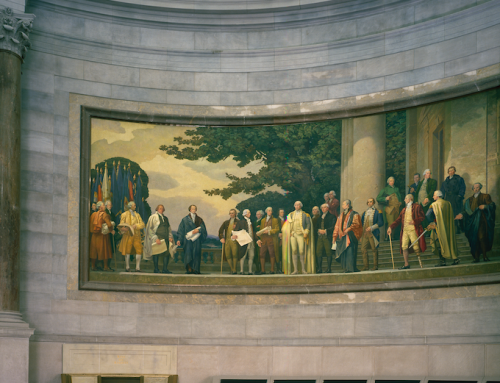


“One by one, the factories shuttered and left our shores, with not even a thought about the millions upon millions of American workers left behind. ”
It’s funny but, just earlier this morning I was thinking of the old Archie Bunker show, aka “All In The Family” and how it represented, right there on the TV screen, the change in the democrat party at the time. For decades, the Archie Bunkers of the world had been the mainstay of the democrat party, working class, often union member folks who voted for Franklin Roosevelt in vast numbers and then Truman, Kennedy and Johnson. But by the early 70’s, they were becoming an embarrassment as the democrat party moved upscale and became more elitist, as represented by the other main character of the show, Mike (the Meathead) Stivik. And it’s continued right to the present. The whole “Occupy” thing wasn’t working class Archie Bunker types but rather upper middle class white college kids for whom protesting was a sort of lark. And it was the same for that idiotic protest the day after Donald Trump’s inauguration. Who were the leaders at this protest? Genuine working class folks? No. It was washed up ex-movie stars (Ashley Judd) and washed up ex-singing stars (Madonna), the former sounding like an escapee from a mental institution.
This is the key line in Trump’s speech: “Every decision on trade, on taxes, on immigration, on foreign affairs, will be made to benefit American workers and American families.”
That doesn’t necessarily call for the end of free trade agreements. Free trade can be beneficial and protectionism can be beneficial. It depends on the agreement. When tariffs are high then a break down of tariffs is economically sound policy, but there is a point of diminishing return. At some point the incentive becomes to move out of the country to a lower salaried work force. So some level of tariffs actually help a nation. The problem is knee-jerk free traders and knee-jerk protectionists. You have to find a sweet spot in between. So if you really think Trump is going to end free trade, I don’t think it will happen. Congress wouldn’t let him anyway.
Respectfully, I disagree with Mr. Pearce’s optimistic view of Trump’s policies. I believe President Trump is on the right track of focusing economics towards the national rather than the global. Along with Joseph Pearce, I applaud him for that. However, President Trump is still very far away from the Distributist principles I know Mr. Pearce espouses as well. Recently, the President has emphasized deregulation as a solution to our national economic sluggishness. Some of these regulations were safety nets for workers and for the environment. Under Trump’s economic policies, we are still in the realm of wage-slaves serving the businesses, rather than the businesses serving the greater and higher needs of the family and environment, both of which God has provided for us. I certainly hope that President Trump leads us further to that direction, but his words and actions thus far, as laudable of some of them may be, still pose impediments to Distributist principles.
Unfortunately, the core of Trump’s policies isn’t subsidiarity (that would bury Musk and the techno-optimists, and restore tariffs at local level) but a return to the imperialist “power politics” of the nineteenth century, when strong economies and militiaries oppressed smaller societies. None of this was done even in the name of Christianity. Trump, like Putin and Xi, believe in a “multipolar world” with no overriding truths or principles, only power and the absolutes of their respective societies (Islam, Confucian atheism, national capitalism, etc). This is said to replace liberal globalism, which does recognise an overriding “truth”, liberalism. Of course, liberalism’s truth is false, but its commitment to rationally knowable universal principles is not wrong in itself. In fact, universal, global, eternal principles applying to all at all times was the basis of the old Christian West. This universality has been totally abandoned by the Guenonist “Traditionalism” of the new paganism espoused by Putin at his last Valdai club speech. This paganism only recognises one truth – society, and whatever respective evolving “tradition” applies.
In such a situation, I vote, like Saint Augustine when the corrupt Roman world of late antiquity was attacked by alien enemies of the West, to defend the shell of that West today. Trump, and many Western “nationalists” are falling into the embrace of the West’s worst enemies, or happy to hand over chunks of the West to its enemies for “raisons d’etat”. The true West is Europe, the Americas (particularly Iberian America and the southern third of the U.S.), the Philippines and, increasingly, much of Africa. This is our home and a very shabby one it is, but there is no other. If the U.S. really is “great”, it does have an obligation to defend Europe, and a country like Ukraine, which is irrevocably committed to being part of the West. Even a total Russian military victory and conquest would not change that now. To solve its existential problem and have unity with Ukraine, Russia will have to return to the West which Vladimir joined by his baptism (as Solzhenitsyn referred to it).
This is an outline of the geopolitics of the traditional West which ended with the Enlightenment. It needs to become visible again. Otherwise, we’ll be choosing false alternatives till kingdom come.
Thank you Miguel Cervantes for what Wm. F. Buckley (Jr.) would have called a trenchant analysis. Too much of what passes for political economy lately derives from talking heads on a couple of cable channels pretending to be “news”.
Of late, I have understood better the last words of Grandpa Joad in “The Grapes of Wrath”, when he declared he wasn’t moving. “This land ain’t worth much, but it’s mine!”
Thank you, David Naas! Grandpa Joad had the right idea, as you say.
I think we should change our language and not allow ourselves to be defined as protectionist. It is not really protection but an entrance fee to our market with rule of equitable of treatment. We expect to pay some small tariff as an entrance fee there. If they engage in protective tariffs we engage in punitive tariffs. In TN, where I live, to transact business I pay a 9.75% entrance fee to the market. There’s infrastructure that has to be paid for to make “the market” possible. I think we fall into the trap of allowing others to define us.
A low tariff makes you business friendly. You want to attract business to your market, so it works like property taxes. Lower you property taxes and you suck owners in. Using low tariff entrance fee as a way to gain funds makes the government desirous to build the frame work for healthy markets within it because the more importers to sell goods the more resources collected. It has the same counterintuitive effects something like cutting taxes does. It increases revenues instead of decreasing them.
However, there are certain industries you can’t let die or face the onslaught of cheap inferior competition. Buying Chinese steel for instance. U.S. Steel being owned by a foreign corporation is nuts. Oil, mining, etc. all fall under common sense conservative principles. For the sake of national security certain industries can/should never be out sourced. Libertarian “Free Trade” is all about prices. It is how we ended buying our drones and chips from Asia that operate out military tech.
I don’t know about you all, but Ive never seen free trade personally. It is always extremely targeted free trade with phone book sized documents explaining the details. Free Trade takes one sheet of paper and a single sentence. No Tariffs. I’m so glad to see a low tariff and equitable principles of trade being applied. It’ll be bumpy for a minute or two but when the dust clears everyone will be better off.
9.75% entrance fee in TN is the sales tax here, if that wasn’t clear.
You have a lot of truth in what you say.
My problem is that I see the “libertarian” or “anarcho-capitalist” myth of laissez-faire as a big fib. That, whether the tale comes from the dueling banjos of Ayn Rand or Murray Rothbard (or the Silicon Valley “tech-bros”).
Any “free-enterprise” capitalist system is never “unregulated”, but “permitted” by State regulations. The State, in fact, has to weigh in on the side of “free-enterprise” for it to succeed.
Then the wealthy moguls convince themselves they are daring entrepreneurs who bootstrapped themselves from the egg into their fabulous well-deserved bank accounts. (And begin buying up politicians — Left and Right — in wholesale lots to keep what they’ve got.)
Nevertheless, in the long run, and for society as a whole, the maximum of freedom available under a stable, ordered continuity is desirable. As you say, we have never seen “free trade”. But the ongoing babble from all sides today attempts to limit discussion to the immediate and transactional, and shut out the voices of the dead and the yet unborn, who also have a “vested interest” in the Present.
I describe the fault of Libertarianism as understanding the only value of a thing as the dollar value. After I wrote this comment here I actually went over to my Substack and published an article that more fully elaborates on the effects of tariffs (I believe that strong money & pro-business/import policies are the result) and the purpose of reciprocal tariffs as a lever to modify the behavior of those abusing our citizens abroad. Thanks for replying. Blessings!
Many good points here. It would be nice if other nations played fair and there was no product dumping in the US and if industries were loyal to the US. I will say it is beneficial to use cheap labor from abroad for things and that it is also beneficial to those economies. Clearly we need steel, mining and energy industries. I was told by a chemistry professor (many years ago) that the chemical industry was really the key – not steel. He may have had a skewed perspective but it is a point to consider. It is true to an extent because the US still had a decent steel industry at that time. It should be obvious that now the manufacture of semiconductors is very important. That and not spending money frivolously.