
On May 7, 1945, the German High Command surrendered to the Allies, bringing the war in Europe to an end. The following day was celebrated as Victory in Europe, or V-E, Day.
On May 8, General Dwight D. Eisenhower issued a Victory Order of the Day, which read in part:
“The crusade on which we embarked in the early summer of 1944 has reached its glorious conclusion….
On the road to victory you have endured every discomfort and privation and have surmounted every obstacle ingenuity and desperation could throw in your path. You did not pause until our front was firmly joined up with the great Red Army coming from the East, and other Allied Forces, coming from the South. Full victory in Europe has been attained….
The route you have traveled through hundreds of miles is marked by the graves of former comrades. From them has been exacted the ultimate sacrifice; blood of many nations – American, British, Canadian, French, Polish and others – has helped to gain the victory. Each of the fallen died as a member of the team to which you belong, bound together by a common love of liberty and a refusal to submit to enslavement. No monument of stone, no memorial of whatever magnitude could so well express our respect and veneration for their sacrifice as would perpetuation of the spirit of comradeship in which they died. As we celebrate Victory in Europe let us remind ourselves that our common problems of the immediate and distant future can best be solved in the same conceptions of cooperation and devotion to the cause of human freedom as have made this Expeditionary Force such a mighty engine of righteous destruction.”
Spontaneous celebrations erupted across the world, as seen in this video clip from “End Game,” courtesy of The History Channel.
Text of the Victory Order courtesy of the National Park Service.
The Imaginative Conservative applies the principle of appreciation to the discussion of culture and politics—we approach dialogue with magnanimity rather than with mere civility. Will you help us remain a refreshing oasis in the increasingly contentious arena of modern discourse? Please consider donating now.
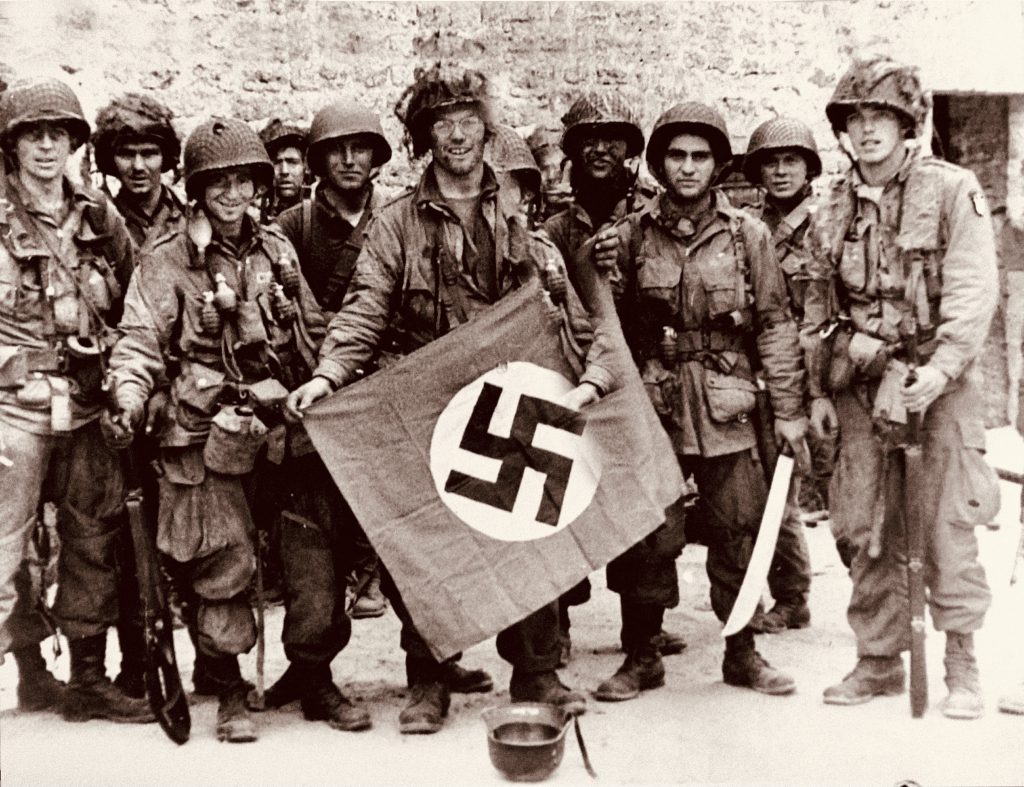
The featured image is a photograph of American paratrooper James Flanagan (2nd Platoon, C Co, 1-502nd PIR), among the first to make successful landings on the continent, holding a Nazi flag captured in a village assault. Marmion Farm at Ravenoville, Utah Beach, France. 8 June 1944. This file is in the public domain, courtesy of Wikimedia Commons.


Great!
My father served in those campaigns.
As did mine. What unit was your father in?
Having lived through both of Dwight D. Eisenhower’s presidential terms, he might be characterized as a man of peace unlike most of his predecessors and those who followed him. One could take fundamental issue with the term “Righteous Destruction” as self contradictory in every possible way and a violation of simple logic or principle. Does the laying down of arms always have to be a function of victory and defeat? Victory in war should be thoroughly regarded as a tragedy and essentially treated as a funeral rather than celebrated. Did any soldier participating in any war truly have personal issues with those he opposed, if not, what was the objective in taking another’s life. If the objective was the triumph of one state over another, for whatever reason, how can that excuse the loss of sons, daughters, fathers, mothers, grandfathers, grandmothers, grandsons, granddaughters, before their time. Is it any less savage to kill another in the name of justice, and has one really broken the bonds of savagery by doing so?