
Why, one wonders, was Hilaire Belloc so wrong about World War One when he was so right about so many other things?
The trouble with satire is that it is topical. It is a child of its time. It is similar to a fad or a fashion. It is very up to date. And the problem with things that are up to date is that they out of date very quickly.
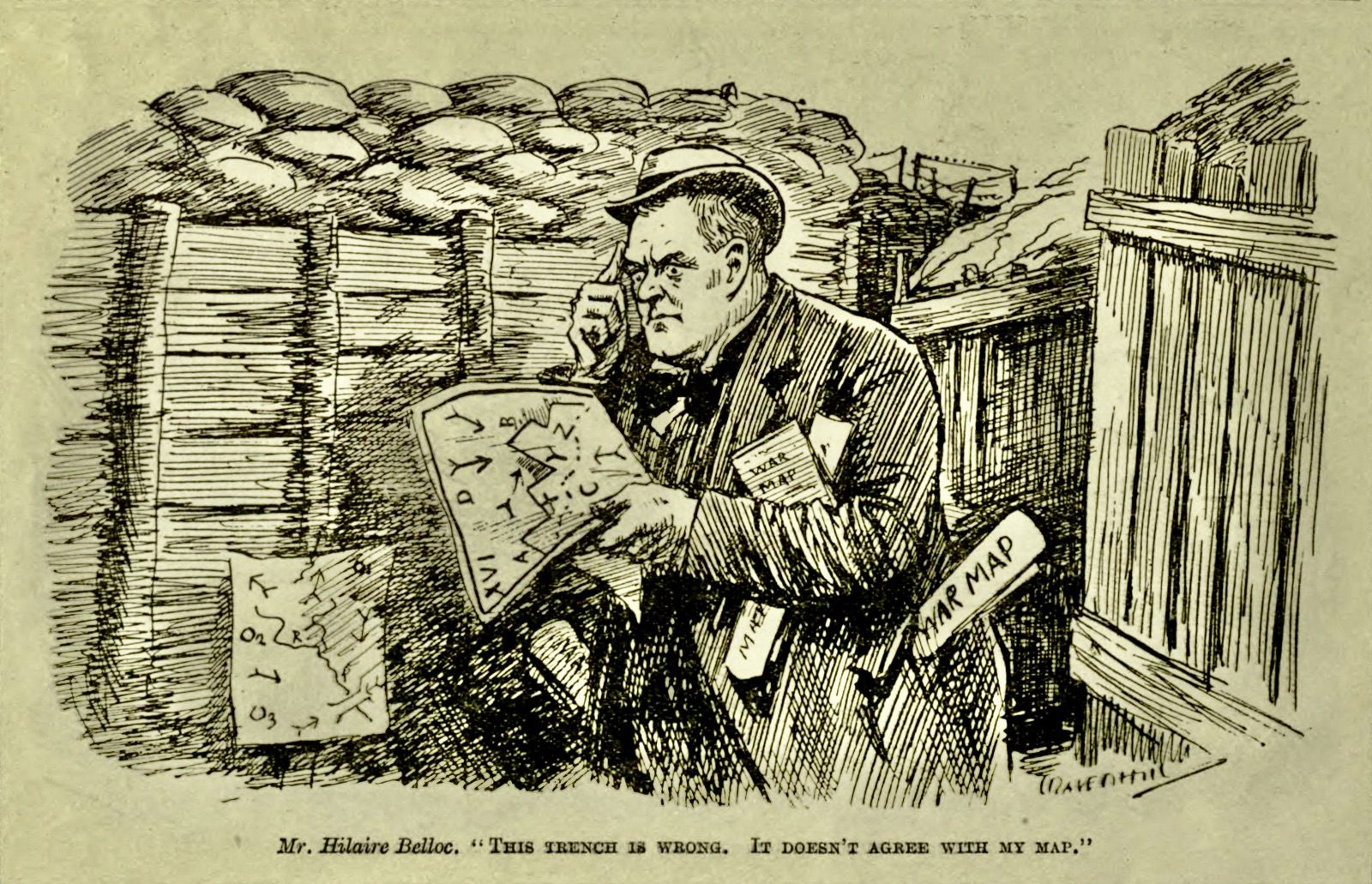
Take the satirical magazine Punch, for instance, a weekly journal published from 1841 until 2001, which popularized the political cartoon. In my own library, I have a curious volume that contains every issue of Punch published in the year 1889. Browsing through it, I am astonished at how obscure and indecipherable most of the content has become. What was considered relevant and humorous in late Victorian England is now merely puzzling. Such is the case with a cartoon published in Punch in 1917, almost thirty years later, which shows Hilaire Belloc, pockets stuffed full of maps, standing in a trench during World War One and looking perplexed. “This trench is wrong,” he ponders. “It doesn’t agree with my map.” Even those who admire Belloc and know something about the history of World War One will be puzzled by the meaning of the cartoon and its caption, scratching their heads in perplexed consternation as Belloc is depicted as doing in the cartoon itself.
In order to decipher this historical and satirical snapshot, it is necessary to understand Belloc’s activities during the war.
World War One began on August 4, 1914. A month later, on September 9, Belloc was visited in his home in Sussex by the proprietor of a new weekly journal, Land and Water, which was dedicated exclusively to the coverage of the war. After a three-hour discussion, the proprietor persuaded Belloc to sign a contract which committed him to the writing of a weekly article on the military situation as it unfolded. The circulation of Land and Water soon reached 100,000, which resulted in Belloc acquiring a wider fame than ever and making him far wealthier than he had ever been before.
The initial success and popularity of Belloc’s coverage of the war was evident in a letter from Spenser Wilkinson, a Professor of Miliary History, published in Land and Water on December 26, 1914:
Hilaire Belloc is rendering a great service to this country and to the cause of the Allies by his weekly articles on the war… of which I have read every word since they began. No other articles have been so helpful to me. They reveal a thorough knowledge of war and a military judgement of a high order, as well as an unrivalled grip of the geography of a theatre of war and of its significance. They are, moreover, so clearly written and so well illustrated that no once can fail to understand them.
The enthusiastic response of military experts was matched by those who could claim no expertise in matters of war. “Belloc has been very fine in Land & Water,” wrote the artist William Rothenstein to the writer and caricaturist Max Beerbohm. “I love to be told by convincing & fine people that we are to win, to go on until we win & that Germany is to be beaten to her knees.”
Rothenstein’s effusive expression of enthusiasm reflected the general feeling of optimism that characterized the first months of the war. Such optimism, expressive of a shallow patriotic jingoism, would become less sustainable as the war became bogged down, literally, in an entrenched stalemate and as the body count continued to rise inexorably. As the war entered its second year, Belloc’s reading of the situation was being widely question. In September 1915, posters appeared in the streets emblazoned with the words “Belloc’s Fables” and listing the errors he had made in his weekly articles. A spoof book, entitled What I know about the War by “Blare Hilloc”, containing nothing but blank pages, was circulated widely. It is in this context that the cartoon in Punch should be read, its satirical gibe indicative that most people now considered Belloc’s judgment of things to be at loggerheads with the reality on the ground.
Ironically, having been hopelessly optimistic in all his predictions since the war had begun, Belloc told his sister at the end of August 1918 that he did not think the war was likely to end “before April or even June” of the following year. His sister, as skeptical of Belloc’s judgement as most other people, preferred to believe a “French Saint [who] says it will end before Christmas”. In the event, the prediction of the “saint” was right, whereas Belloc, predictably, was wrong.
Why, one wonders, was Hilaire Belloc so wrong about World War One when he was so right about so many other things? The answer lies in the pride and prejudice with which he approached the war. The pride of his irrepressible Francophilia and the prejudice of his incorrigible Germanophobia (or, more correctly, his Prussophobic distaste for the Bismarckian spirit of Prussia) led to his seeing things as he wished to see them, not as they really were. In addition, the answer “lies” in the other sense of the word. Belloc was wielding his pen like a sword, as a patriotic weapon of propaganda to assist the cause of the Allies. He hoped that his pen could be mightier than the sword and that his patriotic wielding of it would assist the cause of the Allies. The problem is that the pen that is put to the service of propaganda invariably stabs truth in the back.
__________
The Imaginative Conservative applies the principle of appreciation to the discussion of culture and politics as we approach dialogue with magnanimity rather than with mere civility. Will you help us remain a refreshing oasis in the increasingly contentious arena of modern discourse? Please consider donating now.
The featured image is a caricature of Hilaire Belloc in Punch magazine, 27 June 1917, and is in the public domain, courtesy of Wikimedia Commons.





If America had stayed out of WW1, Germany would have beaten the evil empire of Britain.
Hence there would not have been a WW2 or Nazis.
In that time period there was no sympathy to defend the British.
People had ancestors that fought in the War of Independence, War of 1812, Civil War.
Soldiers at Valley Forge cooked their old boots and ate them, rather than give in the the British.
The evil British started both world wars, and tryin to start WW3, currently.
Eh, I mean maybe. But the Germans weren’t all that noble in World War I either. They were also an imperialistic nation that had engaged in atrocities on subjugated peoples. And their allies, the Ottomans, were at least arguably worse.
I mean I think it might have been best if we had stayed out of it too as it was mostly a European issue. WWII was a bit different and I think blaming the British for WWII is a bit weird. (Maybe you could blame the French or the Soviets, but the British doesn’t really work.)
In regard to U.S.involvement in World War II, I am amazed at how many people seem to forget one basic fact. As “Shifty” Powers of the 101st Airborne put it in “Band of Brothers”: “We was attacked.”
As the grandson of a Polish immigrant, I seem to remember that Hitler’s invasion of Poland on September 1, 1939 had something to do with the start of World War II. (As did the Japanese bombing of Pearl Harbor.) And as the son of an American paratrooper who jumped alongside young British boys in their common struggle to defeat Nazism, I take exception to your blanket indictment of the “evil British.”
You do realize the Author is English, right?
This is a very interesting article, in part because I think Belloc did precisely the same thing with his criticism of the reformation vis-a-vis Romanism (as so many others do). Hear me out. Certainly much of what came out of the reformation turned out to be radical nonsense which destroyed the unity of the Church. But it didn’t start out that way. The reformation of Luther, Melanchthon, Chemnitz, etc. was a very, we might say, “imaginative conservative” reformation and only sought to strengthen the unity of the Church by helping to rid it of the excesses of its medieval corruption. The reformation of the fifteen teens and twenties was throughly catholic, and it was the papacy’s refusal to engage in the conversation and work toward eliminating corruption that caused the decisive split (resulting in the more radical reformers who would follow), rather than beginning with some rogue libertine revolutionaries. My point is that just as Belloc knew some things about WWI and enough to make his account compelling, but his excessive love for his fatherland and his fear (ironically, in this case) of the Germans, caused him to over-exaggerate his statements in favor of the Allies, so too his statements about the reformation (generally) are often correct—it has resulted in horrible disunity in the Church that ought to be avoided like the plague—but his love for the papacy and misunderstanding (or ignoring) of what the conservative reformers were actually up to in striving to recenter the Church’s unity in Christ and in His holy Word and blessed Sacraments, has caused him to look at the whole lot in a way that is askew with the facts and glosses over these theologians’ attempts to simply rid the Church of its divisive falsities.
I thank Mr. Pearce for his objective, enlightening, and amusing story about Hilaire Belloc, which combines satire, war, a cartoon, and the telling explanation of all in one essay. The “whom to blame” comments following the excellent piece have not tracked or could reflect on the message of the article directly. That also proves that the obscurantist, secretive, and indecipherable nature of war reporting deeply touches and influences personal feelings and the interpretation of history for generations to come.