
In the wake of Hamas’ attack on Israel, Douglas Murray asks broad questions: “What can Western liberal societies do in the face of such movements? What can people who value life do in the face of those who worship death.”
On Democracies and Death Cults: Israel and the Future of Civilization, by Douglas Murray (209 pages, Broadside Books, 2025)
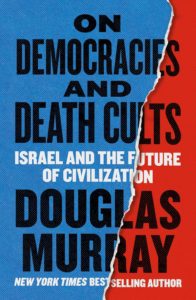 What is Israel to do? What must Israel do? What should Israel do? These are among the many questions that preoccupied Douglas Murray in the aftermath of the Hamas attack on Israel of October 7, 2023.
Near the end of this short book Murray recounts an interview that a “Hamas official” gave to a Lebanese television channel shortly after that attack. According to one Ghazi Hamad, “Israel is a country that has no place on our land.” Therefore, the “occupation must come to an end.”
“Does that mean the annihilation of Israel?” asked the interviewer. “Yes, of course,” was the immediate reply. “The existence of Israel is illogical…. Everything we do is justified.”
Murray’s response to that exchange is to ask even broader questions. “What can Western liberal societies do in the face of such movements? What can people who value life do in the face of those who worship death.”
For those who think that the challenge that Israel faces is Israel’s alone, Murray has a very simple and very direct response: The challenge is not Israel’s alone; hence the subtitle of this book is “Israel and the Future of Civilization” and not “The Future of Israel.”
There is no doubt in Murray’s mind that Israel faces a very real existential threat to its own continued existence. There is also no doubt in his mind that the fate of Israel and the fate of Western civilization are not just closely linked together, but are essentially one and the same. Lastly, for Murray there is little to no doubt that the source of the current threat to Israel’s future is readily traceable to the rise to power of the mullahs who have controlled Iran since the 1979 overthrow of the Shah of Iran.
In fact, this book opens with the January 31, 1979, flight from Paris to Tehran that returned the Ayatollah Khomeini to Iran and set in motion the end of the reign of the Shah and the onset of an attempt to establish Shiite imperial rule in the region. In truth, it is Murray’s correct contention that over the course of the last four plus decades it has been Iran, not Israel, that has sought imperial power over its neighbors.
Murray also takes note of the celebratory response of many Western intellectuals and journalists to that flight and the subsequent Shiite seizure of power that led to the capture and hostage holding of fifty-two Americans in the American embassy, as well as to the murder of many of the Shiite’s domestic political opponents, including communists and trade unionists who had worked with them to overthrow the Shah. It was all a preview of coming actions (on the part of the Islamist regime) and attractions (of too many Westerners, whether intellectuals or journalists or otherwise, to the success of their cause).
At roughly the same time, the position of Israel in the collective mind of too many Westerners had shifted from that of underdog to that of, as Murray puts it, “overdog.” From the creation of the state of Israel in 1948 through the six-day war of 1967 Israel was not just an underdog, but a highly sympathetic underdog at that.
Israel may never again be able to reclaim its underdog status. But does it deserve to be called the overdog? Murray presumes that at this point in its history Israel has no choice. And no doubt he is right, difficult as its choices and position must be.
Difficult, as in reading, also describes the contents of this book, the heart of which is an extended Murray travelogue of sorts throughout the state of Israel in the aftermath of October 7. He makes no bones about the multiple failures on October 7. Almost every element/leader of the state failed, whether they be politicians, the military or intelligence officers. The roots of that failure are traceable to a mistaken consensus that had emerged within the Israeli government among both those on the left and the right. The essence of that consensus was that Muslim terrorists had come to enjoy, and even luxuriate, in simply being corrupt. Forgotten was the simple fact that “some fanatics are simply fanatics.”
Failure extended to the common folk as well. While Murray is not about blaming the victim, he notes that the Israeli media did not report on those party-goers of October 7 who killed themselves or who had been sent to mental institutions. Why? Many of those who had been enjoying the music and the partying had been on drugs. Those on cocaine could at least run, but those on mind expanding drugs, as the phrase would have it, often simply collapsed, because their minds had, well, “simply collapsed.”
But Murrary also discovered many reasons to be hopeful about Israel, especially about the ordinary Israeli citizens who rose to the occasion on and after October 7th. The heart of the book dwells on their stories. And it is important for all Westerners to read such stories, if only because a) Israel is fighting for Western civilization; and b) Murray reminds us that what Israel “stared into that day is a reality that we might all stare into again at some point soon.”
To be sure, this book was written well before the “12 day” war of June, 2025. No doubt Douglas Murray would praise the apparent success of that war. Still, one doubts that he would change a word of his warning in the previous paragraph.
More than that, for much of the book his questions remain unanswered. Just what are “democracies” to do in the face of “death cults.” How do Westerners deal with fanatics who are “simply fanatics,” especially fanatics who are “worse anti-Semites than the Nazis”? After all, the Nazis hid what they were doing, while the Islamists killed with “such relish” and “intense joy.” They were–and are–to put it starkly, “proud of themselves.”
Near the end of the book Murray recounts the April, 2024, confirmation of a Hamas leader who learned that three of his four sons had been killed in an air strike in Gaza. The leader was “not upset. If anything he (was) joyful.” After all, he had often extolled the “martyrdom” of Palestinian children. In 2017 he had openly stated that “children are tools to be used against Israel. We will sacrifice them for the political support of the world.”
A bit later Murray contrasts the grief of Israelis who have lost sons and friends to a “society that is happy to hear of the deaths of their own family and other people’s family.” He then returns to a question that he had “mulled over for a quarter of a century.” For much of his adult life he had been haunted by this taunt of the jihadists: “We love death more than you love life.” It was a taunt that had appeared to him to be “almost impossible to counter.”
But his post-10/7 experiences in Israel had answered his question. At least partially so. Ordinary Israeli citizens and soldiers fought because they do “love life.” In fact, “they fought for life.” Will the West in general do the same? That question is yet to be answered.
To “choose life” is not just a commandment of the Jewish people; it is also “one of the fundamental values of the west.” In other (Murray) words, the Israelis, nay “all of us, can win in spite of the enemy loving death. Because there is nothing wrong with loving life so much. It is the basis on which civilization can win.”
And yet, the question remains: will civilization prevail. Murray himself alludes to a reason for doubt. In fact, his previous books point to such doubts. Murray cannot avoid mentioning that on his brief trips back to America or England he could not avoid noting that both societies, while “far from the front lines, seemed to have been driven mad by war.” Driven mad? How else to account for societies preoccupied with deciding “when you might kill an old person or a fetus.”
Hmmm… maybe the title of this book has a double meaning. Maybe democracies are not just facing death cults, but producing a death cult all its own. If so, perhaps Israel is both fighting for the West and offering an example to the West.
How will this all turn out? No one can know. What Douglas Murray does know is that Israel was the place that “felt least out of joint” to him in the aftermath of 10/7. It was also a place that has helped him lose “some of (his) usual pessimism. Why? Because the Israelis have chosen life.
And the West in general? “What we would do if we came to a time of trial like our forebears did?” Huh? You read that declarative non-sentence ending with a question mark correctly. It must be an uncorrected error. Or perhaps Murray had tired of asking questions that cannot yet be answered. Yes, just what will we do?
___________
The Imaginative Conservative applies the principle of appreciation to the discussion of culture and politics—we approach dialogue with magnanimity rather than with mere civility. Will you help us remain a refreshing oasis in the increasingly contentious arena of modern discourse? Please consider donating now.
The featured image is free and may be used by anyone for any purpose, courtesy of Wikimedia Commons.



I’m struck with the quotes below that so illustrate that we face a battle between life and death. Life promoted by Judeo-Christian beliefs as well as Buddhism, Hinduism, and Confucianism. Indeed life is promoted by everyone wanting to build and improve society. By taking evolutionary improvement steps.
Death is promoted by jihadists, by those hoping we eliminate humanity by not having children, by those wanting to tear down and destroy society, by those demanding revolution, which always causes massive death.
The choice of life versus death is a choice between evolution and revolution. Perhaps explains the bond between jihadists and wokies.
Jihadists: “We love death more than you love life.”
Golda Meir: When peace comes we will perhaps in time be able to forgive the Arabs for killing our sons, but it will be harder for us to forgive them for having forced us to kill their sons. Peace will come when the Arabs will love their children more than they hate us.”
Pope John Paul II: “May the culture of life and love render vain the logic of death.”
Pope Benedict XVI: “Violence is incompatible with the nature of God and the nature of the soul”
I finished reading the book the other day. It is outstanding. It supplements Josh Hammer’s magisterial book “Israel and Civilization.” Together both books will give the reader a deep context justifying support for Israel.
Is it unreasonable to guess that Mr. Murray does not consider the possibility that the Israeli response to October 7 might have been, and is continuing to be, disproportionate? Whatever the death toll due to Israeli military operations since then, whatever numbers should be trusted, it has been a lot. Are they all justified because of the atrocities on October 7?
I initially defended Israel a bit, but nearly two years in I am starting to think they do need to think of an endgame to this. The attack on Christians in Taebiyah and recently Gaza is also kind of making it harder to defend them.
I mean I think Hamas is a dangerous group of extremists and I’ve been appalled by many of the anti-Israel protests. But if the only way to neutralize Hamas is to wipe out the population of Gaza that does feel too high. I’m not sure how I feel though.
It seems to me it ought to be okay to raise those questions, and it is no way a denial of the horror and the evil of October 7 to do so.
The acts of Hamas, Hezbollah, and other Muslim fanatics are acts of heroism for Allah, meant to be acts of honor for other young men to follow. Those who believe they have been somehow unjustly injured commit nearly every desperate act and almost every crime. Through their successful killings and heroic suicides, Allah will give them justice; that is their belief, as it was nearly 600 years ago when the Ottomans conquered Byzantium and southeastern Europe.
The modern Muslim terrorists’ acts have everything to do with justice, albeit a distorted sense of justice, similar to the justice envisioned by all other naïve, idealistic, and fanatic do-gooders. The killers were not evil in a Manichean sense, but they were terrible in the classic Judeo-Christian sense: Twisted in their goodness, just like modern liberals and all radical leftists. They wanted justice and committed horrific crimes to pursue what they thought was justice. It was twisted goodness, but not a senseless action by these devout followers of Islam.
What makes the tragedy of October 7, 2023, so different? It is not merely that so many people died a horrible death; after all, people die in so many awful ways every day. Perhaps the answer is that this catastrophe was a genuine tragedy — a tragedy that was real, yet incomprehensible, sudden yet uncertain, and avoidable yet unexpected. Because 10/07 was not inevitable; it was preventable. But the threat remains, and the world’s discord, injustice, and levels of hate have not abated.
Do we, in the West, love our lives? We find our lives wanting — security and safety are a long way off while living in a broken world at a broken time and coming from broken places. We do not have any purpose in our lives; we live for the day, for the minute, senselessly, irresponsibly, and angrily. Furthermore, we have destroyed our environment, history, identity, culture, and ourselves. And our leaders want to impose all that on other people and cultures. We all know they are wrong and do not trust them, but we feel powerless, defeated, intimidated, and humiliated to fight or do anything — even to live or care.
That is why we secretly even sympathize with those young Arabs who are different from us. Yes, they knew what they were doing and why — and our degenerate world had driven them to do it. The Western world is soulless, spiritless, enervated, declining, immoral, amoral, nihilistic, hypocritical, without a spark of life worth living for or a flicker of light at the end of the tunnel. Living a primitive lifestyle, being the slaves of Western democracy, and having lost even a semblance of decency, we preach about human rights and equality while being barbaric, unfair, unjust, and unlikable.
The countries of the Western world are all divided and will invade other nations that did not threaten them, did not attack them, and did not want war with them, allegedly to disarm those countries of weapons they did not even have, or to protect human rights. And then many Americans and Europeans struggle to understand why an enemy would hate them with such zeal.
Americans and Europeans fear losing their countries to the unwelcome and intrusive millions of the Global South coming to dispossess them of their heritage. They have never been asked or voted for this intrusion but wanted their chosen leaders to stop it.
Talking about democracies and death cults: Abortion, same-sex marriage, transgender rights, socialism, capitalism, affirmative action, Black Lives Matter, urban crime, gun violence, critical race theory, allegations of white privilege and supremacy, and demands that equality of opportunity give way to equity of rewards divide the people, the U.S., Europe, and the entire Western civilization.
Excellent review