
It’s remarkable that “Amahl” should be the most frequently performed opera worldwide, considering this is a work created for a specific seasonal context. Yet in another sense it’s understandable, given how Gian Carlo Menotti brilliantly scaled down the luxuriant demands of opera to create a small-budget piece that just about any group of skilled performers can present, even with minimal costumes and scenery.
 In a recent book, the poet and author Dana Gioia comments that Amahl and the Night Visitors is the most frequently performed opera in the world. Intrigued, I gave a second spin to Gian Carlo Menotti’s Christmas classic, which thrilled in me in my teen years when I played violin in a local production. I found that the work’s charms were enhanced with age: hearing it with adult ears, I discovered layers of artfulness to Menotti’s musical tale. There are rare occasions when an artist strikes gold, creating a work that speaks to people on a direct and universal level and becomes a cultural icon. Such an artist was Menotti and such a work was Amahl and the Night Visitors.
Amahl was originally conceived not for the opera house but for the living room. Broadcast on NBC on Christmas Eve, 1951, it was the first opera written expressly for television, the new medium that was transforming life in postwar America. Hard as it may be to imagine now, TV in its early years was frequently a vehicle for serious art and culture (like Leonard Berstein’s Young People’s Concerts, which introduced a whole generation to the wonders of classical music), and expressions of faith were not out of court. The TV medium offered new possibilities of reaching and connecting with huge audiences through both sight and sound, something that the networks and serious musicians like Menotti quickly seized.
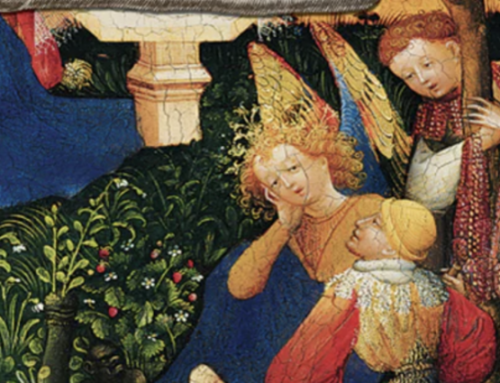
Gian Carlo Menotti, born in northern Italy in 1911, immigrated to the U.S. in the 1930s and staked out a place for himself as a composer (to his own librettos) of compelling, effective, and well-crafted works of musical theater with a broad appeal. Menotti based Amahl on folk legends about the three Magi he grew up with in Italy, but the actual impetus came from viewing a Renaissance painting, Bosch’s The Adoration of the Magi, at New York’s Metropolitan Museum. Menotti was behind on his deadline to deliver the opera to NBC and bereft of ideas; suddenly, as he tells it, inspiration struck and “I heard again […] the weird song of the Three Kings” who used to deliver the holiday gifts to him and his brother. The simple miracle story belongs to the honorable tradition of imaginative elaborations on the Bible, still to be seen on a modern series like The Chosen.
Is there anyone who doesn’t know the story? In brief: Amahl is a poor, crippled boy in first-century Judea who lives with his widowed mother. As he is an imaginative child with a tendency to lie, his mother doesn’t believe him when he tells her of an extraordinary star in the sky and three kings who have arrived at their door. But the kings are there, and they ask to stay the night and explain that they are on a journey to visit a very special newborn child. Amahl and his mother accommodate and entertain them as best they can. That night, the impoverished mother tries to steal some of the kings’ gold for Amahl’s sake, but she is caught red-handed. King Melchior lets her keep the gold, as the King they seek does not need earthly treasure. Amahl offers his crutch as a gift to the child, and the moment he does so discovers that he can walk.
(A grace note: as a child Menotti was himself crippled, and experienced a healing of his leg after visiting a statue of the Blessed Mother at a village church.)
Amahl’s artful simplicity is part of what has endeared it to generations of audiences. The opera features a cast of just six characters, a single stage set, and a small orchestra. It is in one act and just under an hour in length. Yet the opera his sophisticated in its craft; Menotti “writes down” to nobody. The role of Amahl might be the only virtuoso role for a young boy in the world of opera. It’s not “easy” for a lad of 12 to carry a whole drama, and this role requires conspicuous talent for pitch, spot-on rhythm, and the ability to raise a few tears.
Menotti perfectly grasped his assignment to write a popular opera for young and old. His music for Amahl is lyric and gently modern, expertly written for the voice and perfectly married to the text. He even finds room to evoke the Middle Eastern ambiance of the story with a sense of biblical majesty. The quartet for the mother and the kings, “Have you seen a child,” is for me the musical and emotional high point of the work. Menotti translated the Italian operatic traditions he grew up with to a modern American context: recitatives are brittle or filled with wonder, the words often colloquial, and lyrical arias flower up out of the dramatic situation. As a composer, Menotti took influences from wherever he could find them, crafting a style that aimed at effective storytelling. He had an unerring sense of theater and of finding the right music to complement the drama. As one example, the moment when the mother opens the door of the cottage to reveal the three kings, singing their “Good evening” in three-part harmony, is apt to give you chills.
Menotti characterizes the kings as individuals; making Caspar a buffo tenor with a hearing problem was a stroke of genius, adding comic relief and a parallel with Amahl’s own disability. (Why is Caspar deaf in this opera? Menotti’s brother always assumed one of the kings was deaf because he never got the presents he wanted.) The role of the mother has been played by great lyric sopranos, and her “Do rich people know” aria, before she steals the gold, gives scope for drama. Balthazar, the African king, is the deepest voiced of the trio of kings, while Melchior gets the most eloquent solo, toward the end of the opera, a passage in which Menotti shines as librettist:
“Oh woman, you can keep the gold. The Child we seek doesn’t need our gold. On love, on love alone He will build His kingdom. His pierced hand will hold no scepter. His haloed head will wear no crown. His might will not be built on your toil. Swifter than lightning He will soon walk among us. He will bring us new life and receive our death, and the keys to His city belong to the poor.”
Through his opera Menotti extols the poor who will inherit the earth. There is plenty of variety in these 50 minutes, even including a ballet as the shepherds from the country ’round dance to entertain the kings. And if you can remain dry-eyed at the moment of Amahl’s healing…you are more stoic than I.
It’s remarkable that Amahl should be the most frequently performed opera worldwide, considering this is a work created for a specific seasonal context. Yet in another sense it’s understandable, given how Menotti brilliantly scaled down the luxuriant demands of opera to create a small-budget piece that just about any group of skilled performers can present, even with minimal costumes and scenery.
There’s something pivotal, though, about that 1951 Christmas Eve premiere—a live performance before some five million viewers. More people saw Amahl during that broadcast than ever saw an opera performance in history, and critics hailed it the next day as lifting television into “a new cultural sphere of importance.” It was not simply that Amahl brought the grandeur of opera into people’s homes; the camerawork featured closeups and other devices not available in the opera house, enhancing the emotional impact of the piece. Experienced in whatever form, Amahl has served as an entrée into the magic of opera for generations of listeners.
After that initial performance Amahl became an annual tradition, with repeat broadcasts throughout the 1950s and ’60s (I am now enjoying the fabled 1955 version on DVD, and there are several fine studio recordings), as well as endless productions by professional, amateur, church, and student groups. I am sure that Amahl is hobbling about on his crutch, and King Caspar is showing the contents of his traveling box, somewhere in the world right now.
Amahl and the Night Visitors became at once part of the history of opera, the history of television, and the history of Christmas—something few artists have achieved. Menotti, in a word, struck gold. The childlike freshness of the piece can obscure how ingeniously Menotti renewed and extended tradition into the age of mass media. It’s a reminder of a time when inspirational cultural experiences could bring us together in enjoyment and wonder.
__________
The Imaginative Conservative applies the principle of appreciation to the discussion of culture and politics—we approach dialogue with magnanimity rather than with mere civility. Will you help us remain a refreshing oasis in the increasingly contentious arena of modern discourse? Please consider donating now.
The featured image is “The Adoration of the Magi” (c. 1475), by Hieronymus Bosch, and is in the public domain, courtesy of Wikimedia Commons.





It’s been 70 years since I watched and wept with opera. Thank you. Thank you