
The real problem with most materialists is not that they deny the existence of the invisible realm, but they are cowardly and lazy. They have not had the guts or gumption to follow their disbelief to the end point.
Puddleglum is a Marshwiggle. Those who have read The Silver Chair will remember C.S. Lewis’ description of this particular resident of Narnia. On first sighting, Jill and Eustace Scrubb observe the strange creature:
It had “a long thin face with rather sunken cheeks, a tightly shut mouth, a sharp nose, and no beard. It was wearing a high, pointed hat like a staple, with an enormously wide flat brim. The hair, if it could be called hair, which hung over its large ears was greens-grey, and each lock was flat rather than round, so that thy were like tiny reds. Its expression was solemn, its complexion muddy, and you could see at once that it took a serious view of life.”
“Good morning guests,” it said, “Though I say good, I don’t mean it won’t probably turn to rain or it might be snow, or fog or thunder. You didn’t get any sleep I dare say.”[1]
Now Puddleglum is well named because he lives in a puddle and he is glum. As we get to know him, we learn that his pessimism hides a shrewd intelligence. He may be glum, but he’s nobody’s fool. He becomes the guide for the children in their adventure to find Prince Rilian who has been kidnapped by the Queen of the Underworld—she of the Green Kirtle who we will nickname the Green Queen.
Eventually their quest leads them into the caverns where the Green Queen has enslaved Prince Rilian and put him under a spell. When Puddleglum and the children free him and try to escape, she puts all of them under an enchantment. Using deceptive logic, a seductive siren song, and intoxicating smoke, she convinces them that there is no beautiful land of Narnia. The blue sky, the sun, the moon, the stars and the land above ground are all a figment of their imagination, and they are fools to believe that such a place exists.
Her kingdom of the Underland is all that is. She tries to convince them that Narnia—The beautiful country where all is noble and innocent—is no more than a fond wish, a vain dream and a silly fantasy.
What You See is What You Get
What the Green Queen was selling was old fashioned materialism. Now when I say “materialism” I don’t mean going to the mall to shop until you drop. I don’t mean simply grabbing at more and more possessions in the belief that they will make you happy. Greed is merely one of the symptoms of materialism.
Materialism itself is the main head of Hydra. Put simply, it is the proposal that this physical world is all there is. What you see is what you get. It is “the conviction that everything, including reason, is a product of the material world, that at the root of everything is not a Creator… that freely chooses to bring the material world into being and sustain it. There is just material.” [2]
I am aware that “anti-matter” is a puzzling concept in physics, but it may also be a pleasing concept in metaphysics. To believe in anti-matter might be another way of saying you believe there is more than mere materialism.
Like all of the venomous hydra heads, materialism is rarely proclaimed explicitly. Few people argue openly for materialism. They don’t need to. The entire culture has fallen under the spell of the Green Queen. Instead of an open statement of materialism, the materialist point of view is expressed in the form of mockery.
Should the materialist discover that you are a religious believer he may well quiz you, “Do you pray? What about demons and angels? Really? Do you also believe in your lucky stars? Santa Claus with his eight tiny reindeer? Elves and dwarves and ogres and trolls and tree spirits and wee little leprechauns? The tooth fairy? Tinkerbell? I know… if you believe in fairies clap your hands!”
Should you confess belief in the afterlife, the matter of fact materialist will scoff at the idea of heaven and hell. “Heaven, hell and purgatory? That’s just the wishful thinking of folks who are afraid to die. They invent fanciful destinations where they think they’ll live happily ever after. But that is all make believe.”
Humming that tune by John Lennon, the materialist says, “Imagine there’s no heaven… Imagine there’s no hell.” Then he delivers his brutal denial. “There is no life after death. When you take your last breath it’s a flat line. Nada. Zilch. The lights go out. The curtain drops. That’s it. The end.”
Life After Death
Being embarrassed to admit your belief in heaven, hell, angels, and demons you might retort to the materialist, “But surely you believe in life after death don’t you? What about your soul? We all must end up somewhere!”
To which he will reply, “But what evidence is there for any kind of consciousness surviving physical death, and for that matter what exactly is your ‘soul’?”
“There are plenty of near death experiences.” You reply. “People die and see heaven or hell, then they come back to tell the story!”
“Then they didn’t really die did they?” says the materialist with a condescending smile. Besides, we now know that these experiences are caused by a release of enzymes in the brain—the same ones that produce hallucinations. It’s simply a brain burp—a little hiccup as the body gives up the ghost.”
“You just said ‘give up the ghost!’ So you do believe in the soul after all!”
“It was simply a turn of phrase. A metaphor. No more.”
A Universal Majority
Putting aside the specifics of heaven, hell, angels, demons, leprechauns and the tooth fairy, the basic bottom line is whether one believes in an invisible realm of reality or not. “All questions come down at last to the assertion or denial of a reality independent of the mind which we can know by means of the mind with certainty.”[3]
What do I mean by “an independent or invisible realm of reality”? I mean a dimension of existence that is beyond our normal sense perception. We call it “supernatural” meaning “above or greater than nature.” Unfortunately that definition is somewhat misleading because people hearing “above nature” conclude that the supernatural realm is up in the sky. It would be more accurate to say this realm is “beyond” nature, but even this is not quite right because the supernatural is not only beyond the natural realm. It also infuses and flows through the natural realm like electricity through the power grid.
Let me simplify: Everything physical will, given enough time, rot, rust, die, decay and disappear. The invisible realm of reality is not physical, therefore it is not bound by time or the decay for which material things are destined. This supernatural realm, because it is eternal, is superior to the material realm of dust, dirt, death and decay. However, that is not to say that the physical realm is unimportant or bad because it is through the physical, material realm that we experience the invisible, eternal realm.
What has always tickled me is the arrogant assumption of the materialists, that their disbelief in the invisible realm is somehow not only obvious, but that it is the majority opinion of all ordinary, practically minded people who “don’t bother with all that superstitious, fanciful nonsense.”
In fact, the opposite is true. The vast majority of the human race in all places and cultures down through the ages have been supernaturalists. Most human beings who have ever lived and who are alive today believe in God. They believe in life after death, spirit beings and the possibility of interaction between the visible world and the invisible.
Religion is so basic and distinctive to our humanity that we might as well be called homo orans (praying man) rather than homo sapiens. (thinking man) From the burial cairns of Neanderthals to an astronaut reading the Bible on his way to the moon, mankind is innately religious, and religion pre-supposes a fundamental belief in the invisible, eternal realm.
Even those don’t go to church and who will not commit to believing in angels and demons or heaven and hell, still hold to some sort of vague belief in the “spiritual realm”. They hope to see their departed loved ones again. They dabble in horoscopes and palmistry, give meditation a try and watch documentaries about the Day of the Dead. They nod their head when Obi Wan says “The Force be with you”, and even the doubters get chills when they hear stories of exorcisms, hauntings and miracles.
It is the materialists who are in the minority, and in their intellectual arrogance they look down on the vast majority of good, ordinary human beings who believe there is more in heaven and earth than their materialist philosophy has dreamed of.
Under a Spell
The real problem with most materialists is not that they deny the existence of the invisible realm, but they are cowardly and lazy. They have not had the guts or gumption to follow their disbelief to the end point.
It is all well and good pooh-poohing the tooth fairy and sniggering at those who believe in guardian angels, hellfire, brimstone and the sweet by and by. It’s easy enough to sneer at the rubes who believe in heaven and hell, but what is the end point of materialism? What is the ultimate position of one who disbelieves in the invisible realm?
The end point of materialism must be atheism, and this is the second head of Hydra. It is obvious isn’t it? If one does not believe in the invisible realm, dismisses the existence of life after death, heaven, hell and all the rest, then it must follow that one cannot believe in God either, because God, by very definition, is the ultimate, invisible reality.
However, most materialists would not claim to be atheists. That might upset their mother in law or their nice suburban neighbors. Most American materialists are default atheists. They don’t so much disbelieve in God as they never give God a thought at all. They go about their daily lives eating, working, playing, sleeping—never thinking of what’s to come, and never giving the eternal realm a second thought.
The typical American is under the enchantment of the Green Queen completely. Now that is real atheism, and that is the true triumph of materialism—that most atheists are blind to the fact that they are atheists.
Anti-Matter and the Enlightenment
By the seventeenth and eighteenth centuries, thinkers were trying to tiptoe around the obvious conclusion: which was atheism. Diderot, Voltaire, Benjamin Franklin and the rest of the “enlightened ones” devised another intellectual sleight of hand called “Deism.” According to the Deists, God jump started the whole physical world, then he retired. They professed belief in God, but suggested that he never got involved in this world.
But what sort of God is that? I’d rather have Zeus or Ganesh the elephant god than the God of the Deists. At least they do something.
Is there really any difference between a Deist and an atheist except a set of manners and the wish to assume a safe position that does not rock the Christian boat too much?
The brave madman Nietzsche pulled the plug on that polite hypocrisy. He yanked down the silk breeches of the eighteenth century Deists. He pulled off their powdered wigs, exposed their high falutin’ philosophizing and spoke the truth.
God or Nothing
Nietzsche reserved his most vehement condemnation for the Christians who attempted to weave the Deism of their age into Christianity. He accused the liberal Biblical scholars like David Strauss, who denied the supernatural dimension of the faith, of not having the courage of their convictions.
These men were hypocrites of the first degree—keeping their pulpits and paychecks, their scholarships and their chairs of theology when all along, the end point of their polite materialism had to be atheism. There was no way around it. God was dead and they had killed him.
In The Gay Science Nietzsche sets a scene in which a madman goes through the city streets in broad daylight shouting, “I seek God!… Where has God gone?… I mean to tell you! We have killed him you and I. We are all his murderers!… Do we not hear the noise of grave diggers who are burying God? Do we not smell the divine putrefaction? For even Gods putrefy. God is dead! God remains dead and we have killed him…”[4]
If materialism is a mask of atheism, it is also a mask of nihilism. If there is nothing but this physical world, then ultimately there is nothing at all, because you and I and all things will die and decay into dust and “I will show you fear in a handful of dust.” [5]
Puddleglum the Preacher
This is why I stand with Puddleglum. At the climax of the story the Queen of the Underworld casts a spell over Puddleglum, the prince, and the children. She sings a siren song and almost convinces them that there is no Narnia, there is no overworked where the sun shines and the sky is blue. Her enchantment almost works.
But then Puddleglum the pessimistic realist stamps out the fire which spreads the witch’s intoxicating incense and says,
“One word ma’am… I won’t deny any of what you said. But there’s one thing more to be said, even so. Suppose we have only dreamed or made up all those things—trees and grass and sun and moon and stars and Aslan himself. Suppose we have. Then all I can say is that, in that case, the made up things seem a good deal more important than the real ones. Suppose this black pit of a kingdom of your is the only world. Well, it strikes me as a pretty poor one. And that’s a funny thing, when you come to think of it. We’re just babies making up a game, if you’re right. But four babies playing a game can make a play world which licks your real world hollow. That’s why I’m going to stand by the play world. I’m on Aslan’s side even if there isn’t any Aslan to lead it. I’m going to live as like a Narnian as much as I can even if there isn’t any Narnia.”[6]
__________
This essay is an abridged chapter from Fr. Longenecker’s book Beheading Hydra – A Radical Plan for Christians in an Atheistic Age. The premise of the book is that sixteen different atheistic ideologies in our age are like the many heads of the mythical beast Hydra. Fr Longenecker’s latest book Bloodshed and Blessing is published in August by Sophia Institute Press.
The Imaginative Conservative applies the principle of appreciation to the discussion of culture and politics—we approach dialogue with magnanimity rather than with mere civility. Will you help us remain a refreshing oasis in the increasingly contentious arena of modern discourse? Please consider donating now.
Notes:
[1] C.S. Lewis, The Silver Chair, MacMillan, 1971, p.
[2] Samuel Gregg, Reason, Faith and the Struggle for Western Civilization, Regnery Gateway, p. 137.
[3] John Senior, The Restoration of Catholic Culture, IHS Press, 2008, p. 107.
[4] Friedrich Nietzsche, The Gay Science, quoted in Robert Cardinal Sarah, God or Nothing, (San Francisco, Ignatius, 2015) p.170.
[5] T.S. Eliot, The Waste Land, The Complete Poems and Plays, Harcourt, Brace and World, 19971, p. 38.
[6] C.S. Lewis, The Silver Chair, MacMillan, 1971, p.159.
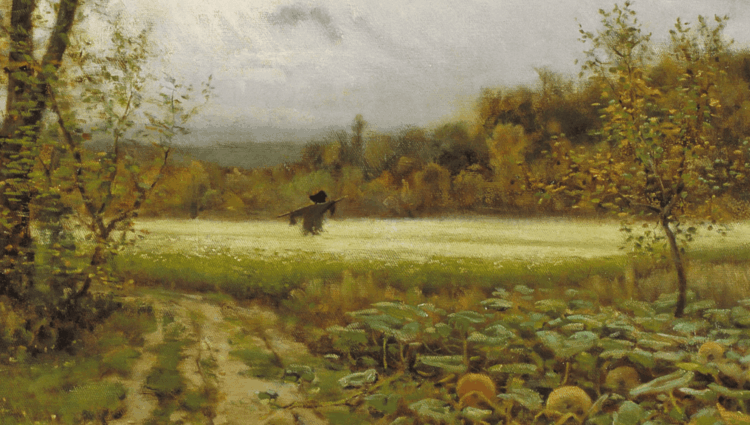
The featured image (detail) is “The Scarecrow” (between circa 1883 and circa 1885), by Joaquim Vayreda i Vila, and is in the public domain, courtesy of Wikimedia Commons.





Brilliantly written
The last paragraph from Puddleglum is more an expression of fideism than faith. But Puddleglum had the great advantage that he was debating a question of science (the existence of the upper world) with the queen, who was really peddling very bad science and superstition. And when she questioned the existence of “Aslan”, she was doing bad history. I did like the debate and could see the argument made against atheism when I first read the book as a child however.
I don’t think the supernatural should be defined as something that is merely beyond our normal sense perception. The supernatural really is above our nature because it is purely spiritual and therefore superior to human nature which, during life, can not naturally perceive it. To say that the supernatural flows through the natural like electricity through the power grid, or that “it is through the physical, material realm that we experience the invisible, eternal realm” seems to confuse the two realms.
God created the world (which is why even the error of Deism is closer to God than spooks like Zeus or the Elephant god, who are not intended to be the creator), and also created humanity which he placed into the world as onto a stage and keeps everything in existence. But creation is not God, and the world is certainly not “inhabited” or “animated” by spooks.
We can infer (as Aquinas does so well) from creation the existence of God. We know through the faith the existence of saints, the angels and devils, the afterlife. The one thing that oak trees, sacred or not, can not do is let us know about such things. The idea that the material world is inhabited by spooks, whose world is only eternal if the material world is too, is the “universal” pagan animist idea shared by most men before Christianity uprooted it forever.
Animism has returned as a “modern” idea. By refusing to consider the supernatural as “beyond” this world, the spiritual is reduced to spooks of various kinds (about which people claim knowledge through subjective “experience” or myth, and therefore humanity can never “know” anything about with certainty) whose very existence depends on the material world. For Hobbes, God himself depends on the material world, because God is “material”, but invisible. The solution to the Enlightenment mess and neo-paganism is the Christian faith, which refuses to divinise this world or give it a “soul”. The human body is animated by a soul but it is unique.