
The Dollar Problem and Its Solution: the Gold Standard

By |2016-05-25T12:56:29-05:00December 1st, 2011|Categories: Economics, Political Economy|Tags: |

  There is little new in this latest cycle of economic boom, panic, and bust. All of these cycles are linked to the life and death of the unstable post–World War II Bretton Woods monetary system. First came the crisis-ridden gold-dollar system from 1944 to 1971. Then came the rise of floating exchange rates and [...]
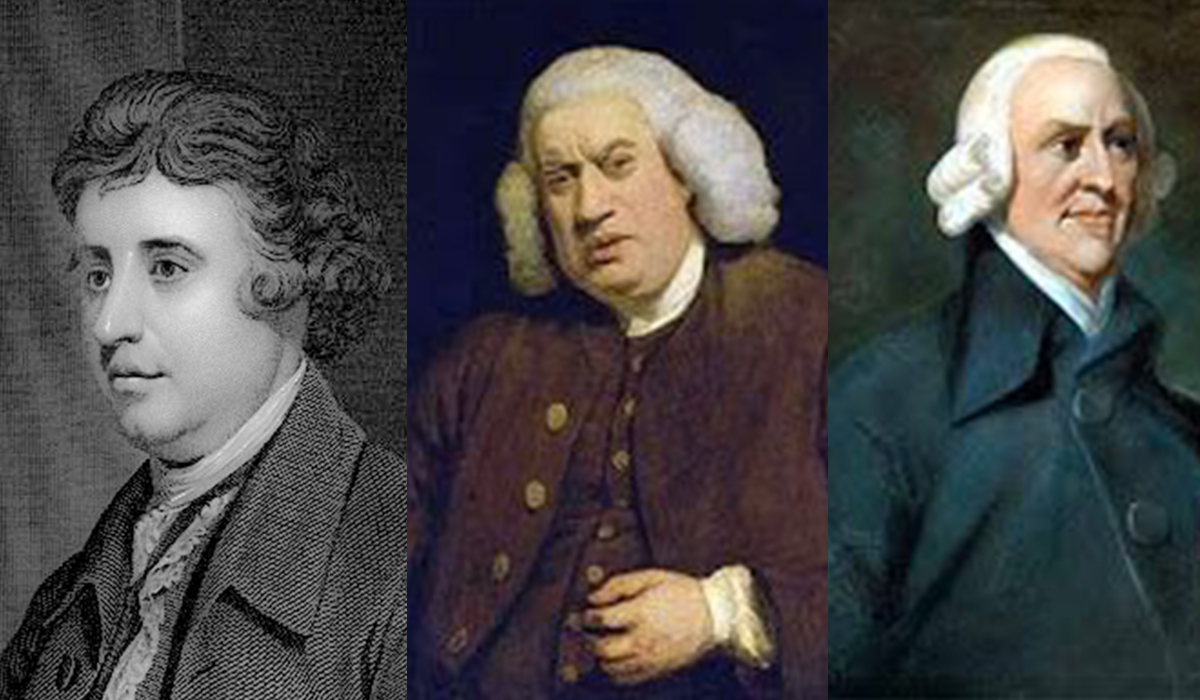
Three Pillars of Order: Edmund Burke, Samuel Johnson, Adam Smith

By |2021-01-07T11:21:29-06:00November 22nd, 2011|Categories: Adam Smith, Conservatism, Edmund Burke, Order, Ordered Liberty, RAK, Russell Kirk|Tags: , |

What Matthew Arnold called “an epoch of concentration” impends over the English-speaking nations. The revolutionary impulses and the social enthusiasms that dominated our century since their great explosion in Russia are now confronted by a countervailing physical and intellectual force. Fanatic ideology has been, in essence, rebellion against the old moral order of our civilization. [...]

What’s Latin for Ben Bernanke?

By |2014-01-26T17:31:32-06:00October 29th, 2011|Categories: Economics, Political Economy, Stephen Masty|

Who invented money and free trade, then screwed it up with Quantitative Easing and inflation? Yep. Guys in togas again. Professor Eamonn Butler, of London’s Adam Smith Institute, identifies a most promising grass-roots outfit called Friends of Classics, and their new magazine soon to be available online, “Ad Familiares.” In the ASI weblog, he summarises [...]

Economic Policy and the Road to Serfdom: The Watershed of 1913

By |2014-02-03T19:52:21-06:00October 26th, 2011|Categories: Brian Domitrovic, Economics, Political Economy|Tags: , |

The following essay is adapted from the book Back on the Road to Serfdom: The Resurgence of Statism, edited by Thomas E. Woods Jr. (ISI Books, 2011). We are perhaps apt to forget that during the Cold War, it was generally conceded that the Soviet Union had a higher rate of economic growth than the [...]

The Moral Foundations of Economics

By |2018-10-16T20:25:19-05:00October 6th, 2011|Categories: Books, Economics, Political Economy, RAK, Russell Kirk|Tags: |

The fol­low­ing essay ap­pears in the final chap­ter of Russell Kirk’s text­book Eco­nom­ics: Work and Pros­per­ity (Pen­sacola, Fla.: A Beka Book Pub­li­ca­tions, 1989), pp. 365–368. Some peo­ple would like to sep­a­rate econ­o­mists from pol­i­tics, but they are un­able to do so. An­other name for eco­nom­ics is po­lit­i­cal econ­omy. As we men­tioned in ear­lier chap­ters, a [...]

In Praise of Lord Keynes

By |2014-01-09T07:20:25-06:00October 5th, 2011|Categories: Economics, Keynesian, Political Economy, Stephen Masty|

For Heaven’s sake, calm down and pour yourself a stiff drink. I know…I know…that John Maynard Keynes is the father of Quantitative Easing, or government effectively printing money to supposedly stimulate economic growth. I know that as he debates the immortal FA Hayek in the two brilliant, modern rap-videos, Lord Keynes enters the room to diabolical [...]

Do the Southern Agrarians and Distributists Still Count?

By |2015-05-15T11:44:49-05:00August 22nd, 2011|Categories: Agrarianism, Bradley J. Birzer, Distributism, South, Southern Agrarians|

As I’m thinking about the various influences on Kirk (and, hence, the post-WWII American Right), I started thinking about the Southern Agrarians as well as the English Distributists. There are many who write for this blog who know far more about these groups than I do. But, from what I can tell, this American version [...]

Walter Williams: Questions on Culture & Economic Decline

By |2014-02-06T12:49:53-06:00May 2nd, 2011|Categories: Books, Economics, Political Economy, Stephen Masty|

Britain’s 2011 aircraft-carrier debacle may seem to have little in common with a 1940s Philadelphia ghetto and a modern French electricity company, but looks can be deceiving. Two new carriers, contracted at $6.5 billion in 2008, may cost $16.5 billion when completed by the end of this decade and cash-strapped Britons are furious. Beneath all [...]

Economics: “The Not-So-Dismal Science”?

By |2017-07-10T15:12:46-05:00April 14th, 2011|Categories: Economics, Political Economy, Wilhelm Roepke|

The title of this essay takes its name, in part, from a speech that William McGurn delivered recently at Hillsdale College. Mr. McGurn served as the chief speechwriter for President George W. Bush from 2006-2008 and is currently the vice president of News Corporation. In his speech, Mr. McGurn sought to look at the claim [...]

Wilhelm Roepke and the ‘Third Road’

By |2017-06-28T16:04:38-05:00April 5th, 2011|Categories: Books, Wilhelm Roepke|Tags: |

  The enormous span of Wilhelm Roepke’s interests and writings complicates the task of doing justice to his thought within the confines of an essay. Hence, I have elected to focus on just one aspect of his approach and of his philosophy, but one that has proved to be decisive in the practical implementation in [...]

The Moral Foun­da­tions of Eco­nom­ics

By |2018-10-16T20:25:36-05:00March 21st, 2011|Categories: Economics, Political Economy, RAK, Russell Kirk|Tags: |

The fol­low­ing essay ap­pears in the final chapter of Russell Kirk’s textbook Economics: Work and Prosperity (Pensacola, Fla.: A Beka Book Publications, 1989), pp. 365–368. Some people would like to separate economists from pol­i­tics, but they are un­able to do so. Another name for eco­nom­ics is po­lit­i­cal econ­omy. As we mentioned in earlier chapters, a [...]

Marxian Interpretations of Plato’s Symposium on Love

By |2024-09-16T17:20:17-05:00February 25th, 2011|Categories: Karl Marx, Stephen Masty|

Reporting a drinks-party at which learned Athenians discussed Love, Plato’s famous philosophical text was given to him by his older brother, Glaucon, having obtained accounts from secondary sources who were told about it by Socrates and another guest. The symposium was hosted in 416 BC by the tragedian Agathon to commemorate his victory in a [...]

Go to Top