
Civilization without Religion?

By |2018-10-16T20:25:01-05:00September 24th, 2012|Categories: Civilization, Culture, Moral Imagination, RAK, Religion, Russell Kirk|Tags: |

Watch ye, stand fast in the faith, quit you like men, be strong. -1 Corinthians 16:13 Sobering voices tell us nowadays that the civilization in which we participate is not long for this world. Many countries have fallen under the domination of squalid oligarchs; other lands are reduced to anarchy. “Cultural revolution,” rejecting our patrimony [...]
A Revolution Not Made But Prevented

By |2021-05-23T11:17:20-05:00August 28th, 2012|Categories: American Founding, American Republic, RAK, Russell Kirk|Tags: |

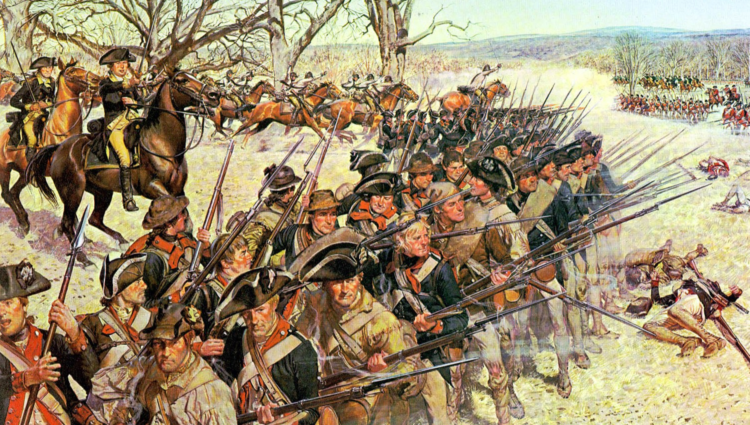
Was the American War of Independence a revolution? In the view of Edmund Burke and of the Whigs generally, it was not the sort of political and social overturn that the word “revolution” has come to signify nowadays. Rather, it paralleled that alteration of government in Britain which accompanied the accession of William and Mary [...]

Capitalism and the Moral Basis of Social Order

By |2018-10-16T20:25:02-05:00July 22nd, 2012|Categories: Capitalism, Economics, Featured, Political Economy, RAK, Russell Kirk|Tags: |

A number of Americans, fancying that the world is governed mainly by economic doctrines and practices, are inclined to think that an era of international good feeling lies before us. I intend to sprinkle some drops of cold water on such hasty hopes. I have no faith in the notion that an abstract “democratic capitalism” [...]

Jacobinism: The Armed Doctrine in Fiction

By |2018-10-16T20:25:02-05:00July 17th, 2012|Categories: Books, Ideology, Jean-Jacques Rousseau, Literature, RAK, Russell Kirk|

Russell Kirk The bicentenary of the French Revolution occurs in this year of 1989 [Ed., originally published in 1989]; and still the world is tormented by ghastly political upheavals and acts of terror that are inspired by what was said and done in Paris two centuries ago. English-speaking countries, nevertheless, have been relatively free of [...]

The World of Ray Bradbury

By |2018-10-16T20:25:03-05:00June 6th, 2012|Categories: Books, Literature, Moral Imagination, RAK, Ray Bradbury, Russell Kirk|

To commence as a writer for the pulp-magazines is no advantage; nor is writing film scripts in Hollywood, decade after decade, generally to be recommended for those who would be men of letters. Such was Ray Bradbury’s background. He had the advantage, however, of never attending college—which salutary neglect preserved him from many winds of [...]

The End of Learning

By |2018-10-16T20:25:03-05:00June 5th, 2012|Categories: Books, Christian Humanism, Christianity, Education, Liberal Learning, RAK, Russell Kirk|Tags: |

Russell Kirk Anyone who turns the dial of a television set nowadays may be tempted to remark that genuine learning came to an end during the latter half of the twentieth century. For the moment, however, I employ the word “end” not to suggest termination, but in the sense of “purpose” or “object.” [...]

What Did Americans Inherit from the Ancients?

By |2019-05-09T11:38:18-05:00May 29th, 2012|Categories: American Republic, Liberal Learning, RAK, Russell Kirk|Tags: |

Just what is this classical patrimony received by the inhabitants of North America and consciously cherished well into the twentieth century? To Europeans living west of the Elbe or south of the Danube, the remains of classical civilization are visible still: intelligent observes are aware of a continuity extending over many generations. For that matter, [...]

Edmund Burke and the Constitution

By |2018-12-10T17:34:01-06:00May 22nd, 2012|Categories: American Republic, Constitution, Edmund Burke, Jean-Jacques Rousseau, RAK, Russell Kirk|Tags: |

Constitutions are something more than lines written upon parchment. When a written constitution endures—and most written constitutions have not been long for this world—that document has been derived successfully from long-established customs, beliefs, statutes, and interests; it has reflected a political order already accepted, tacitly at least, by the dominant element among a people. True [...]

Popular Government and Intemperate Minds: Democracy As Ideology

By |2018-10-16T20:25:05-05:00May 14th, 2012|Categories: Democracy, Ideology, Jean-Jacques Rousseau, Politics, RAK, Russell Kirk|

Ronald Reagan & Russell Kirk At the beginning of the twentieth century, few states in the world could be called democratic. Yet much personal and local freedom existed under the reign of law. Near the close of the twentieth century, nearly every political regime throughout the world professes to be democratic. Yet in [...]

Edmund Burke and Natural Rights

By |2019-05-14T13:42:42-05:00April 21st, 2012|Categories: Edmund Burke, Jean-Jacques Rousseau, Natural Rights Tradition, RAK, Russell Kirk|

Edmund Burke was at once a chief exponent of the Ciceronian doctrine of natural law and a chief opponent of the “rights of man.” In our time, which is experiencing simultaneously a revival of interest in natural-law theory and an enthusiasm for defining “human rights” that is exemplified by the United Nations’ lengthy declaration, Burke’s [...]

Reinvigorating Culture

By |2018-10-16T20:25:07-05:00April 7th, 2012|Categories: Culture, Education, Liberal Learning, RAK, Russell Kirk|Tags: |

Anyone who pushes the buttons of a television set nowadays [written in 1994, Ed.] may be tempted to reflect that genuine culture came to an end during the latter half of the twentieth century. The television set is an immense accomplishment of reason and imagination: the victory of technology. But the gross images produced by [...]

Humane Learning in the Age of the Computer

By |2018-10-16T20:25:07-05:00March 27th, 2012|Categories: Liberal Learning, RAK, Russell Kirk, Technology|

Permit me to offer you some desultory reflections concerning the effect of the electronic computer upon the reason and the imagination. We are told by many voices that the computer will work a revolution in learning. So it may; but that accomplishment would not be salutary. The primary end of the higher learning, in all [...]

Humane Letters and the Clutch of Ideology

By |2018-10-16T20:25:08-05:00March 23rd, 2012|Categories: Books, Film, Ideology, Jean-Jacques Rousseau, Political Science Reviewer, RAK, Russell Kirk|

Literature in Revolution. Edited by George Abbott White and Charles Newman. (New York: Holt, Rinehart and Winston-Triquarterly Book, 1972).  Time was when the study of humane letters stood central in formal education. Public men were brought up in a literary discipline, and “rhetoric” meant more than an orator’s style. The domination of the political order [...]

Go to Top