
Thomas Stearns Eliot (26 September 1888 – 4 January 1965) was an essayist, publisher, playwright, literary and social critic and “one of the twentieth century’s major poets.” Born in St. Louis, Missouri in the United States, he moved to the United Kingdom in 1914 and was naturalised as a British subject in 1927.

Liberal Education and Christian Humanism

By |2016-08-03T10:37:39-05:00October 26th, 2011|Categories: Bradley J. Birzer, Christendom, Christian Humanism, Christianity, Christopher Dawson, Conservatism, Education, Jean-Jacques Rousseau, Liberal Learning, Russell Kirk, T.S. Eliot|

Russell Kirk’s home A friend of mine recently told me about a banner she saw hanging inside the entrance of an American public elementary school. “You’re all number one,” the banner read. I must admit that my reaction to this was rather strong, if not downright irate. Two immediate problems sprang to mind. [...]

Russell Kirk and "The Age of Eliot," 1956

By |2018-10-16T20:25:24-05:00May 11th, 2011|Categories: Bradley J. Birzer, Literature, RAK, Russell Kirk, T.S. Eliot|

All below taken from Russell Kirk, “English Letters in the Age of Boredom,” Shenandoah 7 (Spring, 1956): 3-15. “It is quite within the realm of possibility that the Age of Eliot will be succeeded by a long gulf of vacancy in the history of literature.…Universal war and social dissolution might bring this calamity upon us, [...]

The Christian Thinker: T.S. Eliot

By |2017-07-14T16:29:10-05:00April 27th, 2011|Categories: Christianity, Quotation, T.S. Eliot|

The Christian thinker—and I mean the man who is trying consciously and conscientiously to explain to himself the sequence which culminates in faith, rather than the public apologist—proceeds by rejection and elimination. He finds the world to be so and so; he finds its character inexplicable by any non-–religious theory; among religions he finds Christianity, [...]

T.S. Eliot, If You Will Not Have God…

By |2017-07-10T15:21:04-05:00April 15th, 2011|Categories: Quotation, T.S. Eliot|

T.S. Eliot So long…as we consider finance, industry, trade, agriculture merely as competing interests to be reconciled from time to time as best they may, so long as we consider “education” as a good in itself of which everyone has a right to the utmost, without any ideal of the good life for [...]

T.S. Eliot on Original Sin

By |2017-06-28T15:48:55-05:00April 1st, 2011|Categories: Quotation, T.S. Eliot|

With the disappearance of the idea of Original Sin, with the disappearance of the idea of intense moral struggle, the human beings presented to us both in poetry and prose fiction today, and more patently among serious writers than in the underworld of letters, tend to become less and less real… If you do away [...]

T.S. Eliot’s Ash Wednesday, 81 Years Later

By |2017-06-27T12:48:01-05:00March 9th, 2011|Categories: Bradley J. Birzer, Conservatism, Literature, T.S. Eliot|

Eliot’s “Ash-Wednesday,” a monumental work—the Purgatorio between the Inferno of “The Waste-land” and the Paradiso of the “Four Quartets”—has always been, as long as I can remember in my adult life, a comfort and a mystery to me. I assume it remained as such even to the Great Bard of the Twentieth Century himself. Stephen [...]

T.S. Eliot on the Family

By |2017-06-27T11:32:23-05:00March 5th, 2011|Categories: Quotation, T.S. Eliot|

by T.S. Eliot “But by far the most important channel of transmission of culture remains the family: and when family life fails to play its part, we must expect our culture to deteriorate. But when I speak of family, I have in mind a bond which embraces a longer period of time than this [i.e. [...]

A Brief Review of the Four Quartets

By |2017-06-20T14:13:07-05:00November 9th, 2010|Categories: Bradley J. Birzer, T.S. Eliot|

Yesterday, I was asked to comment on one of my favorite works in the western canon. For what it’s worth, here’s my description of T.S. Eliot’s Four Quartets. The Four Quartets—perhaps the single greatest work of art in the twentieth century, and maybe even of modernity, according to my admittedly not so humble opinion—concluded Eliot’s poetry career. If [...]

The Moral Imagination

By |2018-10-16T20:26:01-05:00August 4th, 2010|Categories: Culture, Edmund Burke, Moral Imagination, RAK, Russell Kirk, T.S. Eliot|

Russell Kirk In the franchise bookshops the shelves are crowded with the prickly pears and the Dead Sea fruit of literary decadence. Yet no civilization rests forever content with literary boredom and literary violence. Once again, a conscience may speak to a conscience in the pages of books, and the parched rising generation [...]

T.S. Eliot on Beauty

By |2017-06-15T14:43:42-05:00August 2nd, 2010|Categories: Beauty, Culture, Quotation, T.S. Eliot|

T.S. Eliot by T.S. Eliot We mean all sort of things, I know, by Beauty. But the essential advantage for a poet is not to have a beautiful world with which to deal: it is to be able to see beneath both beauty and ugliness; to see the boredom, and the horror, and [...]

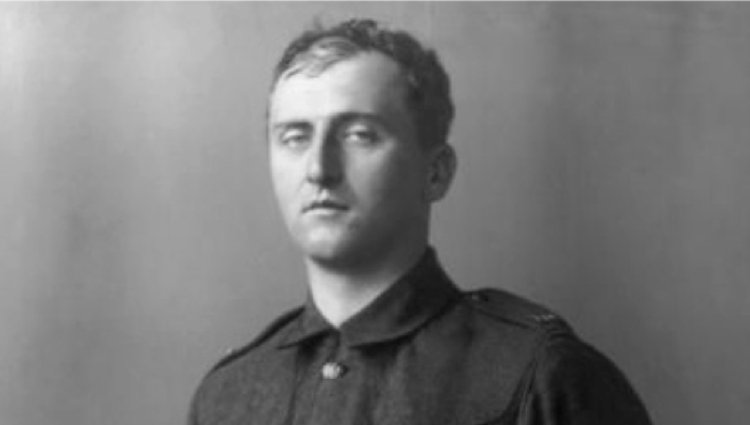
T.E. Hulme: The First Conservative of the Twentieth Century

By |2020-09-15T15:36:47-05:00July 30th, 2010|Categories: Bradley J. Birzer, Christian Humanism, Conservatism, Culture, Modernity, T.E. Hulme, T.S. Eliot|

History should never have forgotten T.E. Hulme, and we would do well to remember him and what he wrote. Indeed, the German shell that took his life in the early autumn of 1917 might have changed a considerable part of the twentieth century by removing Hulme from it. Our whole “Time of Troubles” as Kirk [...]

Go to Top