
Today’s offering in our Timeless Essay series affords readers the opportunity to join Ian Crowe as he explores the thought of T.S. Eliot, Edmund Burke on the permanent things. —W. Winston Elliott III, Publisher
For the present is the point at which time touches eternity. —C.S. Lewis[1]
 It was in 1939, in The Idea of a Christian Society T.S. Eliot defended what he called “the permanent things” against a world that appeared drunk on the politics of revolution and “change.” Eliot’s purpose was not a defense of conservatism—which he referred to in the same passage as, too often, “conservation of the wrong things”—but of the vital role of the institution of the Church in Western society. Eliot considered the province of the “permanent things” to be the “pre-political area,” and their intellectual guardian to be theology.[2] The social sciences, Eliot mentions sociology and economics specifically, may guide us to what is expedient, or ameliorative, or even utopian—that is, they may inform our ethics and politics—but without a claim on permanence, they cannot really reinforce, and certainly cannot replace, theological understanding.
Reading Eliot’s words as a historian, seventy years on, it is difficult to avoid the conclusion that Eliot’s defense of the “permanent things” was both prophetic and elegiac. In today’s even more secularized world, largely intolerant of theology, the pre-political area itself, the moral and cultural substructure of politics, has become the non-political area, or has been dismissed altogether, and perhaps the results are evident in the reckless innovation, blind reaction, and cynical opportunism that appear to underlie politics today. But before I throw in the towel to all of that, I want to suggest we revisit the doom Eliot has laid out before us and ask one more time: Can history offer us “Permanence we can believe in?”
I say “one more time” because the same question was also being asked 150 years before Eliot coined the term “permanent things”—when the astonishing phenomenon of revolutionary France forced commentators to ponder whether history, sundered from its providentialist Christian parents, would become the midwife for a new priesthood of secularized philosophers: whether, in the words of the greatest contemporary commentator on that phenomenon, Edmund Burke, “the age of chivalry” really was being succeeded by the age of “sophisters, economists and calculators.” And, indeed, that famous sentence from Burke’s Reflections on the Revolution in France, precedes by just a few pages Burke’s own invocation of a body of permanent things to preserve politicians from the hubris of the revolutionary mind. “[A]ll who administer in the government of men,” he writes, “should have high and worthy notions of their function and destination…their hope should be full of immortality…they should not look to the paltry pelf of the moment, nor to the temporary and transient praise of the vulgar, but to a solid, permanent existence, in the permanent part of their nature, and to a permanent fame and glory, in the example they leave as a rich inheritance to the world. Such sublime principles ought to be infused into persons of exalted situations.”[3]
 On a superficial reading, Burke may be thought to be speaking here as a rhetorician and politician, but when he goes on to describe those permanent and sublime principles as requiring “religious establishments…that may continually revive and enforce them,” I sense that we are being led further, into a more concrete, historical world that spans the permanent and the accidental, a pre-political world that might put us in mind of Eliot’s drama Murder in the Cathedral.[4] This is noteworthy, since Burke’s “permanent things” are foreshadowed in another of his works, his unfinished and posthumously published “Abridgment of the English History,” which he wrote thirty years before the Reflections, and where the point is illustrated most powerfully through his own remarkably imaginative historical treatment of the martyrdom of Thomas à Becket.
Burke’s “Abridgment” is an astonishingly complex historical work that only recently has begun to receive anything like the sustained attention it deserves.[5] I do not wish to suggest any direct link between Burke’s and Eliot’s uses of the historical accounts of Becket’s martyrdom, but I do think we find in the Becket of the “Abridgment” interesting perspectives that prefigure Eliot’s drama. This is because both Burke and Eliot deal with this act of self-sacrifice, not as that of an “exceptional” individual, but as a necessary consequence of the individual’s extraordinary loyalty to an institution—a “great mysterious incorporation:” the Church. For it is in this way that the particular historical event that was Becket’s death comes, by an act of imagination, to signify the crucial relationship, for both Burke and Eliot, between religious establishment and true order in the state: from “oak and stone”—the church in time, as Eliot’s Becket describes it—to the permanent things, the Church through time. What Eliot attempts dramatically, Burke attempted historically, and to no less effect.
Both Eliot and Burke were non-British, staunch defenders of the Established Church in England as it had emerged from the Reformation and the Revolution Settlement: an exemplar of the via media, balancing secular and spiritual incorporations, neither Erastian nor Puritan, set against priest-craft and “popery,” but committed to upholding organized religion as one of the vital bands of civil society.[6] Burke’s Reflections is, in many ways, the greatest apology we have in print for that religious settlement, and, exactly in this spirit, a prominent theme of the “Abridgment” is the historically providential role that the Church, through “oak and stone” (Burke would have loved that phrase!), has played in the forging of England’s constitutional via media with its inheritance of ordered liberty.[7] Arguing that, “The first openings of civility have been made everywhere by religion,” Burke punctuates his history with digressions on the intellectual developments and social utility arising out of institutionalized religion from the druids to the monasteries and even the Crusading movement of the middle ages.[8] In the majority of cases, these benefits were providential in the sense that they were forged in the heat of particular conflicts between church and monarchy but culminated in outcomes neither expected nor intended by either party. Thus, the long, medieval struggle over clerical privilege that claimed Becket’s life also brought about the baronial triumph over King John and the signing of Magna Carta with its enshrining of the core principles of English liberty—the chief architect and director of that “revolution” being Stephen Langton, one of Becket’s successors at Canterbury.[9] Indeed, Burke is prepared to push this theme to the point of paradox, as the cumulative effect of his historical narrative is to reveal Church and State locked in an almost dialectical relationship of mutual dependence and chronic antagonism: the via media, essential to order and liberty, struck out through the periodic clashes of institutional intransigence. And it is precisely in embracing this paradox that Burke’s tightly historical account of Becket’s martyrdom takes on a symbolic force that resonates with Eliot’s design in Murder in the Cathedral.
 In proportion to the rest of the “Abridgment,” Burke allocates considerable space to the conflict between Henry II and Becket, and prefaces it with a substantial digression on the growth of clerical juridical independence since the dissolution of the Roman Empire in the West. His narrative draws heavily from medieval sources familiar at the time and is also in line with accounts to be found in published mid-eighteenth-century histories. Remarkable, however, is the sophistication and evenhandedness with which Burke adjudges Becket’s motivations. It is true that Henry II’s “humiliating penance” for the “rash words” that occasioned Becket’s death symbolizes the tragedy of a monarch who became “the greatest of kings and the unhappiest of mankind,” and that, as such, it serves to highlight the “inflexible spirit” with which Becket pursued his devotion to the cause of the Church—a spirit “which all his virtues rendered but the more dangerous.” Yet, despite his loyalty to a foreign power (the papacy) and his dogmatic commitment to the cause of priestly privilege, Becket’s death, we are told, was still “sacrilegious and detestable,” since he “might have been justifiable, perhaps even laudable for his steady maintenance of the privileges, which his church and his order had acquired by the care of his predecessors, and of which he by his place was the depository.” This treatment of Becket and his cause marks out Burke’s history in stark contrast to the works of Smollett, Hume, and others, where Becket’s virtues are rendered vices by being placed at the service of superstition, popery, and priest-craft—that trinity of Enlightenment bogeymen.[10]
More remarkable, though, is the way that, in Burke’s vivid account, the strong individual character traits of the leading antagonists are folded into the broader narrative of institutional conflict. F.P. Lock states of this section of the “Abridgment” that “Burke undoubtedly depersonalized the struggle to a greater extent than any of the other historians [of his time]” and showed how “Henry and Becket fought battles that were larger than either knew.”[11] I believe that those astute comments may be pushed just a little further, to the point where one can see Burke applying a rhetoric of synecdoche that serves to translate the immediate conflicted loyalties of two individuals into the perennial tensions between the spiritual and the secular in politics. On bringing his nobles to heel, Henry, “the restorer of the English monarchy,” had aimed “to break the power of the clergy.” Becket, “the whole tenour of [whose] conduct was seen to change” upon his elevation to the archiepiscopate, adopted a lifestyle which, “in all respects, formed to the most rigid austerity, seemed to prepare him for that superiority he was resolved to assume, and the conflicts he foresaw he must undergo in this attempt” [my emphases]. Burke’s purpose in forging this rhetorical structure appears to be twofold. First, he wishes to show that individuals cannot rise to the height of virtuous action independent of the sublime operation of venerable institutions—that is, without “willfully” incorporating themselves into the tragedy and wisdom of past generations.[12] It was in pursuing freely and single-mindedly his duty to an institution of “oak and stone” that Becket was able to pass beyond the accidences of that duty to the calming substantiality of his destiny—his “permanent existence.”[13]
 Second, Burke’s use of this rhetorical device invests his narrative with an allegorical significance in the very process of embedding it in its historical context—a method repeated throughout the “Abridgment.” As he engages his audience with the conflict between Henry and Becket, Burke confronts the educated affections of his readers with a symbol of the ever-present tension between conscience and civic duty, moral order and the social order—or, between the pre-political and the political. Becket’s fate was sealed, his virtues turned (as it were) upon himself, because, in his time, “…the character of the clergy was exalted above everything in the State;” and, Burke is at pains to add, “it could no more be otherwise in those days, than it is possible it should be so in ours.” Through that emphatic accidental contrast, Burke is actually positing a more substantial continuity: Even if the Reformation and the Glorious Revolution have sealed a historic triumph over priest-craft and popery in Britain (and Ireland!), that does not mean that the symbiotic/antagonistic relationship between Church and State has ended. Instead, it has, as it were, by that very triumph, become increasingly internalized as a necessary tension working within the conscience of every patriot.
Burke is arguing nothing less here than that something of Becket’s “inflexible spirit,” born out of duty to a providential, traditional religious institution, must endure within every patriot entrusted with public office. In this way, the Beckets of Burke and Eliot may appear to converge, through similar acts of historical imagination, to symbolize and reinforce the crucial role of the pre-political, and of a sense of the permanent, in politics by offering a sublime paradigm for the citizen: to be, at any time, a conservative and a revolutionary, and yet neither of these.[14] It is only when Becket’s martyrdom becomes truly incomprehensible that the doom Burke anticipated in 1790, and that Eliot laid out for us in 1939, will be sealed.
This essay in our series of “Timeless Essays” was first published here in March 2013. It was a paper delivered at a conference of the Georgia Philological Association at Brewton-Parker College, Mt. Vernon, GA, April 4, 2009. Books by Edmund Burke, T.S. Eliot, and Ian Crowe, may be found in The Imaginative Conservative Bookstore.
Notes:
[1] C.S. Lewis, The Screwtape Letters, #15, p.58.
[2] Eliot uses this term in his 1955 lecture “The Literature of Politics,” with an acknowledgement to Canon Demant, at the time the Regius Professor of Theology at Oxford. See T.S. Eliot, To Criticize the Critic, and Other Writings (New York: Farrar, Straus & Giroux, 1965), 144.
[3] Burke, Reflections, 170, 189.
[4] In Part 2, section 1 of his Philosophical Enquiry into the Origin of Our Ideas of the Sublime and Beautiful, Burke writes that “Astonishment…is the effect of the sublime in its highest degree,” and adds that “the inferior effects are admiration, reverence and respect.”
[5] See, for example, F.P. Lock, Edmund Burke (Oxford: Clarendon Press, 1998), 1:141-64. In many, though not all, respects, I am in agreement with Lock’s insights on Burke’s historical method and the argument in this paper may be seen as an exercise in developing some of those insights a little further.
[6] Herbert Howarth, Notes on Some Figures Behind T.S. Eliot (Boston: Houghton Mifflin Co., 1964), 223.
[7] In Murder in the Cathedral, Becket tells the priests just before his martyrdom, “The church shall protect her own, in her own way, not / As oak and stone; stone and oak decay, / Give no stay, but the Church shall endure.” T.S. Eliot, The Complete Poems and Plays, 1909-1950 (New York: Harcourt Brace & Co., 1980), 211.
[8] Edmund Burke, Writings and Speeches of Edmund Burke, ed. Paul Langford et al. (Oxford: Oxford University Press, 1981 – ), 1:349.
[9] It is significant in Burke’s narrative that Langton, unlike Becket, had become detached from the papal cause by the time of his final rebellion against monarchical power.
[10] Burke, Writings and Speeches, 508, 519, 508.
[11] Lock, Edmund Burke, 1: 163. Lock is also surely correct in raising the “likelihood that Burke identified with Becket as a man after his own heart” (ibid).
[12] The meaning of this “sublime operation” is perhaps contained in a quotation Kirk employs from the writings of Richard Hooker: “The reason first why we do admire those things which are greatest and second those things which are ancientest, is because the one are the least distant from the infinite substance, the other from the infinite continuance, of God.” Kirk, Eliot and His Age, 115. See also Aidan Nichols, “Christianity, Secularisation and Islam,” in Standpoint 2, (July 2008), 44-46. Nichols argues that, “Secular liberalism cannot help looking for a politics without memory.”
[13] Ibid., 498, 499, 500.
[14] Eliot states that the pre-political area is the proper area for those “few writers preoccupied in penetrating to the core of the matter, in trying to arrive at the truth and to set it forth, without too much hope, without ambition to alter the immediate course of affairs, and without being downcast or defeated when nothing appears to ensue.” There could hardly be a more fitting description of Edmund Burke. (See Eliot, To Criticize the Critic, 144.)
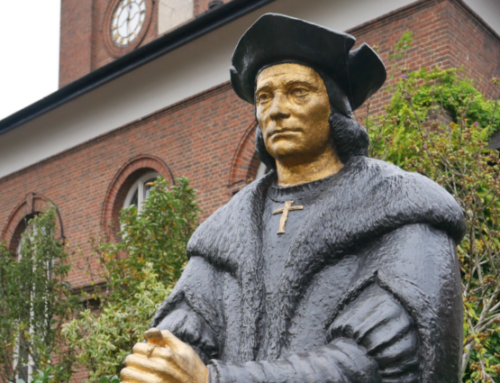
Editor’s note: The featured image is by Brian Norman and is liscensed under creative commons 2.0.





And what the dead had no speech for, when living,
They can tell you, being dead: the communication
Of the dead is tongued with fire beyond the language of the living.
I am curious about the origin of the term “permanent things.” Was it Eliot? Robert Maynard Hutchins used that phrase in his The Higher Learning in America in 1936.”
Thanks