
“I never thought it would come to this,” the despondent college professor-turned-Nazi-cooperator cries near the end of the film “Good.” See this movie, which warns of the dangers of the failure to speak up against encroaching evil, but be forewarned that you may see someone you know—or yourself—in the main character.
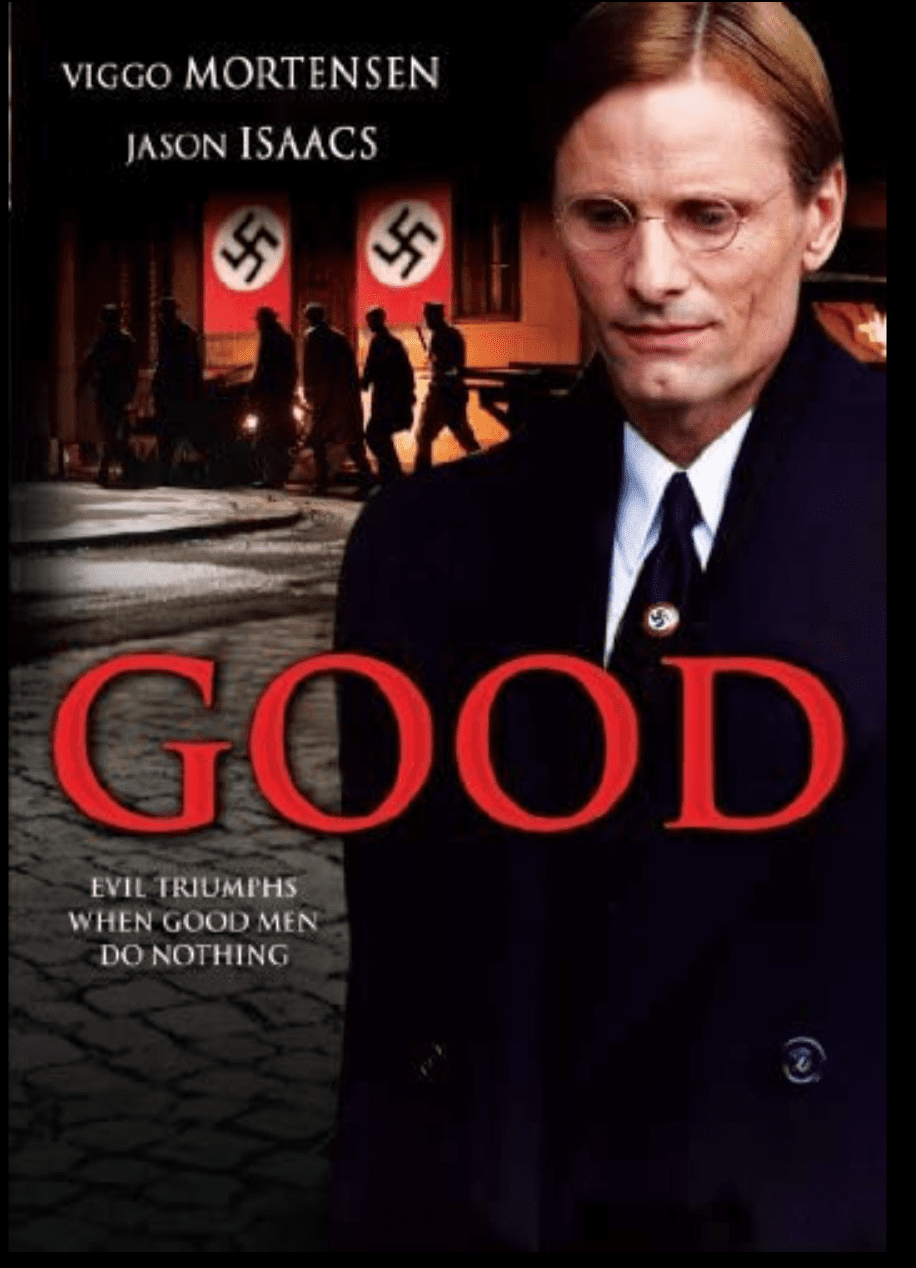 Everyone knows a John Halder, the central character of the 2008 film Good. He is the go-along-to-get-along type, someone who might have passed through life without committing any grand evil if not for the fact that evil found him—and found him wanting. Halder is that passerby who looks the other way when he sees a group of thugs accosting a woman on the street corner; the executive in the workplace who is afraid to oppose the CEO’s corrupt conduct; one of Shakespeare’s “fat, sleek-headed men who sleep a-nights” and who enjoys his creature comforts so much that he tells himself and others “it can’t happen here.” Yes, John Halders are all around us.
In Good, John Halder (played by a thin Viggo Mortensen) is an unassuming, middle-aged professor of literature in 1930s Germany. Lonely and burdened as he takes care of a senile mother and a neurotic wife, Halder is easily seduced, both by the sexual advances of a student and by the Nazi party, which summons him to the chancellery to discuss a piece of writing that has come to the attention of Adolf Hitler himself. The work in question is an obscure novel by Halder, a romance in which a lover helps his suffering companion take her own life in the face of painful, terminal disease. The Nazis ask Halder to write a brief paper defending euthanasia, and the bookish academic, both intimidated and flattered by the attention, complies.
This puts Halder on a dangerous path, as he proceeds to take baby steps—both mental and material—in going along with the Nazis, always out of a mixture of fear and self-interest. Distressed at first by book-burning at the university, he soon rationalizes the act, with the help of his new mistress, Anne (Jodie Whittaker). Reluctant initially to join the Nazi party, he soon relents, as it helps advance his academic career. Learning to ignore his conscience, he deserts his wife and makes a new life with Anne, and though he never takes the step of putting his increasingly burdensome mother out of her misery, he chastises himself after her death for letting her suffer so long.
The one serious obstacle to Halder’s full embrace of Nazism is his long-time friend, Maurice (Jason Isaacs), a Jewish psychiatrist (with a penchant for the f-word) alongside whom Halder fought in World War I. A moral vacuum who relishes in Halder’s dalliance with Anne and whose deepest concern seems to be when he will drink his next beer, Maurice nevertheless is morally outraged at Halder’s cooperation with the Nazis. In one scene, Maurice chastises Halder for joining the Nazi party, and Halder’s response is the quintessential one of the cowardly rationalizer: “It doesn’t matter if I agree with them. The fact is they’re in power,” Halder says in his defense. “At least I’m doing something. If we want to change anything, steer them in the right direction, we can’t stay sitting on the sidelines.”
Eventually, as the situation of the Jews worsens, Halder realizes that he has gotten himself in too deep with evil. Still, he cannot bring himself to risk the benefits of his new life to help his friend. The enthusiastically pro-Nazi Anne (“Anything that makes people happy can’t be bad, can it?” she opines during a Nazi-sponsored parade) tries to assuage any guilt Halder feels during his transformation to a tool of evil. In a scene near the end of the movie, Halder accidentally bumps Anne to the floor as they argue about Maurice’s plight. She is momentarily stunned, and the viewer expects her to lash back at Halder. Instead, she is sexually aroused by his display of power. “Oh, John, look at you,” she coos, as she directs his gaze at the mirror, where Halder looks at himself in full SS uniform. Mortensen conveys wonderfully Halder’s sense of both befuddlement and shock at what he has become.
By the time Halder acts to save Maurice, it is too late. The movie ends with a memorable shot of the horrified Halder, dressed in his SS uniform, helplessly watching Jewish prisoners being herded into a concentration camp, with the mocking “Jewish music” of Mahler’s First Symphony playing around him (Halder hears Mahler whenever he is under stress). A man who once considered himself “good” sees first-hand the ultimate ramifications of his cowardice.
Good has its flaws. Once again on screen, we have ubiquitous upper-class British accents substituting for the speaking of actual German. The script, which is based on a stage play by C.P. Taylor, moves slowly at times, and the death camp and its prisoners could be grittier in appearance. None of the main characters generates sympathy from the viewer, as they are seemingly motivated almost entirely by selfishness; even Halder’s ostensible devotion to his family seems dumbly dutiful, as he is so very quick to succumb to the temptations of the flesh and of power. Yet the acting of Mortensen and Isaacs is masterful, and director Vicente Amorim deftly and quietly builds a sense of dread that culminates in the camp scene through the power of the script’s words, without resorting to cheap action scenes.
You may be asking yourself how you missed this film about a powerful subject, starring two major actors in the lead roles. The answer is simple. The Leftist Hollywood Establishment did not want you to see it. After all, it clearly connects euthanasia to the Nazi program of genocide (Halder’s novel “raises controversial questions on the theme of the right to life,” a Nazi official says near the beginning of the film). It also hints that euthanasia is motivated by selfishness on the part of the living, and it demonstrates how private and public morality are linked. Halder’s faithlessness to his wife coincides with his betrayal of his friend and the corruption of his political and philosophical principles. This a controversial theory of morality in our post-Christian era.
“I never thought it would come to this,” a despondent Halder cries near the film’s end. Good above all warns us of the dangers of failing to speak up against evil. “When bad men combine, the good must associate,” counseled Edmund Burke. “It is not enough… that a man means well to his country; it is not enough that in his single person he never did an evil act.” See Good then, but be forewarned that you may see someone you know—or perhaps yourself—in the character of John Halder.
This essay first appeared here in February 2013.
The Imaginative Conservative applies the principle of appreciation to the discussion of culture and politics—we approach dialogue with magnanimity rather than with mere civility. Will you help us remain a refreshing oasis in the increasingly contentious arena of modern discourse? Please consider donating now.
The featured image and the top image are courtesy of IMDb.







Fascinating! Never miss a Klugewicz piece.
An American spook who worked in pre-Gorbachev Moscow tells me how they kept dissidents in check, not by the old Cheka torture in Lubyanka Prison, or the gulag, but by a cordial meeting. Don’t join the Party or attend the marches and you’re fine but you won’t get promotion, they warned. But publish samizdat and take a public role in opposition and we’ll get you a janitor’s job in some podunk town, your friends will never hear from you, your daughter will not be allowed to go to a good university in Moscow, etc. Unlike Sakharov, nobody will hear from you or know that you existed. But otherwise you’ll be fine.
It often worked.
Steve Masty, you are too kind! Thanks for your nice words on my humble effort(s).
Interesting parallels between the treatment of Good here by the establishment and the HarperCollins cancelation of novelist Nick Cole over a passage in the first chapter of his novel CTRL-ALT-REVOLT! that an editor found objectionable.
Thanks to The Imaginative Conservative for this rerun of an excellent and still timely commentary. I missed it the first time around.
It is always about the Germans under the Nazis, the Italians under fascism, the Soviets under Bolshevism, the French under German occupation, etc. When ANYONE finds itself under such circumstances (national socialism, state socialism, international socialism, or one of their offshoots), few rational people will sacrifice their families, their loved ones, and themselves for…. what exactly? A “cause,” “freedom,” or “democracy”? Committing suicide? Could the Jews do anything in any of the European countries? How? Emigrating to America? (Oops!) I know: I fled Communism to the latter 48 years ago, after the “comrades” had locked me up at the ripe age of fifteen (for political reasons) — and I was the very few exceptions. It is evident to me today that I picked up the wrong map. Take it from an old curmudgeon: These are excellent stories for Hollywood and armchair intellectuals, but real life is somewhat different. Just ask the employees of any company (mini-dictatorships themselves) — the people who are asked by their hypocritical management to be “perfect” every day. They suffer under the John Halders — and can do nothing about it.