
One doesn’t have to agree with everything Michael Novak argued to recognize the genius of the man. Like all true conservatisms, his democratic capitalism was as much an anti-system as anything recognizable as a system. He was a giant of an intellect, and his best book deserves to be remembered, even if in friendly opposition.
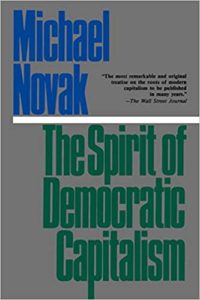 I first read huge sections of Michael Novak’s The Spirit of Democratic Capitalism when it initially came out in 1982. It was something of an expected read for high-school debate and forensics, and I can still see its distinctive silver dust cover with bold aqua-and-green lettering. At the time, I thought it was an excellent book, though it failed to fire my young imagination as other early Reagan-era works—such as Milton Friedman’s Free to Choose or Robert J. Ringer’s Restoring the American Dream—had.
Then, I began to learn about the difference between neo-conservatives and traditionalist conservatives, and Novak’s book mostly fell out of my life sometime in college, as I delved into figures such as T.S. Eliot, Irving Babbitt, Russell Kirk, and Christopher Dawson (the last, interestingly enough, Novak also greatly admired). Novak was just no longer a part of my intellectual universe. Yet, there was a wonderfully strange moment during the 1999-2000 academic year when Novak visited Hillsdale. I was utterly taken with him as a person. He was the highest of gentlemen, and he even spoke to one of my classes. Consequently, I picked up several of his books again, but not The Spirit of Democratic Capitalism. Jump forward nearly four decades since high school, and I had the great good fortune of re-reading it for an Acton/Liberty Fund colloquium. To be sure, I’m sorry that I ever put it down.
An apology (in both senses of the word) of sorts, Novak’s The Spirit of Democratic Capitalism wants to defend what had been American capitalism up through the early 1980s as a sort of evolutionary process. “Its success in the political order and in the economic order,” he claimed, undermined “it in the cultural order.” Further, he noted with much regret, it had little respectable intellectual lineage.
In good faith, who can be, by conviction and by a willingness to commit one’s life to its defense, a democratic capitalist? Those who would do so are everywhere embarrassed by the lack of an intellectual tradition that would nourish them; a theory that would satisfy them; a description of the world of actual experience which is recognizably true. Too many, repelled by the adversaries of democratic capitalism, are nevertheless also dissatisfied with the theories about democratic capitalism inherited from Adam Smith, Jeremy Bentham, Ludwig von Mises, Frederick [sic] von Hayek, Milton Friedman, and others.
Still, Novak continued, there was something truly new about modern capitalism, especially when coupled with democratic institutions that fought for the rule of law. Much of this spirit—here, distinguishing the neo-conservatives from the more traditionalist conservatives—came from philosopher John Locke.
Permit me to put Locke’s point in theological terms. Creation left to itself is incomplete, and humans are called to be co-creators with God, bringing forth the potentialities the Creator has hidden. Creation is full of secrets waiting to be discovered, riddles which human intelligence is expected by the Creator to unlock. The world did not spring from the hand of God as wealthy as human beings might make it. After the Fall, ignorance and disorder became commonplace.
In other words, democratic capitalism answers fundamental theological impulses implanted in the human person from the time of Creation.
Six things, Novak argues, echoing Russell Kirk’s six tenets of conservatism, intentionally or not, help define democratic capitalism: free labor; reason; continuous enterprise; impersonality; stable networks of law; and cities and towns. These six, Novak takes from the great sociologist, Max Weber. As such,
the spirit of democratic capitalism is the spirit of development, risk, experiment, adventure. It surrenders present security for future betterment. In differentiating the economic system from the state, it introduced a novel pluralism into the very center of the social system. Henceforth, all societies of its type would be internally divided—an explosively revolutionary.
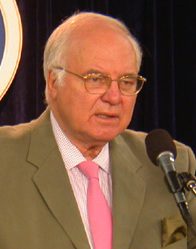
Michael Novak
The revolutionary element of democratic capitalism comes not just from the freedom of the economic system—“to live in an energetic, dynamic, free society is to experience culture shock frequently”—but, especially, from its embrace of pluralism. For, Novak writes, “in a genuinely pluralistic society, there is no one sacred canopy.” Thus, such places as Brazil and China—no matter how competitive their markets—cannot be considered as having embraced the spirit of democratic capitalism. Such places become examples of what should not be. In its pluralism, “a democratic capitalist society mirrors the infinity of God through the conflicting, discordant, irreconcilable differences of huge numbers of persons, each of whom is an originating agency of distinctive insight and distinctive choice.” Here, Novak sounds very similar to John Paul II, who called each person an unrepeatable center of dignity and freedom.
In contrast, Novak contends, traditionalist societies care too much about maintaining “order and stability,” while socialist societies overly worry about “inequalities in wealth and power.” The democratic capitalist society, though, most “fears is tyranny, most notably by the state, but also by excessive private power.” In its promises, democratic capitalism never claims to end sin, but it does hope to inculcate traditional virtues through persuasion rather than force. Still, Novak cautions, “democratic capitalism is not a system of radical individualism,” as some of its critics and proponents have proclaimed. Rather
Parties and factions loom large in it.Family is central to it.Structures, institutions, laws, and prescribed procedures are indispensable to its conception. In economic matters, its chief social inventions are the business corporation and the free labor union. Its theory of sin makes such complexity necessary. Its theory of sin makes creative use even of self-interest.
And, “the success of democratic capitalism in producing prosperity and liberty is its own danger,” and, thus, “the commercial virtues are not, then, sufficient to their own defense. A commercial system needs taming and correction by a moral-cultural system independent of commerce.”
In these arguments, Novak sounds very much like Madison, especially in Federalist no. 10, and Adam Smith in The Theory of Moral Sentiments. And, to be sure, Novak lists “the inventors of democratic capitalism—Montesquieu, John Adams, Adam Smith, Benjamin Franklin, Benjamin Rush, James Madison, Thomas Jefferson. . .”
One doesn’t have to agree with everything Novak argued to recognize the genius of the man. Like all true conservatisms, his democratic capitalism was as much an anti-system as anything recognizable as a system. If he gets wildly theological from time to time, it’s worth remembering, Novak was a theologian, first and foremost. He was a giant of an intellect, and his best book deserves to be remembered, even if in friendly opposition.
The Imaginative Conservative applies the principle of appreciation to the discussion of culture and politics—we approach dialogue with magnanimity rather than with mere civility. Will you help us remain a refreshing oasis in the increasingly contentious arena of modern discourse? Please consider donating now.
The featured image is courtesy of Pixabay. The image of Michael Novak is in the public domain, courtesy of Wikimedia Commons.




Michael Novak is indeed a giant. Thanks Bradley
But a few days ago, my copy of Democratic Capitalism arrived from (that mail order house whose name may not be mentioned in a family magazine). It has been 40 years, almost, since last read, and I thought I should have another look, my old copy having gone the way of too many paperbacks.
Trying to balance it with reading “Goodbye to All That” makes for an interesting juxtaposition. What I forgot, and (shame, shame) you did not fully bring out, is Novak’s optimism. The first chapters were penned by a man who is confident in what he is writing, and happy at the prospect of sharing his thoughts. It is joyful. (Well, that may only me me, after all.)
Unlike too many. his apologia is not apologetic, and as noted, bears the test of the years.
I am looking forward to finishing it. Again.
John Paul II is mentioned as affirming each person as an “unrepeatable center of dignity and freedom.” This resonates with the Church’s social doctrine which tilts toward market approaches as the means to personal self-fulfillment and the economic common good, but with attention given first to needed ethical preconditions (e.g., Novak’s “traditional virtues” through “persuasion”). John Paul II seems to endorse the freedom of democratic capitalism, while also affirming a higher personal freedom for the truth.
The question seems to be exactly how the market, the political order and ethical preconditions actually fit together. When asked if the fall of communism meant that “capitalism” should be universally applied. He proclaimed justice with a market face:
“The answer is obviously complex. If by ‘capitalism’ is meant an economic system which recognizes the fundamental and positive role of business, the market, private property and the resulting responsibility for the means of production, as well as free human creativity in the economic sector, then the answer is certainly in the affirmative, even though it would perhaps be more appropriate to speak of a ‘business economy,’ ‘market economy’ or simply ‘free economy.’ But if by ‘capitalism’ is meant a system in which freedom in the economic sector is not circumscribed within a strong juridical framework which places it at the service of human freedom in its totality, and which sees it as a particular aspect of that freedom, the core of which is ethical and religious, then the reply is certainly negative” (Centesimus Annus, 1993, n. 44).
Another fine one dear professor.
I have been missing you in these pages and glad you are back.