
With the publication of “Homo Americanus,” author Zbigniew Janowski has tentatively entered the dissidents’ camp, and does so by following in the footsteps of Southern agrarian professor Mel Bradford, who warned us several decades ago about “the heresy of Equality.”
Homo Americanus: The Rise of Totalitarian Democracy in America, by Zbigniew Janowski (255 pages, St Augustine’s Press, 2021)
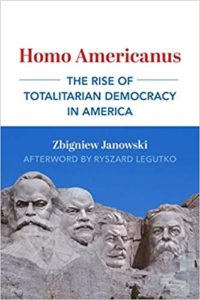 For some years now I have taken a keen interest in the work of dissident rightists, from old-school Chronicles paleoconservatives, to European identitarians, to Catholic traditionalists. While these and the numerous other dissident groups I could name hardly represent a unified school of thought, and would no doubt disagree with one another regarding many important questions, what can be said for all such dissidents is that they have the spirit to challenge key tenets of the West’s prevailing public cult – i.e., liberal democratic ideology. With the publication of Homo Americanus, Zbigniew Janowski has tentatively entered the dissidents’ camp, and does so by following in the footsteps of Southern agrarian professor Mel Bradford, who warned us several decades ago about “the heresy of Equality.”
For like Professor Bradford, Dr. Janowski sees an egalitarian fixation lying at the heart of modern America’s pathologies:
Most people who participate in pro-gay, pro-abortion, pro-transgendered, anti-racist, protests are neither gay nor transgendered nor black; nor have most of them had abortions, or even the attributes that presuppose such a choice, and they are usually young. The question arises: Why do they participate in rallies that quite often, make them behave as if they lost their minds, or as if they saw the second coming of Christ? The answer is that they unleash their neurotic frustration, not because any specific decision limiting their freedom has been made, but because they believe that as long as there is still someone, somewhere, who refuses to believe without reservation in the idea of equality, their dream of a perfect egalitarian utopia is in danger.
What all those who have been “canceled” have in common, continues Janowski, is “a lack of unconditional commitment to equality. Any remark – however sound or factual – that questions equality meets with condemnation, rage, and hysteria.” The preceding insight alone makes Homo Americanus a noteworthy book.
Here I would only emphasize that this “unconditional commitment to equality” is flaunted by both political parties, and even by many of those who have been passed off as daring right-wing renegades. Nowadays only those who are quite outside the pale of American discourse and its perks dare to challenge the unconditional commitment, which brings up a peculiar gap in Dr. Janowski’s text. Given his thesis, as well as the presentation of his book as a piece of “Dissident American Thought,” it is strange to find that he never so much as mentions Professor Bradford or any of the other paleoconservative dissidents who have offered detailed critiques of egalitarianism.
This absence is even stranger given that Homo Americanus does in fact commend the likes of Peggy Noonan, the Wall Street Journal, and the late Allan Bloom, three voices that have endorsed the neoconservative program of “global democratic revolution” in the name of Equality. Yet if Dr. Janowski’s counter-egalitarian moral compass is not warped, that of the longstanding conservative establishment is. Whose rhetoric and outlook call to mind the work of democratic triumphalist Harry Jaffa – General Milley’s, or Ryszard Legutko’s?
In other words, for all its appropriate denunciations of the Democratic Party and the establishment left, we do not find in Homo Americanus anything like a deep examination of the “respectable” right’s own explicit, militant commitment to egalitarianism, or any reference to the serial purges – e.g., Murray Rothbard, Joseph Sobran, John Derbyshire – which have for decades defined said establishment and ensured its perpetual leftward shift. Although it is understandable that Janowski should dwell upon presently hot issues such as transgenderism, it might be more helpful to ask how yesteryear’s initial conservative ranting against affirmative action or gay “marriage” has long since given way to such innovations being embraced in the pages of William F. Buckley’s National Review.
That is, rather than simply highlight America’s decline, we must consider how she reached such a condition. If we believe American discourse is suffocating under an “unconditional commitment to equality,” surely it behooves us to scrutinize the American record and ask some hard questions. Can Antifa and the “woke” set point to any precedents for their monist religion, for their assumption that Equality automatically and absolutely trumps not only the Constitution and rule of law, but also friendship, loyalty, and family ties? Can we ourselves identify particular events, figures, and movements which led to the enshrining of the claim that America is not a patria in the traditional sense, but is instead an ideological regime based upon the proposition that all men are created equal? Are those of us who would challenge conventional wisdom permitted to dispute the conventional interpretation of such precedents, events, figures, and movements? Unless and until he addresses such riddles, Dr. Janowski’s erudite analysis will remain less dissident than it could be.
The Imaginative Conservative applies the principle of appreciation to the discussion of culture and politics—we approach dialogue with magnanimity rather than with mere civility. Will you help us remain a refreshing oasis in the increasingly contentious arena of modern discourse? Please consider donating now.




In my humble opinion, the USA needs a regular secretary of culture, as well as a constitutional amendment to define culture as to be free from politics. That is e.g. liberal arts, common sports, classical humanities, music & dance, ancient craftmanships (male) and house care (female). Philosophy starts with wonder, said Aristotle, hence people can think, only with wonder. When Denmark was humiliated in the Napoleonic wars, we also went national bankrupt. The crown prince Christian VIII refunded culture and school. Our former enemies, the English, funded the Danish bible society. Americans should donate money to classical colleges, Christian schools, and prolife.
“Poor and lousy are we, let us now become stupid also, then we can well cease to be a state.”