
In our own days, characterized by a narcissistic daze, the lessons that Romeo and Juliet teaches about “violent delights” and their “violent ends” are as relevant as ever.
 A few days ago, I gave a talk on Romeo and Juliet to a high school freshman class, after which I endeavoured to answer the many great questions that the students asked. It dawned on me that these young people were actually a year older than Shakespeare’s thirteen-year-old heroine, a sobering thought that highlights Juliet’s extreme youth. Time did not permit me to answer all the students’ questions. I was pleased, therefore, when some of the unanswered questions were kindly supplied to me by the teacher who had invited me to speak to her class. Considering that the questions are written by those who are effectively Juliet’s peers, I thought it would be good to share them, along with my answers.
When Tybalt sees Romeo in the party, he wants to fight him and drive him out, on first glance this would be because Romeo is a Montague, but with the understanding of Romeo’s sinfulness, can’t we see him as loving and protective of his cousin? As an older brother myself, I can sympathize with his wanting to protect Juliet. Did Shakespeare intend for Tybalt to be a caring/protective person or just as another violence-fueled character?
This is a great question to which, unfortunately, Shakespeare does not offer a definitive answer. It’s possible that Tybalt is concerned for his young cousin’s wellbeing but his words suggest that he’s more concerned with pursuing the vendetta against the Montagues. He says a great deal about his hatred for the rival family and nothing directly about Juliet. I fear, therefore, that we must suspect the worst with respect to Tybalt’s violent and vituperative nature.
Is there a particular production of the play that was your favorite?
Almost all modern productions of the play, and all recent film productions, ignore the fact that Juliet is a mere child, a fact which Shakespeare accentuates by making her three years younger than she is in the source which inspired him. Shakespeare’s own daughter, Susanna, was about Juliet’s age when he wrote the play. The play’s tragic dimension springs from the failure of the adults to protect the child from the erotically charged Romeo, who is at least five years Juliet’s senior and is, therefore, a sexual predator, to put the matter bluntly. This cautionary dynamic, which is clearly what Shakespeare intended and what his contemporaries would have understood was his intention, is ignored by modern romantically salacious productions.
If Romeo didn’t really love Juliet then why did Juliet’s death drive him to commit suicide?
We need to understand what is love before we can judge whether Romeo truly loved Juliet. In Christian terms, the act of love is laying down our lives for the good of the other; in classical philosophical terms, love is wiling the good of the other. Where do we see any evidence of Romeo loving in this way? On the contrary, we see from the play’s outset that he is obsessed with an erotically-charged and ultimately self-gratifying understanding of love, which he himself calls “madness”. He attempts to seduce Rosaline, apparently even with the offer of money, but is rebuked. We are then told by the dispassionate and objective narrative voice of the Chorus that Romeo’s “love” for Juliet is the same as his unhealthy love for Rosaline. He is “Belov’d and loves again, Alike bewitched by the charm of looks.” We are told by Friar Lawrence that “violent delights have violent ends”. Romeo becomes possessed by his possession of Juliet, as she becomes possessed by her possession of him. Succumbing to this “madness” of which Romeo speaks and the “violent delights” of which Friar Lawrence warns, they meet their “violent ends” at their own intemperate hands.
How did the story of Romeo and Juliet get to be so misinterpreted to the point that it is widely taught in the way that is completely opposite to its true meaning?
There are two principal reasons. First is the rise of Romanticism in the late seventeenth and early eighteenth centuries, which placed feelings and emotions above reason. Romantics judge the play from the feelings of Romeo and Juliet, not by the rational consequences of their actions. Second is our ignorance of the times in which the play was written. It is assumed that it was normal for thirteen-year-olds to marry in Shakespeare’s time, which is nonsense. The average age for women to marry in Elizabethan England was in their early twenties; the average age for men was their late twenties. Shakespeare’s audience would have seen Juliet as a mere child. They would have been shocked that she was neglected by her parents in the face of the dangers she faced.
In your opinion, what is Shakespeare trying to tell us through the fight between Tybalt and Mercutio?
He is showing us the wisdom of Friar Lawrence that “violent delights have violent ends”. This applies to those who follow the violence in their hearts, refusing to practice the virtue of temperance, as it applies to the other form of violent passion in the hearts of Romeo and Juliet, which also refuses to practice the virtue of temperance.
Do you think the violent upbringing of Romeo because of the feud led to his intemperance and independence later?
This is a truly great question. It is clear that Romeo had very bad role models. His father is full of the violent desire for vengeance. It is hard to imagine that Romeo ever saw his parents practicing prudence or temperance. Is it any wonder, therefore, that he also fails to practice prudence and temperance?
(An insight, rather than a question) “Romeo is also a serpent to the Apothecary.”
A wonderful insight and oh so true!
Did Romeo intentionally groom Juliet or was he blinded by attraction and so he did not notice the age gap?
He knows nothing about her whatsoever, not even her name. As the Chorus tells us he is bewitched by the charm of looks. He wouldn’t have known her age but one suspects that he wouldn’t have been deterred if he had. He is intent on gratifying his passionate desires with a woman. The only difference between his feelings for Rosaline and those for Juliet is that the former refused his advances whereas the latter, initially through her innocence and naiveté, was defenceless against them and later succumbed willingly.
At first Juliet is hesitant and tells Romeo that their relationship is moving too quickly. Why do you think she agrees to marriage and changes her mind so fast?
In the balcony scene she is unaware that Romeo is listening when she declares her love for him. She thinks she is talking to herself. She would never have said the things she did if she’d known he was listening. Having confessed her love to him unwittingly, she can no longer deny it nor expect him to court her in the customary and decorous way, though it’s clear from her words that she would have preferred it had he done so.
I have shared these questions from those who might be considered Juliet’s latter-day peers as a means of showing the power of great literature to prompt great conversation. Such conversation, with great art as the catalyst, leads to questions that need to be asked and to answers that need to be understood. In our own days, characterized by a narcissistic daze, the lessons that Romeo and Juliet teaches about “violent delights” and their “violent ends” are as relevant as ever. Let the conversation continue.
The Imaginative Conservative applies the principle of appreciation to the discussion of culture and politics—we approach dialogue with magnanimity rather than with mere civility. Will you help us remain a refreshing oasis in the increasingly contentious arena of modern discourse? Please consider donating now.
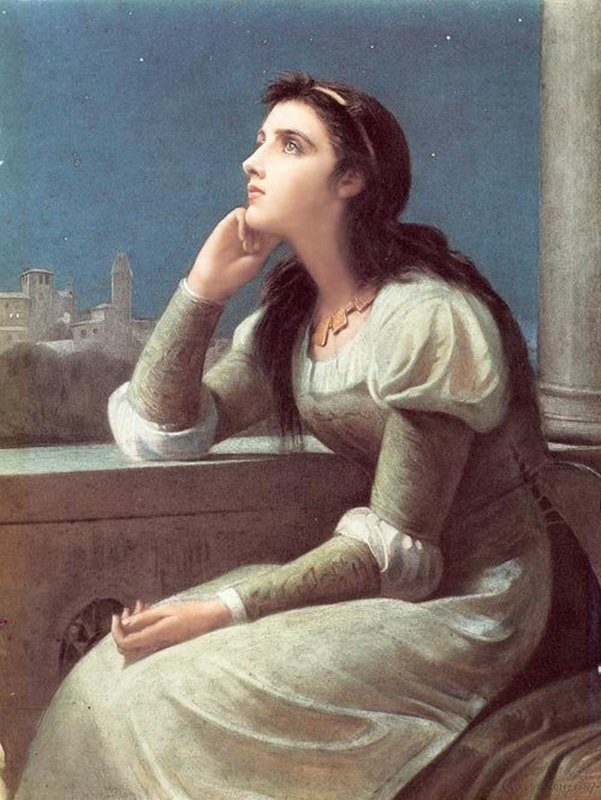
The featured image is “Juliet” (1888) by Philip Hermogenes Calderon and is in the public domain, courtesy of Wikimedia Commons.






I am inspired that a classroom of young people asked such excellent questions! There lies hope for our future… and theirs!
This entire piece reframes Romeo and Juliet for me. The modern take that it is a celebration of adolescent fueled angst, misunderstandings, and noble intention of teen love and rebellion has turned me from reading this with my teens. My last serious encounter with it was in a 400 level Lit class in college when the prof had her own issues and agenda she used to cudgel Mr Shakespeare (and her students).
Am going to pick up R&J and reread, keeping the concept of parental rights and responsibilities as a lens to view the moral questions and humor and thought woven throughout each of his plays.
The idea that audience members would find “shocking” that the adults and family for these young teens, especially the child Juliet, would not have protected them from this scenario… is vital and so very timely for today.
In a newsletter this morning, I read that Austin ISD is hosting a weeklong “Pride Week” complete with activities, pronoun buttons, mental health experts, games stories and information and more.
This is not a minor school district in a tiny liberal town – this is a massive ISD in Austin, the state capital of Texas. Albeit a liberal town, there is a diversity of persons, cultures, churches.
My heart broke for our culture and after stopping to say a prayer aloud for all of these young people who will be subjected to misguided “education” and literal grooming, was to ask: where are the parents? Where are the adults?
Who is protecting the children today?
William Shakespeare would have something to say about the violence being done to childhood, am sure.
If I have ever read a better discussion of ROMEO AND JULIET, I can’t remember when. I also very strongly Katherine’s comment about how inspirational it is that high school freshmen could ask such questions.
I meant to say that I very strongly second Katherine’s comment. When one is old enough to be Juliet’s grandfather — or maybe great-grandfather — things don’t always come out right.
I love you Mr. Pearce (in a brotherly way of course) but your interpretation of Romeo & Juliet flies off the rails a bit. I am no expert, but I was taught (in college) that Romeo’s purported “love” for Rosaline was nothing like his love for Juliet. Romeo was sad and cloistered, essentially in love with love, when talking about Rosaline at the beginning of the play. Whereas, when Juliet appears to him, he is filled with overflowing happiness and openness. He does not want to hide; he wants the world to know, despite the fact that she is a member of the enemy camp. Plus, at the end, we are led to believe that this tragic love might bring together the Montagues and Capulets, when nothing else has done so. The fact that the lovers are (perhaps) teenagers, to me, merely makes the story even more tragic. Thay had so much to live for, so much of life ahead, but their family wars, and fatefull mix-ups brought their lives to a tragic end. Romeo as a “sexual predator”? Methinks you read too much current events into the play. But I still love ya!
A fellow Merry Chestertonian. Gary
Gary, I was taught the play in exactly the way you were taught it. The problem is that such a reading is a misreading of what Shakespeare actually wrote. Dare I suggest that you read my book Shakespeare On Love?
Thanks for sharing these questions and answers! I would love to read or hear the talk from which they came, since the questions are clearly based on an alternative interpretation of the play, and we have to make educated guesses as to what that is from the questions.
I have always hated Romeo and Juliet, but that is because I thought it was the most ridiculous “romantic” story I’d ever heard. It seems that your interpretation re-frames it in a new light, one that I could have more respect for.
I see your suggestion above to Gary to read your book “Shakespeare on Love.” Perhaps that is where I should start as well! Thanks!
So something that I like to consider are the politics in Romeo and Juliet. If one pays attention there are three great families overseeing Verona: the Montagues, the Capulets, and the Escaluses (the prince, Paris, and Mercutio’s family). There’s a balance of power between the three families, which is why there’s so much tension. The marriage between Juliet and Paris threatens this balance, leading the a union between the Escalus and Capulet family. Up to this point, the Escalus family has remained neutral, but seems to be picking a winner. Friar Lawrence has the same idea by uniting the Montague and Capulet family are both rivals, though no one knows about it.
I think Pearce is a little harsh on Romeo. He’s not just a lustful teen taking advantage of Juliet, but a person fails to understand the implications of his romantic decisions. Marriage was mainly political, and he had no choice but to follow his parents in whom to marry, just as Juliet had to do the same. And this decision of the parents was determined more by power and influence than by who would make their child happy.
Power has more to do with the hatreds and rivalries than the Romeo and Juliet’s lust–this is the idea behind Romeo’s bullying of the apothecary, he is higher class and gets his way. Everyone’s to blame, to be sure, which is why Shakespeare kills off two members of each family: Romeo and his mother, Tybalt and Juliet, and Mercutio and Paris. Seen in this light, the play is not just a caution of “violent delights” but of a social system that ties the elites’ love lives to the welfare of the whole community.
Great Questions (smart kids) – Great Answers. To know Shakespeare’s works is a journey that takes a lifetime. Thank you for giving them such a tremendous head start.