
Victor Davis Hanson links the long history of progressive dominance with the gradual “dying” of American citizenship. Is he wrong to do so?
Victor Davis Hanson, The Dying Citizen: How Progressive Elites, Tribalism, and Globalization Are Destroying the Idea of America (419 pages, New York: Basic Books, 2021)
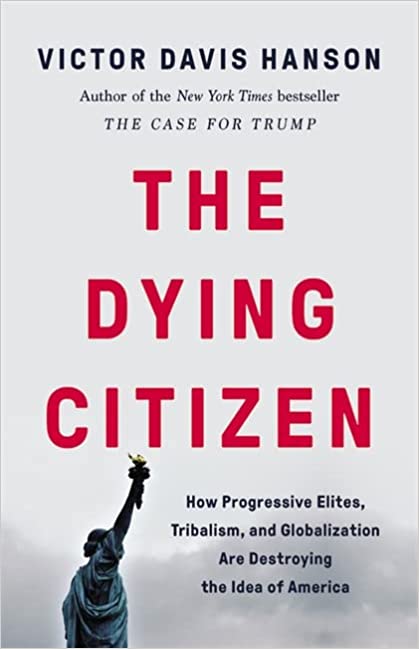 Here and there Victor Davis Hanson tries to pretend otherwise, but this is not an optimistic book. The dying American citizen may not yet be the dead American citizen, but Dr. Hanson finds precious little reason to believe in the revival of American citizenship.
Classicist that he is, Dr. Hanson gets little help from Plato. “Among his bleaker notions,” the author tells us, was Plato’s conviction that an equality-driven, ever-more “radicalizing democracy” would eventually lead to “chaos.” And that wasn’t the worst of it. Following on the heels of this ill-defined chaos, Plato did not see a revival of Athenian citizenship, but a return to some form of “tyranny.”
No doubt Dr. Hanson set out to write this book less to prove Plato wrong than to warn his fellow Americans to change course before Plato’s bleak notion comes to define an American story of chaos and tyranny. One can only wonder about the evolution of the state of Dr. Hanson’s mind between this book’s conception and its completion. Note the less-than-optimistic subtitle. Might the originally-conceived version have gone something like this: “Why the Idea of America Is Under Attack and What Can Be Done to Revive It?”
After all, the forces arrayed against real citizens—and against the idea of citizenship—are powerful indeed. And few are more aware of this bleak state of affairs than one Victor Davis Hanson, whose indictment dwells on three troubling phenomena: the rise of the administrative state, the power of identity politics, and the lure of a globalist (as opposed to an American national interest) agenda.
That all three threats to American citizenship come from the American left might be so obvious as not to deserve mentioning. That Dr. Hanson sees no comparably powerful threats coming from the American right is less obvious, but worth noting. So is this reviewer’s agreement with Dr. Hanson’s judgment.
Dr. Hanson divides his book into two sections. The first is labeled “precitizens,” and the second is devoted to “postcitizens.” He then subdivides the former into “peasants, residents, and tribes,” before subdividing the latter into the “unelected, the evolutionaries and the globalists.”
Caught between them is the real citizen, here defined as the “dying citizen” and previously defined as members of Burke’s “little platoons” or Jefferson’s “yeoman farmer” or Tocqueville’s or Lincoln’s or Chesterton’s “common man.”
Dr. Hanson contends that the two most dangerous threats to traditional American citizenship are identity politics (tribalism) and a post-national or even anti-national thrust to American politics, both of which are being aided and abetted by an “unelected” American elite that comprises and/or supports the administrative state.
Dr. Hanson pithily summarizes each major threat in a single sentence. On the danger of tribalism: “Once a man owes more loyalty to his first cousin than to a fellow citizen, a constitutional republic cannot exist.” And on the danger of globalism: “In the end, globalization may not westernize the planet so much as internationalize America.”
Dr. Hanson properly presumes that a society of engaged citizens can only be a society with a large, confident, and solid middle class. He also presumes that this was essentially the American story of not so long ago.
Lastly, Californian Hanson presumes that his home state offers a bleak, even foreboding, hint of the “dystopian future” that awaits the entire country. That would be an America dominated by two classes, specifically a class of the well-to-do and the very well-to-do, and a class of the poor and very poor. The eventual, and virtually inevitable, result will be an America that he defines as a “strangely medieval America.”
The California version of this two-class society is primarily composed of immigrants (meaning “residents,” as opposed to citizens), but far from exclusively so. Hovering within this lower class are and will be fully American peasants, many of whom are and will be the sons and daughters and grandchildren of the state’s once vibrant middle class. Actually, many of these newly-created peasants might best be categorized as post-citizens, not pre-citizens.
 That quibble aside, Dr. Hanson is correct to worry that that the California “model” portends a “bleak” future for America: impoverish or drive out the middle class; import the poor; “enable staggering levels of wealth”; and then cap it all off with one-party rule, all the better to “fuel such medievalism.”
Dr. Hanson’s accompanying worry is the revival of a very “ancient” practice: tribalism. Put simply, but accurately, American tribalism is “at war” with American citizenship. Tribalism is not just an ancient practice, but an “ancient narcotic,” and one that is “almost impossible to thwart.” But tribalism is not simply ancient; it is also “natural, insidious and odd.”
“Odd” seems to be an odd choice of adjectives to add to a string that includes “natural.” But Dr. Hanson is out to make a point that is at once telling and devastating: It is “odd” that alleged progressives should adopt such a reactionary idea to advance their cause.
Dr. Hanson also links our modern progressive tribalists (otherwise disguised as multiculturalists) with pre-Civil War southern secessionists. And why not? After all, these secessionists were tribalists of a different, but no less dangerous, sort. And it was—and is—very much the case that both have sought to divide America on the basis of skin color, thereby confirming for Dr. Hanson that both invite societal disaster: “When the wealthy children of privilege who are not white gain further advantage over the poor who are white, or, alternatively, when wealthy whites enjoy both class and supposed racial advantages, then the ingredients of social chaos arise.”
No doubt today’s progressives will object mightily to any comparison to mid-19th-century southern racist secessionists, but Dr. Hanson is not about to let them escape the logic of his argument. After all, what are today’s advocates of sanctuary cities if not a reversion to Calhounite nullifiers of federal laws?
And who is Beto O’Rourke, contends Victor Davis Hanson, if not a close intellectual and political cousin of Alexander Stephens, Vice-President of the Confederacy? Both are not just would-be presidents, but both believe in a fatally flawed America. Stephens criticized the Constitution for failing to institutionalize white racial supremacy, while Mr. O’Rourke indicts an entire country for having been founded on white supremacy.
For Dr. Hanson, Mr. O’Rourke serves as a bridge of sorts between his treatment of pre and post-citizens. If many among the victimizable “precitizens” are genuine victims, few among the “unelected, the evolutionaries and the globalists” deserve to escape Dr. Hanson’s indictment of them.
In all likelihood, members of the administrative state, as well as those who believe in a living (meaning evolving) Constitution and those who think in terms of what they think is best for the world (as opposed to the United States), all see themselves as good citizens. Dr. Hanson might even be willing to give them credit for thinking such thoughts and for trying to behave accordingly. But the consequences of their thoughts and actions have been devastating for the “dying citizen,” otherwise defined as our once-vibrant middle class.
To be sure, all three types of postcitizens have done their part to contribute to the gradual demise of genuine American citizenship. If there is a chief villain here, it isn’t a relatively minor figure like a Beto O’Rourke, but a minor figure who burst into national prominence in 1912. That would be a one-time college professor and later governor of a middling state, who subsequently managed to squeak into the White House following a split with the Republican party. Woodrow Wilson anyone?
In many respects, Wilson could serve as a representative example of all three forces that have long been at work creating an America of, by and for postcitizens. This would be the same Wilson from whom Dr. Hanson borrows the following: “The Constitution was not made to fit like a straitjacket.” It would also be the same Wilson who believed that the purpose of public education was to wean children from the ideas and practices of their parents.
Dr. Hanson links the long history of progressive dominance with the gradual “dying” of American citizenship. Is he wrong to do so? Hardly. Is there a path to the renewal of American citizenship? No doubt Victor Davis Hanson would like to believe as much. But let’s let him recover from the consequences of spelling out his warning before expecting him to offer a way forward. Or should that be backward, as in backward to the American Founding?
The Imaginative Conservative applies the principle of appreciation to the discussion of culture and politics—we approach dialogue with magnanimity rather than with mere civility. Will you help us remain a refreshing oasis in the increasingly contentious arena of modern discourse? Please consider donating now.
The featured image is courtesy of Pixabay.




I do wish we would quit using the same word “Progressive” for Teddy Roosevelt and AOC. If you re-read this article and do a word replace of “progressive” with “Jacobin” – the whole concept makes much more sense. Because the Jacobins, ignorant of history as they were, did not see the logical end to their madness. Being educated by Hansen, Plato and Aristotle, the Imaginative Conservative readers look at these Jacobin tribalists, and we wonders “How could it end any other way?”. Especially when we have Illinois, New York and California leading the charge down the drain.
You make a very good point. TR, the progressive, would likely turn over in his grave if he knew what today’s “progressives” were up to. He would even oppose today’s progressive environmentalism.
While concurring with most of this, I do find it a bit odd to blame the globalist focus solely on the American Left. This seems,to put it mildly, implausible. Sure, the Right may have retained more of the lingo of nationalism than the left, but that’s just the lingo. Who rolls over every time big business makes decisions that negatively impact Americans? The answer to that is as bipartisan as it comes.