
Switzerland remains feisty, free, and a bright beacon in a dark age for a collapsing civilization that should be looking to its example. For those weaned on the open-borders, Leftist humanitarian brainwashing of modern times, here are a few rules from the Singapore of Central Europe.
“When all the world is socialist, Switzerland will have to remain capitalist, so that it can tell us the price of everything.”– Nikita Khrushchev
 During the great days of my salon monarchism and alpine anarchism while living in street clean Wien, I traveled with the beloved Graf so-and-so by car from the Salzkammergutl to Zurich past many a forlorn castle and mighty monastery to check in on family Schwarzgeld held here and there in attractive old banks run by the same Catholic families two hundred years on. In those days I roomed with an astute German princess whose sister had been part of the July 20 plot against Hitler and I wrote various stories for the Herald Tribune and Wall Street Journal Europe about the post-war confiscation of art and lands of the Austro-Hungarian ancien regime under scurrilous pretexts of EU legal cloak-and-daggerism. Thus, among these friends there prevailed a mentality of seeing oneself orphaned from history and, as a result, ‘The State’ could in no way be trusted—what with socialists, communists and Freimauer types leering at you from behind every foggy Jugendstil street lamp. This attitude included a rather sacrosanct insistence upon guarding one’s wealth, or what remained of it, within ye olde financial secrecy rules of the proud Confederation next door, despite the general trend internationally that the party was truly over by the mid 2000s. I was fascinated by what seemed to be a permanent fin-de-siècle, Stefan Zweig-esque melodrama that anxiously wound its way through the psyche of these characters, all of whom suffered from that very Central European trauma known as Erbsunde. This roughly translates as the inherited psychological state of one’s ancestors; a secular brand of original sin that comes with being at war with the world every sixty years or so and an outlook that regards History, capital-’H’, as a prison through which one entered by many doors, not one of them offering an exit.
It was this combination of Spenglerian dread mixed with Dr. Mabuse’s prophetic evil grin mixed with the rough splinters of noble pride still stabbing at the Habsburgian heart that compelled these members of a collapsed civilization to cast a hopeful gaze to the arrogant democracy next door—to its love of privacy, its respect for meritocracy, its love of order and cultural continuity. A country that was and remains solid, stable and secretive; a safe haven of I-told-you-so European high standards. That doesn’t need you, want you or care what you think. Today, members of another collapsing civilization should be looking to its example as well.
I now live in northern Italy and my Lugano-born, Milan-raised husband stresses his Lombardian affinities to Switzerland with a rapture as intense as his contempt for gracious and degraded Rome. Many memories of one’s clean, beautiful public hospital room like a private club with gourmet food and tranquil views. Wistful respect for the cultural ministry that will long-lease to you an unclaimed castle if you give it an art collection. Paying for your sandwich with a 500 note and no one blinking an eye. The competing cantons whose modern battles consist of offering businesses lower taxes and better educated workers. The half-dozen private bankers (a special status beyond “bank”) that adhere to the 1934 laws requiring the total personal liability of its partners, high cash reserves and that do not permit speculative investment. The stately national newspaper that is still an objective, high-brow print newspaper. The Sunday laws against noise and work. The thrill of disbelief in being fined for J-walking or cited for using a non-approved color of garbage bag at your apartment building, or of police stopping at someone’s home when the wash is not hung out tidily. Of course, one does not simply “move to Switzerland”: a visa and passport generally take fifteen years, with some notable exceptions, and even then the inhabitants of your county district must vote to approve of your staying there. Ach, Du lieber Himmel!
And for those weaned on the open-borders, gauchiste humanitarian brainwashing of modern times, here are a few rules from the Singapore of Central Europe:
- If you enter Switzerland illegally, you are thrown back out, no exceptions. If you manage to slip through illegally and you commit a crime, you must pay for your jail time—the shelter, the food that consumes tax money. How is this paid? Forced labor, dear.
- Switzerland has a zero-tolerance approach to homelessness. There are ‘homeless’, who tend to be of the minority-formerly-called gypsy variety, but they are fined and warned and forced to leave. Last year, Basel announced a program whereby homeless individuals would be given a one way ticket to any other European city and twenty Swiss francs if they promised never to return–at least for four years (This proved very popular). Violators are deported.
- Begging on the streets is illegal, for which one is fined hundreds of francs. In Geneva in 2015, a Roma woman, not able to pay several fines for begging that amounted to around 500 CHF, received a sentence of five days in prison in that city. The globalist cabal of the soi-disant European Court of Human Rights demanded that Geneva overturn its decision, maintaining with its brand of looney logic that begging is an expression of ‘human dignity’. The city was told to pay her close to 1000 CHF in ‘damages’. Nonetheless, Swiss law enforcement throughout all the cantons continues to fine begging
- If you are employed and then become unemployed in Switzerland, your name is put in a central database with your qualifications and background in your canton. That canton will then start to send you notifications of job offers commensurate with your work history and education. You are allowed to reject two of these offers. If you reject the third you must leave the country, unless you can prove at once enough wealth to sustain your livelihood for a specified amount of time.
- If you become unemployed in Switzerland, the state will give you, for a short while, welfare benefits. Once you are employed, you must pay the welfare back. No living off of the public trough. If you refuse this you must leave the country.
- Corporate taxes are the competitive open-field between the twenty-six cantons. These are federal, cantonal and communal. The federal (national) corporate tax rate is a flat 8%; the cantons determine the rest individually. For all federal, cantonal and communal corporate taxes combined, you are looking at a range of 11.9% to 21.6%. The VAT is one of the lowest in Europe although import and customs duties are high.
- There are very strict Sunday laws. Sunday is considered sacred–not just in religious terms but as a matter of civic respect. You aren’t allowed to mow the grass, you can’t hang laundry, and you cannot recycle your trash. If you are caught sending out the trash on Sunday to one of the centers close to you, you will be fined. If you cannot pay the fine, you can choose the option of a few days in jail.
- Good Samaritan laws are still in place. If you see something happen or someone in trouble, the least you are required to do is to call the police. The failure to do so can get you in hot water.
- Memo to San Francisco: In an attempt to liberalize the drug laws, the Platzspitz or “Needle Park” in Zurich was an open drugs scene in the 1980s and early 90s when heroin users could inject the drug without being arrested and volunteer doctors supplied the needles. The scene spun horribly out of control with the number of drug-related deaths in Switzerland increasing twelvefold between 1975 and 1992. Authorities shut it down that year, with a heavy gate built across the park.
- That famous healthcare system is expensive and you pay mostly out of pocket, reimbursed later. Even though Switzerland’s healthcare system is universal, there is no free public healthcare. Instead, all residents of Switzerland must pay for their own private health insurance. There is no Medicare. Subsidies are provided in extreme cases (poverty, the infirm) with strict conditions, including the recipient having to pay back those subsidies eventually. Once voluntary, insurance coverage has been compulsory since 1996.
- And yes–Switzerland still has National Service in the armed forces, where each able-bodied Swiss man has to spend time each year in a training camp that forms part of the military. Soldiers must keep a gun in their home, which is a part of the military framework in readiness for potential conflict
Naturally, things are not perfect. The repeal of its famous neutrality to denounce Russia’s attacks on Ukraine, the climate-change politics, “Davos”, the perennial Socialist politician wanting more central government etc. disappoint. But the country remains feisty, free, and a bright beacon in a dark age. Since winning their independence in a series of bloody battles against Habsburg Austria in the 14th century and then Burgundy in the 15th century using that famed phalanx fighting style, the Swiss aren’t to be messed with. Machiavelli regarded them as the epitome of efficient soldiers. Rich in brains, poor in natural resources, and with a reputation for discipline, the Swiss were chosen in 1506 to be the protectors of the spiritual leader of the Western world, a role lasting through to this day. And how.
The Imaginative Conservative applies the principle of appreciation to the discussion of culture and politics—we approach dialogue with magnanimity rather than with mere civility. Will you help us remain a refreshing oasis in the increasingly contentious arena of modern discourse? Please consider donating now.
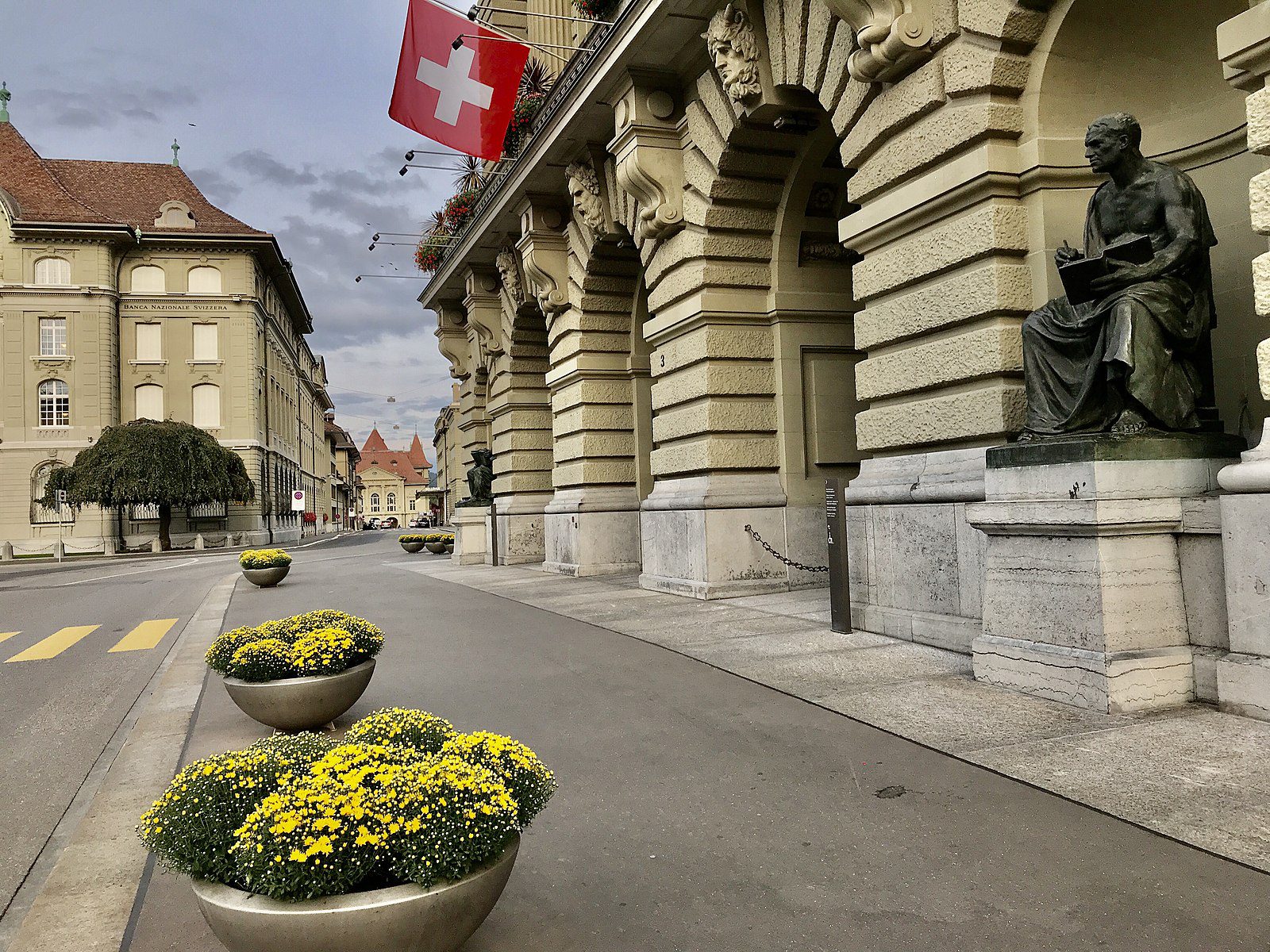
The featured image, uploaded by Ank Kumar, is a photograph of the Bundeshaus, Swiss Parliament, in Bern. This file is licensed under the Creative Commons Attribution-Share Alike 4.0 International license, courtesy of Wikimedia Commons.




I serendipitously stumbled into an article of yours, and have since been reading one after another…..delightful! Thanks.
Having gone to school in Fribourg as a child, and worked and lived in Geneva and Zurich as an adult, I can relate to this essay. Switzerland is a wonderful country in (almost) all respects, although I don’t believe they’ve yet resorted to caning vandals as Singapore does.
i am 50% Swiss, and 50% English; and proud to be a living container of Swiss blood. my Father was a strict disciplinarian, who learned the meat business from his Father who developed and an export/import business: western beef to Switzerland/Swiss cheese to America. i attended university and earned a BS in mechanical engineering that enabled me while working on projects in Europe, to visit my paternal grandparents homesteads. located a maternal cousin and had a splendid lunch with him………much to talk about !
First, what a beautifully written essay. I loved the following description: “It was this combination of Spenglerian dread mixed with Dr. Mabuse’s prophetic evil grin mixed with the rough splinters of noble pride still stabbing at the Habsburgian heart that compelled these members of a collapsed civilization to cast a hopeful gaze to the arrogant democracy next door—to its love of privacy, its respect for meritocracy, its love of order and cultural continuity.”
Second, a fascinating list of facts that describe the Swiss psyche and if nothing else, their sense of responsibility. I pray the American experiment will cast its gaze on the Swiss democracy and awake from its wokeness to a renaissance of the values that made it the shining beacon of liberty.
Switzerland should be a beacon to Americans of what we were-a land of opportunity, but also a land of personal responsibility and being self sufficient. We have slowly become consumed by our own riches and technologies and societal conveniences, and this has weakened us as humans, Americans and Christians as a whole and individually.
Are there any books on this subject where I can research further? Thanks
To be accurate, the Scandinavian social democracies are mixed economies. Parts of their economies are capitalist while other parts are socialist. In fact, large parts of their economies are socialist: education, healthcare, natural resources, etc. Iceland, for example, runs a national surplus that can only be spent on public good. They create that national surplus by the government running a public-owned-and-operated oil company that has a monopoly over oil reserves.
Public resources are used for the public good, instead of privatizing them as benefits through capitalist profits while socializing the costs. That kind of partial socialism is how Scandinavians are able to fund all of the social benefits and safety net without raising taxes too high. Yet they still maintain other sectors of economy within capitalist markets, although they are much more friendly toward corporate regulation than in the US. So, it’s definitely not the laissez-faire capitalist realism idolized by libertarians and objectivists.
To understand what makes those countries unique, read The Nordic Theory of Everything by Anu Partanen. She explains how it’s precisely the government interventionism of social democracy that allows for greater individual autonomy. The Nordic governments tend to treat citizens as individuals, as opposed to the US tendency to legally define people according to relationships (e.g., mixing of finances in marriage). Relationships are a private, not a legal, matter. Those governments treats all people as individuals.
So, it doesn’t matter if a Swedish kid has rich parents because he’ll get the same government-paid college and healthcare as those with poor parents, at least at a basic level; although one could always seek further services on the market if so desired. Similarly, someone seeking to escape a violent spouse can obtain the same government resources and protections no matter the economic status of one’s spouse. It’s the same reason that Finnish government gives baby boxes even to the wealthiest. That is not true in the US where resource availability is determined by various factors and so there is no equality of treatment.
That is why, among those populations, there is such strong and widespread support of social democracy. Such issues, as applied equally, can’t be used to divide citizens against one another. Think about how political and media elites in the US constantly splinter the American public on so many issues, despite the fact that the supermajority of Americans agree on most major issues. Identity politics, on all sides, trumps a culture of trust and a sense of solidarity among the general public. The Nordic style of social democracy is better at preventing this kind of Machiavellian manipulation.
Let me add some side observations. Those Nordic countries have low rates of religiosity. They are the leading examples of successful secularism in the world. Religious people still exist there and they aren’t oppressed. But the secularism means both that religious people are protected from government and the public is protected from the religious taking over the government. That is why culture war issues (abortion, euthanasia, same sex marriage, etc) are less often used as political footballs.
Those Nordic countries also have low rates of marriage, probably related to the lack of religiosity. Also, that is because legal marriage is less relevant, as it isn’t as mixed up in other areas of law such as finances, since public benefits and resources aren’t determined by marriage and other relationships. Interestingly, this doesn’t increase single parenting. It’s just that more people live in what we would call common law marriages. That is to say they simply live together. That is how a culture of trust operates, not requiring laws to enforce social order and social norms.
It turns out that, in a post-scarcity society where basic needs (shelter, healthcare, education, job training, etc) are guaranteed by the government, most romantic relationships remain less stressed and hence are more easily maintained over the long term. The main cause of divorce or else not getting married in the first place is simply economic difficulties. For example, a major contributor to divorce is long commutes, as studies have shown. One might suspect that, in having less poverty and inequality, Scandinavians have more freedom to look for better work near where they live, instead of taking any job that is immediately available out of desperation.
And it is a beautiful country! Very scenic and fun! Neat climate, great mountains!
What is the name of the print magazine on the old masters for which the author edits? I’d like to subscribe but a google search of her name doesn’t reveal the magazine, if extant.
Further, I might add: I’d love recommendations on any good up-to-date considerations of The state of Swiss banking secrecy. I read much on this in the 80’s and 90’s. There were some alternatives at the time in neighboring countries which had the advantage of not being as high profile as the brand “Switzerland”. One was Anglo-Irish bank in Vienna. Though that didn’t turn out as well in the long run! I think the author is right that by mid-2000’s things were over. At least for American passport holders. Or those with substantial assets in the US. When I first started attending seminars on this topic in the early 80’s, the legendary “Secrecy” was already being argued to have been in decline. At the time, the argument was to use another non-US passport to open an account. And it was easier to get passports from certain EEC countries then. And the strategy was to have a non-interest bearing account so that not reporting the account, you were not not reporting un-earned income. I can’t remember in what year the the 1040 had the box you check on whether or not you hold a foreign bank account. Maybe it was always there. Anyway I suppose media reports of nazis and drugs dealers and a few high profile IRS cases in US helped kill this for Americans. I remember some Americans confined themselves to safe deposit boxes at local cantonal banks. And even in the early 90’s there were arguments for avoiding the “Big 3” Swiss banks for the smaller ones. Though I was using the internet for early email and very limited browsing and communication in ‘82-‘83 I certainly didn’t see the extent of electronic communication and surveillance we see today; and to read today some of the suggested measures argued for them for asset protection and financial privacy seem (almost) quaint. Books on obtaining citizenship in Switzerland were popular amongst a certain set as well as a handful of newsletters whose writers were very loosely connected to Von Mises Inst (and allied orgs) — they all recycled the same material and argued for certain techniques of “financial privacy”. A few of the core tenets are still useful but mostly outdated stuff. I was amused to see finally that one guy who I think had an NYT best seller on the topic and with whom our families were close continues his grift with a very successful conference each year in the US.
Being Swiss, I appreciate the kind words, BUT please do your research.
1) CHF 500 Bill was discontinued in 1996, and you are writing in 2022
2) What do you mean with “National newspaper”? There is no national newspaper in Switzerland. There is national TV and Radio.
3) Soldiers do no longer have to keep their guns at home.
4) The draft is significantly smaller than the number of young men of age, so saying that “each able-bodied Swiss man has to spend time each year in a training camp” is false
You get the point. This is a nice concept for an article but executed half-hazardly with insufficient research. Try revising it.
Switzerland is wonderful and definitely still has a healthier discourse than many other western countries. It is however not impervious to the spirit of the times.
To add some clarification:
1. In terms of the 500 CHF note, the article does not specify 2022, but within an historical context, referring to the time I was there. The 1000 CHF note was even more attractive at the time
2. By national newspaper I mean the Neue Zurcher Zeitung which is distributed internationally and has the “national” identity of the country to foreign readers.
3. Soldiers do not have to keep their guns at home, but the common tradition is and was that they do.