
I remember the excitement the day the crates arrived and were carefully opened, and what emerged was overwhelming. What was beginning to happen was a unique partnership combining all the art forms: poetry, painting, music, and theater into one evening’s performance.
She was British-chilly until I brought out the gin: one ice cube and a mint leaf for color. She was visiting from the sea-side town of Bath where she taught at the University. She would have been 63 if I were to guess but one does not ask the age of a lady who was the daughter of a British soldier. She lived with her mother. She had once played tag with the Queen.
My college (to introduce a different topic) had just completed construction of a fine arts center which included an empty museum. It’s called the Sage Center for the Fine Arts.
The place needed a dedication which led to some serendipity.
Her name is Brigid M. Boardman, conservative and Roman Catholic, and the author of a fine biography Between Heaven and Charing Cross: The Life of Francis Thompson, published in 1988 by Yale. In her earlier years, she told me over that chilled glass of gin, she was an artist rather than a writer or a professor.
We first met before during a weekend at the Kirk Manse in Mecosta, Michigan, and in early 1993. She was staying at Piety Hill and I was there to offer her a short venue at my college. We talked about Thompson and her biography. She asked if I had knowledge of R. H. Ives Gammell’s pictorial sequence based upon Thompson’s poem. I confessed ignorance.
She produced galley proofs of a book she was preparing on Gammell’s pictorial sequence. She had come from Boston College where she was conducting research and finishing her introduction and commentaries on The Hound of Heaven: A Pictorial Sequence R. H. Ives Gammell.
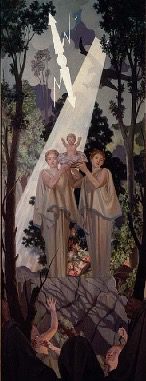 I opened the book carefully and landed on page 83, Plate XI, and the epigram “Drew the bolt of Nature’s secrecies,” the words from Thompson’s poem. It was smallish in the book and I could hardly begin to “sense” the insights Gammell found in the poem which seemed to have stepped outside time-bound human experience. We agreed that I could call her Brigid.
Our conversation vectored along these lines:
Would the college be interested in hosting an exhibition of Gammell’s sequence which was to begin an international tour in 1994. A fall slot in August and September 1993 could be arranged.
Back home I scurried, gained enthusiastic approval from all the fine arts faculty and a good- sized budget from the administration. Brigid—by now we were on a first name basis— prepared the way for conversation with the Gammell Foundation who agreed to an August 27 through September 18 itinerary once proof of a million-dollar insurance policy was in place.
I remember the excitement the day the crates arrived and were carefully opened, and what emerged was overwhelming.
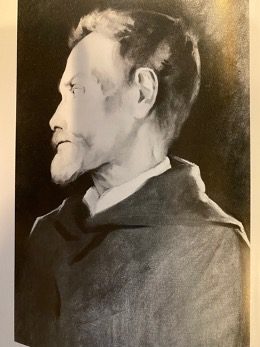 What was beginning to happen was a unique partnership combining all the art forms: poetry, painting, music, and theater into one evening’s performance. I discovered that Boston College owned a collection of musical scores for “The Hound of Heaven,” which excited our choral director who happily agreed to prepare a string quartet and then at the beginning of the program a small mixed chorus with a small orchestral accompaniment. One of our theater folk had a lovely voice and would perform portions of the poem while a small entourage of male and female dancers would also perform dramatic activity synonymous to the poem in a dimly lighted background on stage. Brigid would offer a synopsis of the poem and the paintings. As the conclusion neared, one more solo boy’s voice, an ode from the poem. Then the theater darkened but on two large screens a pencil drawing of Thompson and a photograph of Gammell.
The audience exited and made their way to the Gallery where a student stood by the side of each panel and offered insights.
Serendipity does happen and as for Thompson’s life and Gammell’s life the poem and paintings all worth discussion.
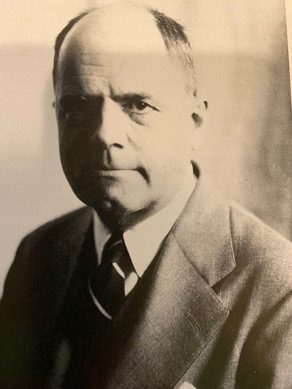 Brigid’s biography was a timely reappraisal of Thompson’s life and works and for the reader a portrait of Thompson different from his early Catholic admirers for whom he was represented as the last word in pious orthodoxy. Her argument is that Thompson would have thought such a too etherealized version of his life and would hold contempt for those detractors who believed him a drug-crazed failure. Brigid confronts the Victorian polarized views about a man whose sense of God and opium did indeed vie for control. In the pages of the biography she calls him “Francis.”
K. Chesterton believed “The Hound of Heaven” one of England’s greatest poems by one of England’s greatest poets and at that time could be recited from memory by Catholic school children. Add to that list of admirers J. R. R. Tolkien and Eugene O’Neill.
The poem is written in a dignified style expressing deep feelings and classified as an irregular ode in the manner of Crashaw. Early book blurbs note how the poem fingers all the stops of the spirit with a note of doom but also with the “quiring of the spheres.” It has the solemnity of Thomas a Kempis. Few mystical works have touched us so unless found in Dante Gabriel Rossetti’s The Blessed Damsel. No poem has so touched the passion of penance since George Herbert and it won the love of a Catholic mystic like Coventry Patmore.
I fled Him, down the nights and down the days;
I fled Him down the arches of the years;
I fled Him, down the labyrinthian ways
Of my own mind; and in the mist of tears
I hid from Him, and under running laughter.
Up vistaed hopes, I sped;
And shot, precipitated,
Adown Titanic glooms of chasméd fears,
From those strong Feet that followed, followed after.
But with unhurrying chase,
And unperturbed pace,
Deliberate speed, majestic chase,
They beat—and a Voice beat
More instant than the Feet
“All things betray thee, who betrayest Me.”
One might call these “lines from a wanderer with an allegorical bent.” And he was as Brigid makes clear: there were years of destitution and no welcome in the public library because he was too ragged but he could scratch bits of verse and prose. Some poems were sent to a new Catholic magazine, pigeon holed, and then unearthed by Wilfrid Meynell, the editor, who lost no time in responding to Francis whose address was a post office box.
Mr. Meynell sought him ought and found him hard by selling matchsticks but took him under his care then with his health returning found room and board at a monastery which left Francis free to write. His magnificent “Ode to the Setting Sun” with the sultry prelude was one of the first fruits with lines like,
Too long in aching music. Spirit pined . . .
In wafts that poignant sweetness drifts, until
The wounded soul ooze sadness . . . .Yet in this field where the Cross planted reigns,
I know not what strange passion bows my head
To Thee, whose great command upon my veins
Proves Thee a God for me not dead, not dead!
And there was an essay on Shelley, and one titled “The Life of St. Ignatius” and another titled “Health and Holiness.”
As for the poems and especially “The Hound . . .” there are imaginings and images of mystical splendor and words that seem to cling to heaven by thin strands or perhaps the arched bridging stones between Heaven and Charing Cross and the story of one more everyman in flight from divine order, the “I” in “The Hound….”
The speaker is running from God choosing a dissolute life of laudanum rather than the love of God which would square a reading of the poem as Francis’ confessional biography in verse. Submitting would mean losing those dissolute pleasures and as he runs he pleads one moment that when the morning dawn arrives the day might be brief and darkness come again to hide him, God still pursues, saying “Naught shelters thee, who will not shelter Me.” His days pass but the happiness he sought in the things of this world are elusive.
Thus there are strong visual elements in the lines at the poem’s beginning and a source for Gammell’s magnum opus.
We know that Gammell was born in Rhode Island in 1893 and died in Boston in 1981. He completed the pictorial sequence in 1956 having started work on the paintings some dozen years before. He dedicated himself to a revival of the academic tradition out of favor with the moderns but now steadily gaining ground especially by those he trained now called “Gammellites.” Academic art is understood to be true to life but also high-minded such as one might find in Poussin’s “Abduction of the Sabine Women.” In Gammell’s case the high-mindedness is a self-conscious attempt to convey the range of ideas offered by the poem but anointing those ideas with myths and symbols that suggest eternally recurring patterns of human life from which they evolved. It was Gammell’s belief that he was not advocating a mere academic revival from the past but something in keeping with the needs of the modern world.
It’s here the issue becomes problematic.
Recalling for the moment that the first word in the poem is “I” the first panel is 6’7’’ by 2’7” and understood to be contained within the word “I.”
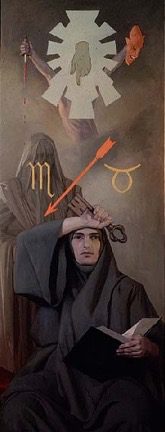 The hooded classical figure in the foreground holds a book that represents rational thought, the Apollonian “I” that also represents Descartes’ cogito placing existence in reason. One wonders if the hooded figure isn’t attempting to fix his gaze outward to other unknown regions. The “Key” he holds to his forehead suggests the means to unlock the mind to those more esoteric regions. And in the background are floating mists one might think of as The Cloud of Unknowing, and another shrouded figure representing Dionysian values but also Jungian instincts which oppose the rational self and also psychic energies, seer-like, creative trance-like shadows. One might suggest “she” is an Anima figure, too, described by Jung in his theory as the unconscious masculine side of a woman and as the unconscious female side of man and one of the four major Jungian archetypes, the Self, the Personae, the Shadow and the Anima/Animus. The panel is also illustrated by symbols that will appear and reappear, haunting the monk-like figure: the Key, the Mask, the Cloud, the Arrow, and the Hand.
Thus in the background of the panel are symbols reflecting mental struggle but including the Hand which Brigid suggests is the hand of God pointing to a downward journey and farther back in the panel behind the Hand the outstretched arms of a crucifixion figure holding the bloody dagger of spiritual struggle and the mask torn away if the true self is to be revealed.
Does this square with the poem or did Gammell venture into regions discontinuous with the poem?
There is Francis’ own imagery in the poem but our problem is the tendency to read into the poem only his experiences but not in relation to Christian heritage’s mysterious roots which Brigid notes recalls the words of the Psalmist, 139: 7-12, King James Version:
Whither shall I go from thy spirit? or whither shall I flee from thy presence?
If I ascend up into heaven thou art there: if I make my bed in hell, behold thou art there.
If I take the wings of the morning, and dwell in the
uttermost part of the sea;
Even there shall thy hand lead me, and thy right hand shall hold me.
If I say, Surely the darkness shall cover me; even the night shall be light about me.
Indeed, the darkness hideth not from thee; but the night shines as the day: the darkness and the light are alive to thee.
The poem is rife with Hebrew cabalistic sources and known in depth by the writers of the early church and St. Augustine for whom flight and pursuit led to both self-negation and self-acceptance. Here’s St. Augustine writing in a manner that might be regarded as an epigram to Francis’ poem and Gammell’s pictorial sequence:
Late have I loved Thee, O Beauty so ancient and so new; late have I loved Thee! For behold Thou wert within me, and I outside; and I sought Thee outside and in my unloveliness fell upon those lovely things that Thou has made. Thou wert with me and I was not with Thee. I was kept from Thee by those things, yet had they not been in Thee, they could not have been at all. Thou didst call and cry to me and break open my deafness: and Thou didst send forth Thy beams and shine upon me and chase away my blindness. Thou didst breathe fragrance upon me and I drew in my breath and did not pant for Thee. I tasted Thee, and now hunger and thirst for Thee. Thou didst touch me, and I have burned for Thy peace (Confessions, Book X).
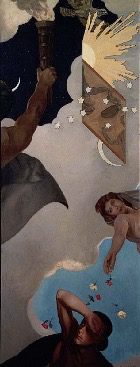 Here is the second panel in the sequence titled by extending the first line of the poem: “I fled Him, down the nights and down the days.” Brigid quotes Gammell in her analysis by noting how such heroes in Christian history are wanderers of a certain type, longing, ever relentless, and the underlying myth is suffering while wishing for an antidote to an unquenchable longing for some kind of communion with infinite life.
The poem’s protagonist is again in a cosmic setting, different from nights spent under a bridge along the Thames. Nights and days suggest our time-bound lives are governed by what Brigid refers to as “the mysterious workings of the universe, to which we are . . . no less subject.” There is again the cottony cloud which owns a larger and more distinct role in this panel but the figure on the bottom, has lost some of his monk-like garb. The issue is whether “he” will look more toward The Cloud of Knowing and veer away from the “she” who could be understood as an emanation from that cloud. If she is the Anima from the first panel, she has also shed the more fearful form and is now a young girl inviting “him” to experience the pleasure of human love what with the dispensing of roses, white and red and with that fragrance referenced by Augustine.
The gesture with his right arm is much like that from the first panel but now his reason is confronted by the unknown. The Sun and Moon share space but are fragmented symbols of creativity; the moon is waning. What appear to be diamonds are like stars placed in the skies not as a constellation symbol but—forgive the pun—the fact that diamonds are forever and greedily sought after. Often the subject matter is related to mankind’s deep seated fears and aspirations. Gammell also noted that age old myths and symbols had lost their effectiveness and what is represented is often ambiguous.
That point is reinforced by the muscular arm holding a torch which holds a number of suggestions including mastery of fire but also inspiration, knowledge, light bringing culture and civilization, the very essence of life and spirit. Given the Christian context of the poem my own sense is to think of the torch as the living light of Christ within us.
 But the myth suggests the trial the protagonist must undergo is like a curse from which he is compelled to escape. When the trial comes to an end that will be as if the curse has been cast out and the result will be a blessing.
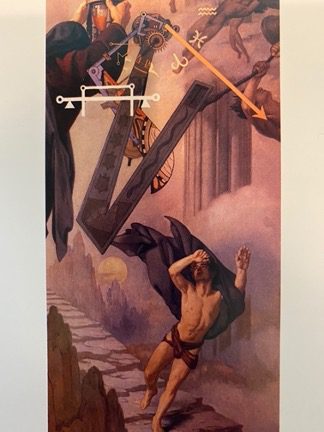
It might be best to consider two plates in tandem, Plat III, “I fled Him, down the arches of the years, and Plate V, “…and in the mist of tears I hid from Him.”
Noting again that the usual analysis of the poem’s setting assumes that the topic is Thompson’s opium addled life on the London streets. But Brigid and Gammell are aware of the allegorical depth of the poem; Gammell’s images emphasize the cosmic setting enhanced by the complex of fragmented images which when studied and compared beginning with Plate iii suggest a vectoring into the underworld and across a precarious bridge, a symbol for the arches of the years but resonating with echoes from ancient astrologers and their pagan secrets for immortality. In his own preface for the first catalog,Gammell commented that flight “from life does not free us from the law of age and death,” haunted as we are by ‘time’s singing sorrows.” Brigid quotes Francis’ “Song of the Hours” to suggest the futility of escaping time represented in the upper left hand corner by an ambiguous figure holding the hour glass.
We are columns in Time’s hall, mortals,
Where through Life hurrieth;
You pass in at birth’s wide portals,
And at the postern of death.
As you chase down the vista your dream or your love
The swift pillars race you by,
And you think it is we who move, who move, —
It is you who die, who die!
The monk-like figure has yet to become nude but his clothing is in disarray as if torn from him and his right arm is similarly placed as in previous plates. Above him are symbols drawn from the Zodiac which have served as interpretive devices between man and the universe.
What’s lacking is the key. What’s present are various talismans including bells in the upper right hand corner tolling or heralding death or birth. But so far in the poem and in the panels what’s represented in these cosmic scenes are outside the orthodox boundaries of Christianity. Brigid notes that the figure holding the hour glass is similar to the previous Anima figure looming over the scene from above as if to suggest futility in fleeing from time. There is also a mechanical clock device with parts sword-like. The arrow pointing downward is a Sagitarian arrow contributing to a torment for the protagonist figure experiencing an imprisoning fragmented view of life. The figure must, however, continue to confront the shadows of his own being.
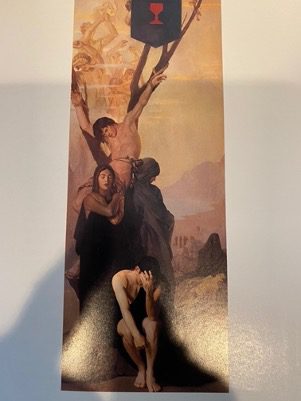 Plate V illustrates another dimension but resonating orthodox Christianity. The coloring is softer. The panel is matched with a line from the poem, “…and in the mist of tears I hid from him.”
The point is easier to make with fewer ambiguous symbols To the left and facing out is the archetypal Mother of God. The protagonist is seated with his hand over his forehead, the mist of tears overwhelming emotion but still he hides from Him who is the dying Son of God mourned by the bereaving women.
But the painting here goes beyond the level of psychic experience asking the viewer to listen, perhaps, to the lamentation of the women echoed by the more distant figures in the background. Even so, the painting echoes Christian art with women below the crucified Christ. What is equally apparent, furthermore, is emblazoned on the shield but hovering above it all as if to juxtapose the central image with that of the Grail, the pursuit of so many of those archetypal wanderers.
There are again twenty-one large panels in Gammell’s sequence with two smaller, one at the beginning and one at the ending which Gammell notes all of which germinated for many years before their completion. But it’s clear that the poem supplied Gammell with pictorial ideas and the comparison between the poem and the panels are capable of evolving into an artistic unity.
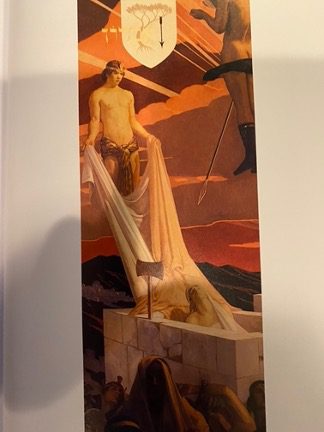 Panels Twenty and Twenty-One conclude the transcending journey with its procession of allegorical themes now decidedly Christian with panel Twenty drawing from the poem, “Rise, clasp My hand, and come.”
The end of the pursuit has come with death as with all human experience. Death is the shadowy figure in the bottom foreground who resembles the punishing figures in earlier panels but here surrounded by other shadowy figures claimed by Death. The double bladed ax fastened to the edge of the tomb suggests the means of death but not as if a beheading has occurred but more as a final act of initiation by Death, sans his usual scythe. The allegorical figure is also positioned in such a manner to suggest that he is lifting his head toward the life-bringing figure holding the shrouds of resurrection. Some ambivalence remains since in the upper left hand corner are Hebrew letters spelling out the word Avodon, signifying Sheol, the Hebrew Underworld. The shield with a clean ivory finish and a stylized tree of life is placed to the left of the Anima figure with hands out welcoming the rising sun suggesting she now plays a new role, a Christian role, identified with the protagonist since now she is part of his rebirth experience.
The final seven lines of the poem read as follows and accompany the final large panel:
Rise, clasp My hand, and come.”
Halts by me that footfall:
Is my gloom, after all,
Shade of His hand outstretched caressingly?
“Ah, fondest, blindest, weakest,
I am He Whom thou seeks!Thou gravest love from Thee who gravest Me.”
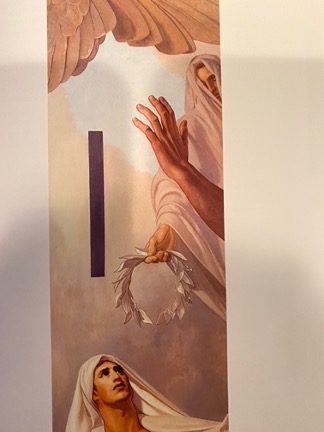 Brigid’s commentary suggests that the flight and the search have become inseparable and the relentless beat of the pursuer at the end owns an identity with Christ Who in the panel needs no personification, His presence and His power greater than the power of death.
There’s one distinct note in the panel which suggests a quote from Psalm 91 also recited in the evening prayer of Compline:
He shall cover Thee with his feathers and under his wings shall Thou trust: His truth shall be Thy shield and buckler.
It’s spiritual surrender followed by profound peace which is the case with Everyman who suffers sickness and pain and the final mortality before what we understand to be the mystical union symbolized once again by the Anima figure stretching out her hand with the laurel crown—both a final victory over death but also Francis’ own creative achievement. The wings, the wreath, and the outstretched hand move in the same downward direction as in a benediction which is also suggested in the tender lines at the poem’s ending, the raised hand taking the place of the accusing hand found in earlier panels.
The dark pillar shape remains ambiguous unless it relates back to the “I” of the first panel. But unlike that first panel where the “I” represents Decartes’ cogito, here reason receives no answer other than acceptance of mysteries beyond reason. The invitation transcends reason with faith since faith offers an invitation to enter into the fullness of eternity embraced as the gift of love.
As for the poem, the pursuit is long and over 182 lines before the dark night of the soul shatters the speaker, “shard on shard” which leads to God speaking at poem’s end.
Brigid’s biography in good detail traces Francis’ life on the London Streets, what she calls the gutters of humanity, but then overcoming heart-perturbing things as his physical condition deteriorates which leads to hospital treatment where he believes he is dying from laudanum poisoning.
He left his literary copyrights to Wilfred Meynell, now one constant visitor his last days before his death likely from tuberculosis. Brigid’s narration achieves a special personalism in the last pages when she again refers to her subject tenderly as “Francis”:
At the end he was, fittingly alone. The most solitary moment in a human life comes at its close and for Francis who had so often known loneliness it brought no fear. In the early morning of November 13 the sunset shadow cast by the Calvary in the Field of the Cross at Storrington deepened at last into night. But he knew . . . this night was not the end. As he watched the grey dawn filter through the windows of the ward, his sun’s setting was also leading to sunrise.
His funeral was in keeping with his life; about a dozen mourners gathered in the Catholic portion of the Kensal Green cemetery where he was buried on November 16. There was no hypocrisy attending the moment, no publicity. Francis was a true poet, one of a small band.
Brigid also suggests that Francis’ poetry contained a message that would have to wait for a future age to be understood and that he believed some great cataclysm was ahead. To use a metaphor that would have seemed familiar to Francis, the age needed an infusion of new blood into the tired body of Christianity of his own day which meant to be restored in flesh and life and vigor.
Whether he was the last poet whose true role was to reach beyond the limits of time and space, maybe so ,maybe not so. But Brigid argues poignantly that Francis had a great vision and saw the essential values in Christianity as common to all human experience. “The Hound of Heaven” reaches back to man’s earliest symbolic acts and utterances where we “see” expressive attempts to make union between divine and natural human life. Francis refused to compromise.
Wherefore would the singer sing,
So his song be true?
Truth is ever old, old
Song ever new.Ere the world was, was the lie
And the truth too:
But the old lie still is old,
The old truth new.
He was not neglected in the decades following his death and as Brigid writes in her notes to The Hound of Heaven a Pictorial Sequence R. H. Ives Gammell that consideration of the visual content of “The Hound of Heaven,” the poem’s sublimity, became of special interpretive interest. She then suggests that the poem’s synthesis of religious mysticism was best achieved by Gammell whose large panels lead cosmically into a mythical labyrinth, the byways and dead ends of memory with more hauntings of grief and joys as ephemeral as the water, from daydreams to the chasm of nightmares. How else to read “Adown Titanic glooms of chasmed fears”?
From the “running laughter,” then, Brigid develops her critical biography quoting the recurring pulse beat in the poem’s lyrics which gives the whole a brilliant “majestic instancy” in its imagery:
But with unhurrying chase
And unperturbéd pace
Deliberate speed, majestic instancy
They beat—and a Voice beat
More instant that the Feet—
“All things betray thee. who betrays Me.”
The poem is filled with what Brigid calls verbal galaxies in which man is haunted by the fear of being “dunged with rotten death.” She broadens her analogy by suggesting that such hauntings of the human mind existed long before the Preacher in Ecclesiastes who compared man’s “dunged death” as being the same as crushed at the fountain or when Isaiah warns in 30:14 that he who flees from divine mercy will be broken small, as the potter’s vessel is broken all to pieces: “there till not be found in the bursting of it a shard to take fire from the hearth, or to take water withal out of the pit.”
Francis is the subject of his own poem which has not confounded modern readers but more likely the poem illustrates his intimacy with the stripped soul of Everyman who will either be remembered as an object of contempt, to be discarded on the rubbish heap as one more drug-addled failure, or saved by a hand outstretched caressingly.
He also knew where the real strength of his poem was to be found. The lines referring to love—“For, though I knew His love Who followed / Yet was I sore dread / Lest, having Him, I must have naught beside”—require a total surrender that bears close resemblance to St. John of the Cross. And when Francis writes near the poem’s end—“All which I took from thee I did but take, / Not for thy harms, / But just that thou might’s seek it in my Arms”—infers a sentiment with words reaching back over centuries of Christian teaching which is far removed from pagan teaching delighting in the senses which ends in disillusion.
During one dark afternoon in December, “The Hound of Heaven” took on skeletal form as part of a Christian heritage reaching back to the words in Psalm 139: 7-12:
Whither shall I go from thy spirit? or whither shall I flee from thy presence?
If I ascend up into heaven, thou art there: If I make my bed in hell behold, though art there.
If I take wings of the morning, and dwell in the uttermost parts of the sea;
Even there shall thy hand lead me, and thy right hand shall hold me.
If I say, Surely the darkness shall cover me, even the night shall be light about me.
Yay, the darkness hideth not from thee; but the night shines as the day; the darkness and the light are both alike to thee.
Noting for the moment that the Catholic Church in England was a direct outcome of the Oxford Movement such was constructive background for the early life and training of Francis. But there’s also the guilt in the poem and a desire for grace that will permeate an animating spirit absolving the guilt. But until that time, the hungry hours are the pursuit of fate itself. Plate XV which owns an epigram from the poem, “Naked I wait Thy love’s uplifted stroke” brings the protagonist to the point of exhaustion and standing self-revealed, and crucified by a ruthless paradox: What is this love that strips and wounds?
Omnia per Ipsum, et Siine Ipso Nihil is the title to a poem published after Francis’ death. The title translates “Everything through him and nothing without him” and based on John 1:3. Two lines from that poem suffice to conclude: “What I write; Thy wings incline, / Ah, my Angel, o’er the line.”
The Imaginative Conservative applies the principle of appreciation to the discussion of culture and politics—we approach dialogue with magnanimity rather than with mere civility. Will you help us remain a refreshing oasis in the increasingly contentious arena of modern discourse? Please consider donating now.
The featured image is



Leave A Comment