
Science writing, especially about the quantum world, has come far as a sub-genre of intellectual historiography. Yet it never occurred to me that a narrative of twentieth-century experimentation, let alone one that engages—even grips—the lay reader, could attain the status of dispositive intellectual history. Such is the achievement of Dr. Suzie Sheehy, whose “The Matter of Everything” causes the reader to feel the kindling of her contagious enthusiasm.
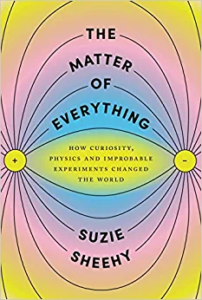
The Matter of Everything: How Curiosity, Physics and Improbable Experiments Changed the World, by Suzie Sheehy (313 pages, Knopf, 2023)
 Not long after the babe is newborn curiosity encroaches, and, if the babe is raised right, never stops. Suzie Sheehy was raised right, and as with many curious people she has been born over and again into the wonder that accompanies the itch. Once, outside of Melbourne at the Leon Mow Dark Sky Site, Dr. Sheehy found the celestial multitude overwhelming, with their distances and speed (all the galaxies zooming along at 600kms/second), their nebulae, black holes and quasars. “I felt deeply,” she writes, “that all this mattered.” Eventually “I set about trying to understand the entire universe… to figure out the meaning of my own existence.”
With elegant efficiency (she is an efficient writer, at times overly so) Dr. Sheehy describes the Standard Model: everything consists of two types of quarks (‘up’ and ‘down’) and electrons, along with three forces, electromagnetism and the strong and weak nuclear forces – but not gravity, which does not only not fit but is exponentially weaker than the other forces.
How to know more? Well, there is mathematics, sure, but that is really not close to enough. “The reason we can say… that we know all this stuff… is not because we have pretty mathematics, but because we have done experiments,” following “curiosity from a seed of an idea, to a real physical piece of equipment, to the accumulation of new knowledge.” As an experimental physicist in the field of accelerator physics Dr. Sheehy specializes in “real-world equipment that manipulates matter on a tiny scale.” So the scientist gets an itch, which becomes a question, then a design whereby to answer that question, and that leads to a machine.
The machines, however, are infrequently small, sometimes larger than whole cities. They make the experiments possible, as they made possible the “dismantling” of classical physics. And therein lies the beginning of our twentieth-century “understanding [of] our place in the universe, a truth I have felt ever since [the author] saw the night sky anew.”
Dr. Sheehy’s method is as much narration as it is exposition, and that makes it fresh. She examines twelve twentieth-century experiments, describing, analyzing, explaining and vindicating each in terms of both intellectual and practical impact (for example MRIs and other scans), and this reader becomes intellectually thrilled by the sheer propulsion and determined artistry – there is no better word – of the efforts to scratch the curiosity itch.
She tells us of the cathode ray tube, the structure of the atom, and (the final step in Part 1, Dismantling Classical Physics) the light quantum emerging from the photoelectric effect (not all Einstein, as it turns out). That’s the appetizer. The first main course (Part 2: Matter Beyond Atoms) tells of cloud chambers and cosmic rays, particle accelerators and the splitting of the atom, cyclotrons (the artificial production of radioactivity), and synchrotron radiation (unexpected light).
Here the plot thickens considerably, and although Dr. Sheehy’s prose remains accessible, the compactness of her storytelling makes the plot somewhat less so. I wondered if a more relaxed account of, say, eight rather than twelve experiments might not have lightened the intellectual load. Nevertheless, along the way the reader comes to know dozens of brilliant, obstinately committed thinkers and experimenters of enormous imagination (precisely the right word) working with each other or in competition but often like a relay team.
Part 3, The Standard Model and Beyond, can sound like fifties science-fiction cinema, with its “strange resonances,” its neutrino (who knew?), spooky quarks, the Tevatron, and finally the Large Hedron Collider. Withal, her “and Beyond” does seem a stretch – until the final chapter, Future Experiments. Might we hope for a sequel? After all, Dr. Sheehy is a born storyteller, providing plots (complete with denouements), settings and characters. (Though I did wonder: why no Hubble, Lemaître, Penrose, or Penzias, along with their big machines and our Big Bang, or Schrödinger and Heisenberg, whose Uncertainty is anticipated by the light wave v. light particle conundrum.)
She sets the pattern in the very first chapter (Cathode Ray Tube: X-rays and the Electron) by first introducing us to Wilhelm Röntgen (“ordinary as a child” and “a shy man”). He noticed that a phosphor-coated screen would record patterns when in the vicinity of a glowing cathode ray vacuum tube, even when a barrier intervened. Within a year of his discovery (1895) of “X-rays” news had spread and uses from medical to (failed) attempts to see women’s underwear had taken hold.
James Thomson of Cambridge enters the story and the existence of the electron is established. Thereafter ‘electronic’ (electrons moving through a vacuum) departs from ‘electrical’ (electrons through wires); others enter the story, seventy years go by, and we have CT (and other) imaging. Sheehy is happy to tell us (and the reader is happy to know) that “none of it would have been possible without scientists constructing cathode ray tube experiments with no commercial purpose in mind.”
 Chapters three and eight (The Photoelectric Effect, Particle Physics goes Large) feature Max Planck. (In between we learn of cosmic rays, the influence of solar wind and its heliosphere, and climate changes). It is Planck who posits that light comes in packets and calls those ‘quanta’ (leading to ‘photons’ the smallest item in those packets), and it is he who allows Lise Meitner (“the German Marie Curies”) into his class, after which she discerned that the nucleus of an atom could be split (named ‘fission’ by her nephew Otto Frisch). Our confidence in the solidity of the world gets a blow to the solar plexus when, in extending the thinking on the photoelectric effect, Louis de Broglie shows that all matter can be waves. Then Dr. Sheehy delivers the knockout: if empty space were removed from all humans the matter left over would be the size of a sugar cube. We have arrived at industrial scale Big Science.
A very long way from the double split experiments with light is the biggest machine on earth, the Large Hedron Collider, a twenty-seven kilometer circular tube one hundred meters underground on the border of France and Switzerland. Approved by the European Organization for Nuclear Research (CERN) in 1994 (from an idea of Lyndon Evan, a Welshman), twenty-five years later it would accelerate protons. Dr. Sheehy’s account of her first visit is stirring. (Think 2001: A Space Odyssey on steroids.) Scores of nations and thousands of scientists have collaborated on its projects.
And “yet there was still one undiscovered piece of the puzzle missing,” we read near the end of chapter eleven,” a force-carrying particle called a Higgs boson…. The Large Hedron Collider was about t come to life.” The prediction, as far back as 1964 by Peter Higgs (among others), was of a “Higgs” field through all of space. Dr. Sheehy provides an effective analogy to explain the field – a room filled with socialites gathering around a newly-arrived celebrity – and then tells us, “Higgs bosons were going to be fiendishly difficult to find.” How difficult? It required Tim Berners-Lee to invent the World Wide Web, which itself was a devil of a job, told pellucidly. Thereafter enter the God Particle (unnamed as such by Sheehy: God makes no appearance), the boson and its wave that makes all mass possible.
Science writing, especially about the quantum world (e.g. Carlo Rovelli, especially Reality Is Not What It Seems), has come far as a sub-genre of intellectual historiography. Yet it never occurred to me that a narrative of twentieth-century experimentation, let alone one that engages—even grips—the lay reader, could attain the status of dispositive intellectual history. At the end, Dr. Sheehy brings the tale up to the very writing of her book and into her own lab. There the reader still feels the kindling of her contagious enthusiasm.
The Imaginative Conservative applies the principle of appreciation to the discussion of culture and politics—we approach dialogue with magnanimity rather than with mere civility. Will you help us remain a refreshing oasis in the increasingly contentious arena of modern discourse? Please consider donating now.
The featured image is courtesy of Pixabay.





It is rare to read something so endorsing by a clearly critical reading. Added to my reading list. Thank you.
A really fruitful preliminary to meditation on Christmas Eve.