
Much of what Jesus had to say on debts, taxes, death, and charity, as well as other aspects of money, economic life, and discipleship, was expressed in his parables. Thus, this might be a very good time to pick up Fr. Robert Sirico’s new book, “The Economics of the Parables.”
The Economics of the Parables by Robert Sirico (204 pages, Regnery, 2022)
 It’s January and you’re probably thinking, as I am, about money and God. There is the VISA bill bringing remembrance of the financial cost of Christmas’s celebration of good news of great joy. There are the tax bills, which both make us ask ourselves what exactly we owe to Caesar as opposed to God and remind us of that other unpleasant certainty—death. Finally, Lent is now in view with the call for more alms as well as prayer and fasting.
As it so happens, our Lord had a number of things to say about debts, taxes, death, and charity. Much of what he had to say on these topics, as well as other aspects of money, economic life, and discipleship, was expressed in his parables, which the late Pope Benedict called “the heart of his preaching.” Thus, this might be a very good time to pick up Fr. Robert Sirico’s new book, The Economics of the Parables.
Fr. Sirico co-founded and, until his retirement last year, served as the president of the Acton Institute for the Study of Religion and Liberty, a Michigan think tank that looks at economic and political life through the lenses of religion, philosophy, and free-market economics. He is also a priest who has served as a successful pastor at several parishes in west Michigan. In this book he brings together, perhaps even more than some of his other books, his economist’s mind and his pastoral touch.
Why did Jesus teach in parables? Fr. Sirico highlights the political situation in which our Lord, whose Messiahship was to create enemies of both Rome and his own people, had an interest in not being too direct in his statements. But even for those without malice and with “ears to hear” his message, what our Lord had to teach was not easy. The reality of God and his kingdom is beyond our ordinary experience. The parables bring the unfamiliar things of heaven close to us by using what we know of familiar earthly ones. Given that dealing with money is a universal experience, it is no surprise that so many of the lessons in the parables come with economic images.
But wasn’t the economic world different in the first century A.D.? Certainly, Fr. Sirico writes, but the power of the parables lies in what is common: “After all, people still fish, dive for pearls, tend grapevines, sow seed and reap crops, store up harvests, adjudicate inheritances and gifts, build houses with foundations, pay debts (or don’t), struggle with income disparity, encounter the poor in their midst, endure inter-family tensions, and experience many of the other variations of life one finds in the parables.”
Even amidst the differences, “certain fundamental truths about the economic dimension of life… remain unchanged….” This is where Fr. Sirico’s economic expertise comes in handy, for to see the deeper, supernatural meanings of the parables, not only the particularities of first-century wages and savings plans must be understood, but those fundamental and timeless truths about economic reality must be understood.
Yet knowing those particularities can be helpful. In his chapter on the Parable of the Talents, Fr. Sirico lets us know that burying money was an accepted first-century way of saving it. He also lets us know that a single “talent” may not sound like much but would be worth almost $348,000 in today’s money. Thus, the master would have entrusted about $1.74 million to the servant in charge of five talents.
If the English word talent is now taken to mean “all of the various gifts—natural, spiritual, and material—that God has given for our use,” having that larger dollar value in our minds might help us realize how much is at stake in our response to God. We are much more than what we might seem. And given that, we might be able to do great things for God if we take the opportunity. The master in the story, Fr. Sirico tells us, “evidently understood that breaking even would actually be a loss—because wealth has potential.” That is why wealth and the rest of our talents are our responsibility. And yet trying to do something with our talents (monetary or otherwise) involves risk that God wants us to take. We can let a desire for this-worldly security or a “fear and distrust” of God (much like that which the servant who buried his talent had for his master) paralyze us. Not only is this a guaranteed loss, it is ungrateful. As Fr. Sirico concludes, “Not even to try is another way of failing to acknowledge the receipt of the gift in the first place.”
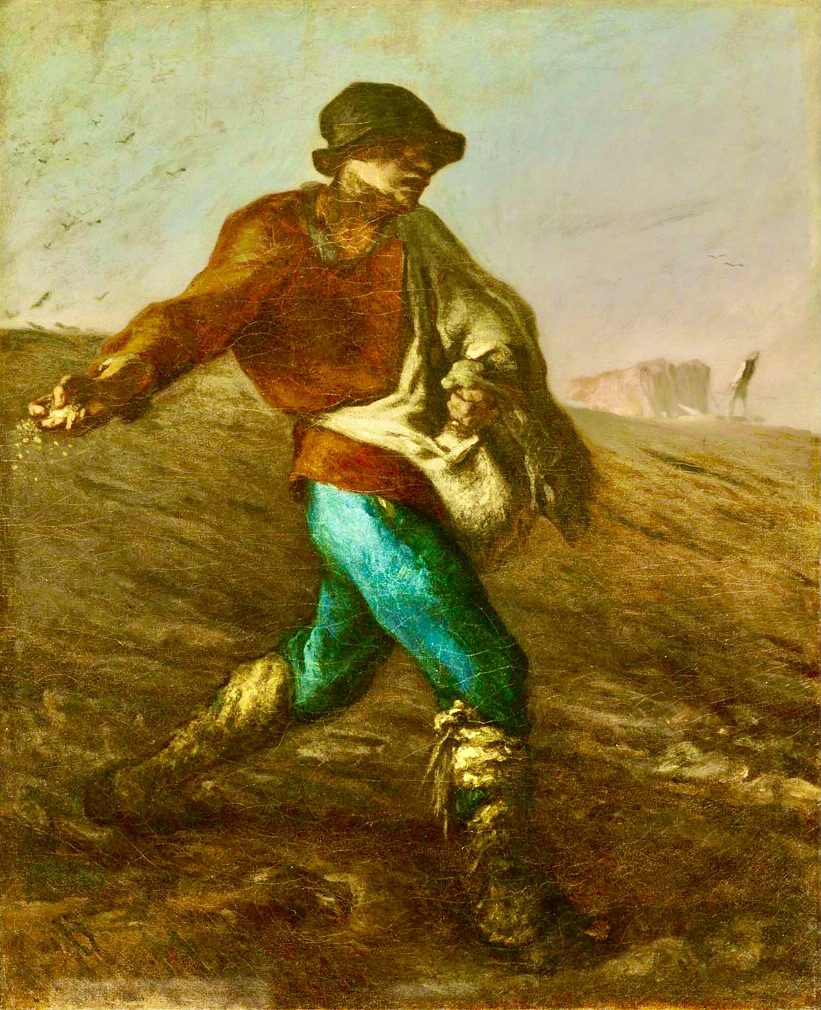 I haven’t covered all of the insights, either economic or spiritual, that Fr. Sirico draws from that one parable. Each chapter contains a great many insights such as the above about the details of at least eleven other parables (really, more since some of the chapters address multiple parables) including: The Rich Fool, The Laborers in the Vineyard, The Sower, The Pearl of Great Price, The Rich Man and Lazarus, The Good Samaritan, and The Prodigal Son.
While Fr. Sirico is scrupulous about not trying to turn the lessons learned into an artificial and misleading “theory of biblical economics,” he does not refrain from correcting those who do—especially those who try to read communism or the need for an omnicompetent welfare state into the Lord’s commands. Much of this distinguishing of charitable sheep from socialist goats comes in the final chapter’s broader discussion of the economic themes and lessons of the New Testament.
Whether your bank account is little or great, it is part of the talent that God has given you. Fr. Sirico’s book, which quotes the texts from the sonorous King James Version, is a beautiful way to think about how the Lord wants you to profit in both natural and supernatural ways this year.
Republished with gracious permission from The Catholic Servant.
The Imaginative Conservative applies the principle of appreciation to the discussion of culture and politics—we approach dialogue with magnanimity rather than with mere civility. Will you help us remain a refreshing oasis in the increasingly contentious arena of modern discourse? Please consider donating now.
The featured image is “The Sower” (1850) by Jean-François Millet, and is in the public domain, courtesy of Wikimedia Commons.





Does Sirico explain that until the Venetians took over the Vatican about 500 years ago, it was a mortal sin to charge interest on a loan?