
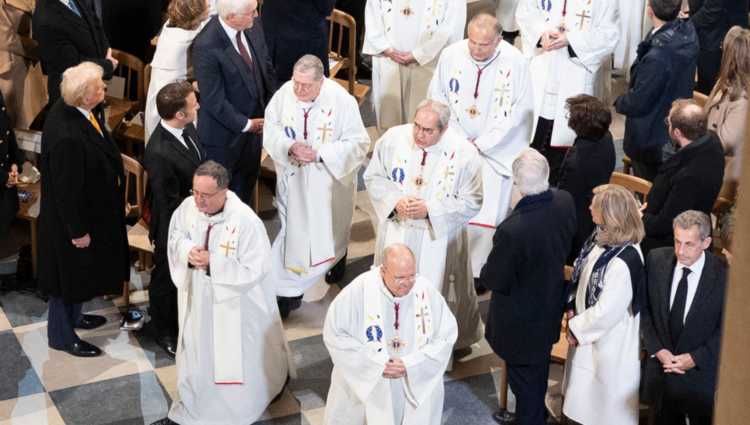
While one might respect the French traditions of haute couture and the artistic avant garde, who thought it was a good idea to mar the otherwise grand reopening of the historic Christian monument of Notre Dame by dressing the clergy in costumes so garishly outlandish?
 Once when I was living in England, I stood in the supermarket queue behind a young man dressed in the costume of a punk rocker. He had a safety pin through his nose, a Mohawk haircut dyed a bright violet color, ripped jeans exposing UK flag underwear, high top laced boots and a denim jacket over a tee shirt portraying the portrait of someone called Sid Viscous—or was it Vicious? And he was carrying a large battered tin teapot which he was using as a handbag. I was gazing in wonder at this preposterous person when he turned and snarled at me, “Wotchoo starin’ at mate?”
I said, “I’m sorry, but you have deliberately worn this preposterous get up to draw attention to yourself and to cause dismay and consternation among dull people like myself. Why are you annoyed that you have succeeded?”
I had a similar reaction to the ridiculous vestments worn by the Catholic clergy at the grand re-opening of Notre Dame cathedral in Paris. The designer of the vestments is noted couturier Jean-Charles de Castelbajac who is known for his use of vibrant primary colors in designs that echo the striking paintings of Piet Mondrian or the party vibrancy of circus clowns.
While one might respect the French traditions of haute couture and the artistic avant garde, who thought it was a good idea to mar the otherwise grand reopening of this historic Christian monument by dressing the clergy in costumes so garishly outlandish?
The problem here is on two levels. The first is the problem I had with the English punk rocker. He deliberately chose a bizarre costume to draw attention to himself, not only to cause dismay among more conventional people but also to mock them for being dull and conventional, and thus inferior to himself. This is the typical behavior of a spoiled and arrogant adolescent. The vestments by Monsieur de Castelbajac displayed the same insouciance and insolence. They were deplorable, not adorable.
The second, and more profound, problem with the vestments is the same problem that infests most modern ecclesiastical design and architecture: an arrogant ignorance of what these things are actually for. The modern architect follows the dictum “Form follows function,” but when it comes to designing Catholic Churches they don’t trouble themselves to learn what the function of a Catholic Church is. Thus we are given stark auditoria graced with the odd pillar, tacky stained glass portraying a bunch of grapes, or the occasional window with a pointed arch to make the place look “churchy”.
Likewise with vestments. I can remember once designing some altar frontals for an Anglican Church where I was serving. In enthusiastic ignorance I designed the frontals with lots of “meaningful” artwork. After the project was completed I read a book on liturgical design (why didn’t I do that first?) and was duly chastened to read, “Extraneous messages should be avoided. The liturgical vestments should make a statement only through the quality of the fabrics and the skill of the craftsmanship in their fabrication.”
Indeed. If only Monsieur de Castelbajac (and those who commissioned him) had taken the time and had the humility to learn what vestments are for, they might have avoided the embarrassment and approbation their error of ecclesiastical taste has occasioned.
So what are liturgical vestments for? They do several things. First, they both conceal and reveal the mystery of the priesthood. They conceal the personality of the individual. Like any uniform, as he dons it, the man disappears into the role he plays. At the same time, through the dignity and beauty of their design, the worthy vestments reveal the glory and beauty of Christ the Great High Priest—whom the ordained man typifies. This being the case, what did the Notre Dame vestments say about Christ the King? I fear they reminded us of the clown Jesus of the 1970s musical Godspell.
What else are the functions of the liturgical vestments? They connect our worship through two thousand years of history to the Roman Empire. The priest and deacon process into church garbed in robes that echo the formal wear of Roman gentlemen from ages ago, and this is a tangible, visible connection with our living history. To turn them into a clownish costume is too clever—remembering Ogden Nash’s quip, “Here is a good rule of thumb: too clever is dumb.”
The role of the vestments, like all of the accoutrements of worship, play their part not by being obtrusive and outlandish, but by being subdued, understated—even dull. One should not come away from Catholic worship either exclaiming about the superlative vestments, music, or preaching… or complaining about them. They serve the liturgy and should not draw attention to themselves either by their superb or inferior quality.
The fact that de Castelbajac’s kitsch and flamboyant vestments are the subject of debate makes my point. They were outrageous because they were out of place. They belonged to a Parisian catwalk, not a liturgical procession. The adolescent attention-seeking design distracted from the solemnity of the occasion, the significant sacrifice of the cathedral’s restoration, and the historic gravity of Notre Dame’s position in Christian culture.
The Imaginative Conservative applies the principle of appreciation to the discussion of culture and politics—we approach dialogue with magnanimity rather than with mere civility. Will you help us remain a refreshing oasis in the increasingly contentious arena of modern discourse? Please consider donating now.
The featured image (detail) is a photograph by Francesco Ammendola: “Il Presidente della Repubblica Sergio Mattarella e Laura Mattarella, Volodymyr Zelens’kyj, Faure Gnassingbé, in occasione della cerimonia di riapertura della Cattedrale di Notre-Dame. Parigi, 7 dicembre 2024.” This file is courtesy of Wikimedia Commons.





Has our good Father Dwight forgotten those “Clown Masses” from decades ago?
There was even one, IIRC, where the priest processed up the aisle in roller skates.
But we must be “relevant”, and “edgy”, and “provocative”. And especially, anchored to our ephemeral Time, and disconnected from eternity.
Else how will we demonstrate our cool/hip cultural bona fides?
A word on the infamous “Clown Mass” and the “Clown Jesus” in the musical “Godspell.” I am far from defending either, but both were ostensibly inspired by the idea of Christ as the bringer of festivity and of the call to “become as little children” and had reference, I think, to the idea of the carnivalesque found in Latin cultures. It was actually meant as a comment on the absence of festivity and joy from modern life and the idea that Christian culture embodies these things (cf. Josef Pieper on this topic).
The original “Clown Mass” (never actually called this by its perpetrators) was held in Pres. Kennedy’s former parish in Georgetown and was occasioned by a visit of a circus troop to the city. During the course of the liturgy the members of the troop processed down the aisle and offered some of the accoutrements of their profession as offerings at the altar. There was also as I understand some circus performance. Again, I am not defending any of this, just urging us to inquire into the philosophical origins of this strange late-20th c. phenomenon.
Good morning! Really excellent article, couldn’t agree more!
Excellent, thoughtful essay.
As a lifelong 85 year old Catholic I watched the reopening of Notra Dame from beginning to end. I was shall I say annoyed at the vestments but felt I am too critical of all the modern jazz within the Church. After watching the Papal Posse and readng your very inforative column I return to my basic thoughts. It was a part of what we suffered through after Vatican II. In the mid seventies I witnessed a Good Friday Celebration here in New York City with two hefty women dancing down the aisle in very tight leotards. Not a very prayful event. And, so we suffer through and pray. God’s blessings upon you and your work. Mary Durkan
As an English woman who remembers being a punk back in the day, I have a clear recollection of the ridicule and sometimes violence meted out to those whose adolescent rebellions were generally little more than that. I wasn’t particularly snotty then, as we say in England, but had I met with a snotty priest I would reckon that the fault was at least equal on both sides – and I do. Of course with the distance of time and maturity, I see it, as I hope that young man will, for what it was: a childish desire for attention, to stand out in the way that is an integral part of youthful development – not really comparable to the more ‘mature’ vestment disasters of Paris. Yes, that young man was striking a pose and not a very appealing one and hopefully he’ll have grown out of it – but what a laughably pompous response. A change to ignite real change was missed in favour of striking a platitude in the face of an attitude.
Looking for taste and decorum in some sectors of the modern Roman Catholic Church is often like looking for a virgin in bordello. It is possible to find, but it is also rather too often a surprise.
Sorry, but the real problem lay almost entirely with the clergy who so willingly donned the idiotic vestments and deliberately debased themselves rather than maintain their dignity and even their manhood.