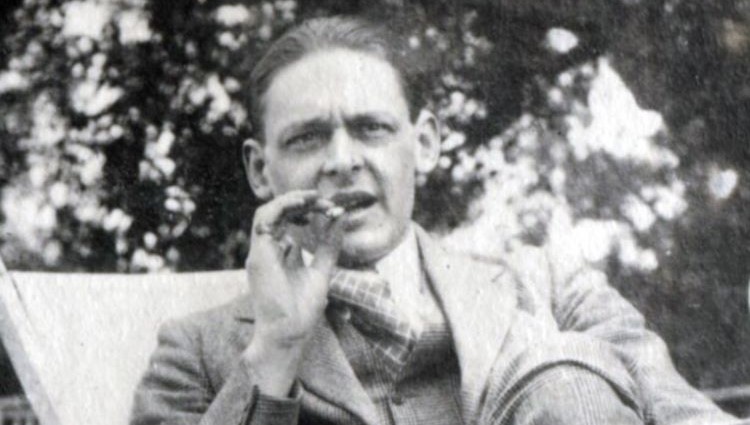
Thomas Stearns Eliot (26 September 1888 – 4 January 1965) was an essayist, publisher, playwright, literary and social critic and “one of the twentieth century’s major poets.” Born in St. Louis, Missouri in the United States, he moved to the United Kingdom in 1914 and was naturalised as a British subject in 1927.

T.S. Eliot’s Comedy

By |2015-04-25T23:44:37-05:00January 31st, 2014|Categories: Books, Dante, Dwight Longenecker, Featured, Poetry, T.S. Eliot|

Although he was friends with Groucho Marx, T.S. Eliot is not usually considered a comedian. His appearance was described as “liturgical.” He was buttoned up. So much so that Virginia Woolf once quipped about him, “Tom will be here in his six piece suit.” Nevertheless, Eliot was capable of real buffoonery. Writing ribald verse for [...]

Nostalgia and Desire in C.S. Lewis and T.S. Eliot

By |2019-12-13T15:55:39-06:00November 19th, 2013|Categories: C.S. Lewis, Christianity, Conservatism, Dwight Longenecker, T.S. Eliot|

There is an open space in the human heart–a void that seeks fulfillment and a hunger that longs for satisfaction. For the progressive this longing looks to the future. A brave new world is envisioned, an ideology is espoused and an action plan that brooks no dissent is put into place. For the conservative that [...]

Tradition and the Individual Talent

By |2022-08-17T16:38:50-05:00October 31st, 2013|Categories: Books, Poetry, T.S. Eliot, Tradition|

In English writing we seldom speak of tradition, though we occasionally apply its name in deploring its absence. We cannot refer to "the tradition" or to "a tradition"; at most, we employ the adjective in saying that the poetry of So-and-so is "traditional" or even "too traditional." Seldom, perhaps, does the word appear except in [...]

T.S. Eliot’s Dry Salvages: “I do not know much about gods”

By |2015-01-07T13:50:26-06:00October 24th, 2013|Categories: Books, Bradley J. Birzer, Poetry, T.S. Eliot|

The Dry Salvages. Photo by Hye Tyde. “I do not know much about gods.” So begins Eliot’s third of four quartets, “The Dry Salvages.” Many have argued that this is one of Eliot’s weakest poems and the least effective of the Four Quartets. I can’t write as a literary critic, but I can [...]

Dawson, Eliot, and the Word

By |2016-08-03T10:37:08-05:00June 17th, 2013|Categories: Bradley J. Birzer, Christendom, Christian Humanism, Christianity, Christopher Dawson, Featured, Language, T.S. Eliot|

Christopher Dawson Continuing the theme of language and its importance to the human person, both individually and relationally (see previous essay), let us turn now to Christopher Dawson. The English historian Christopher Dawson (1889-1970), another patron of The Imaginative Conservative, embraced a solidly Aristotelian view of the social world.  Aristotle had famously written [...]

English Letters in the Age of Boredom

By |2019-10-30T13:35:41-05:00April 27th, 2013|Categories: Books, Literature, Moral Imagination, RAK, Russell Kirk, T.S. Eliot|Tags: |

Some day I shall write a book with the title The Age of Eliot (ed., published as Eliot and His Age). The span of Mr. T. S. Eliot’s life, extending from the ascendancy of President Cleveland and Lord Salisbury to our present troubled hour, has been characterized by as much material change as any age in the whole [...]

The Permanent Things

By |2018-10-16T20:24:53-05:00February 9th, 2013|Categories: Permanent Things, Quotation, RAK, Russell Kirk, T.S. Eliot|

T.S. Eliot By “the Permanent Things” [T. S. Eliot] meant those elements in the human condition that give us our nature, without which we are as the beasts that perish. They work upon us all in the sense that both they and we are bound up in that continuity of belief and institution called the [...]

On Popular Fictions, Or How I Learned to Relax and Enjoy Downton Abbey

By |2016-02-12T15:28:30-06:00February 9th, 2013|Categories: Art, Books, Christianity, Culture, Daniel McInerny, Fiction, Film, G.K. Chesterton, T.S. Eliot|

Downton Abbey cast A friend of mine wrote on Facebook about Downton Abbey: “take away the English accents, the bucolic setting, the period costumes, and the antiquated moral code, and you’re left with Days of Our Lives. Some truth to that, I thought at first. Downton Abbey often suffers from severe melodramatic fits. [...]

Modernism & Conservatism: Does the culture of “The Waste Land” lead to freedom—or something more?

By |2014-01-21T12:51:53-06:00November 26th, 2012|Categories: Conservatism, Film, Modernity, T.S. Eliot|Tags: , |

Nearly 30 years before he shocked National Review by endorsing Barack Obama for president, senior editor Jeffery Hart announced a divorce of a different kind from the American right. With “The Intelligent Woman’s Guide to a Modern American Conservatism”—published in The New Right Papers in 1982 and previewed in NR a few months earlier—Hart split [...]

Use of Poetry: One Man’s Life

By |2015-12-11T15:25:55-06:00September 26th, 2012|Categories: Quotation, T.S. Eliot|

To do the useful thing, to say the courageous thing, to contemplate the beautiful thing: that is enough for one man’s life. Few men have known better than he* how to give just place to the claims of the public and of the private life; few men have had better opportunity, few of those having the [...]

Go to Top