Thomas Stearns Eliot (26 September 1888 – 4 January 1965) was an essayist, publisher, playwright, literary and social critic and “one of the twentieth century’s major poets.” Born in St. Louis, Missouri in the United States, he moved to the United Kingdom in 1914 and was naturalised as a British subject in 1927.

The Permanent Things of T.S. Eliot’s Politics

By |2018-10-16T20:24:35-05:00May 31st, 2015|Categories: Conservatism, Featured, RAK, Russell Kirk, T.S. Eliot|

T.S. Eliot One hundred years ago, Thomas Steams Eliot was born into an intelligently conservative family in St. Louis. His grandfather, a Unitarian minister and a man of mark, founded the Church of the Messiah and Washington University; the Eliots of St. Louis were Republican reformers, active in good causes, pillars of order. [...]

Three White Leopards Sat Under a Juniper Tree?

By |2024-02-14T05:28:21-06:00March 29th, 2015|Categories: Ash Wednesday, Christianity, Culture, Dwight Longenecker, Featured, Poetry, T.S. Eliot|

In re-reading T.S. Eliot’s Ash Wednesday on Ash Wednesday, a friend asks what many have wondered: “Excuse me, but what on earth does ‘Lady, three white leopards sat under a juniper-tree’ mean?” Is it such a mystery? With a little bit of detective work we can see through the illusion, connect the allusion, pick up [...]

The Hideous and the Damned: Arguing with Roger Scruton

By |2016-02-12T15:28:01-06:00March 26th, 2015|Categories: Beauty, C.S. Lewis, Christianity, Poetry, Roger Scruton, T.S. Eliot|Tags: |

I have been encouraged by Mr. Joseph Pearce’s two excellent essays, “How Many Loves? Arguing with C.S. Lewis” and “The Vulgar Mob: Arguing with G.K. Chesterton,” to offer up a little challenge to one thinker who has indelibly influenced my own conservatism. I have tremendous admiration for Roger Scruton’s courage in abandoning his academic career [...]

Eliot Agonistes: The Struggles of Eliot in Love

By |2015-03-01T20:20:29-06:00March 1st, 2015|Categories: Dwight Longenecker, Love, T.S. Eliot|

T.S. Eliot and his second wife, Valerie The struggles of T.S. Eliot’s personal life continue to fascinate both his critics and admirers. Eliot was frustrated and wounded in love, and the women in his life thus assume mythical proportions, as if his life and literature have become a unified drama. Eliot married Vivienne Haigh-Wood [...]

Mass Murder and Modern Ideological Regimes

By |2019-09-12T11:29:32-05:00February 24th, 2015|Categories: Aleksandr Solzhenitsyn, Bradley J. Birzer, Christian Humanism, Christianity, Christopher Dawson, Ideology, Religion, Revolution, T.S. Eliot|

The twentieth century witnessed the shattering of the traditional social and moral order among nations as the infection of the ideologues and their murderous ideological regimes spread throughout the civilized world. It began in earnest with the assassination of a central European archduke and the consequent destruction of the Old World in 1914. But in truth, the [...]

Two Quartets for the End of Time: The Work of T.S. Eliot and Olivier Messiaen

By |2015-02-12T15:07:11-06:00February 15th, 2015|Categories: Catholicism, Dwight Longenecker, Music, Poetry, T.S. Eliot|

Two profound meditations on the end of time sprang from the desolate decade of the 1940s giving an austere hope in the midst of the dark. T.S.Eliot’s Four Quartets, begun in 1937, were finally published in 1943. Olivier Messiaen’s Quartet for the End of Time was composed in 1940 in the most extraordinary circumstances while [...]

Russell Kirk’s Historical Imagination

By |2016-02-12T15:28:02-06:00February 6th, 2015|Categories: Christian Humanism, Christianity, Christopher Dawson, Conservatism, Edmund Burke, Featured, Gerald Russello, Russell Kirk, T.S. Eliot|

“Our religion, our culture, and our political rights all are maintained by continuity: by the respect for the accomplishments of our forefathers, and by our concern for our posterity’s well-being.”[1] In his private library at Piety Hill, Russell Kirk devoted a large bookcase to the works of those he called “philosophical historians.” Kirk placed on [...]

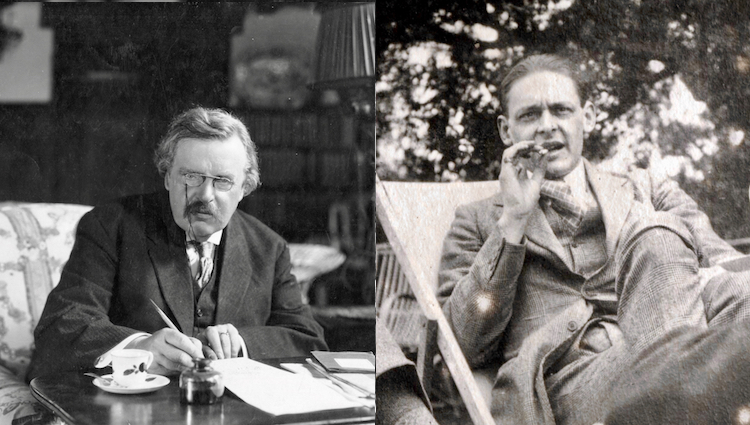
G. K. Chesterton & T. S. Eliot: Friends or Enemies?

By |2023-05-26T10:28:51-05:00September 22nd, 2014|Categories: Christendom, Christianity, G.K. Chesterton, Joseph Pearce, T.S. Eliot|

Should G.K. Chesterton and T.S. Eliot be considered friends or enemies? As champions of Christendom, they were united in the friendship of faith. With regards to whether one sides with Eliot… or with Chesterton, apparently Eliot said this: “Mr. Chesterton’s brain swarms with ideas. I see no evidence that it thinks.” ∗∗∗ I think a [...]

The Humane Tradition of the American Founding & Conservatism

By |2019-11-14T15:10:09-06:00April 12th, 2014|Categories: Audio/Video, Bradley J. Birzer, Edmund Burke, Russell Kirk, T.S. Eliot|

In this video, Dr. Bradley Birzer of Hillsdale College discusses the humane tradition of the American founding and conservatism. We hope you will join us in The Imaginative Conservative community. The Imaginative Conservative is an on-line journal for those who seek the True, the Good and the Beautiful. We address culture, liberal learning, politics, political economy, literature, the arts and [...]

T.S. Eliot: Culture and Anarchy

By |2019-12-13T11:14:37-06:00March 30th, 2014|Categories: Conservatism, Poetry, Religion, T.S. Eliot|Tags: , |

The title of my talk today may strike some of you as curious, if not confused. One recognizes the name of the Nobel-prize-winning Anglo-American poet and critic, T.S. Eliot; one may recall also that, late in his career, he published a small book entitled Notes Toward the Definition of Culture (1948). But the phrase, “Culture [...]

Go to Top