
 As another year draws to a close, the high quality problem of a personal library, one that never stops growing, is all around me. I am surrounded on all sides.
This is not just a metaphor. In my home study, all bookshelf space has already been filled. I have doubled it up with that familiar bibliophile trick of placing books in front of books. In this year’s new predicament, I am now literally surrounded by towers of additional books (pun intended).
As I look back over previous months, I happily recall some of my favorite books. I choose to share them with you, dear reader, in the hope that kindred spirits will reciprocate and share their own favorite bookish explorations.
In fact, I always look forward to the end of the year, as other citizens of the republic of letters circulate annual book recommendations. Again and again, I discover volumes I would have otherwise overlooked. I catch up on the missed books of the year by reading them well into January. Yes, that’s how I celebrate the New Year: namely, by reading old books.
Here is a list of all my favorite new books from the past year. Get them while you can; there is something truly satisfying about acquiring a book in the year of its first publication, and then holding on to it for the rest of your life.
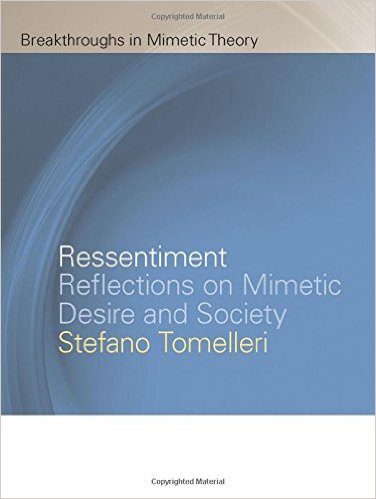 Let me begin with my top ten philosophical books published in 2015, the year that the great Catholic thinker René Girard died, a man who made a great impression on me. Michigan State University Press published, in its “Breakthroughs in Mimetic Theory” series, Stefano Tomelleri’s fine book, Ressentiment: Reflections on Mimetic Desire and Society, to which Girard himself wrote a foreword. No doubt Girard’s “mimetic theory”—his fruitful insights about the mimetic behavior of human beings—will continue to inspire more such meditations from ever more authors in the years to come.
One of my favorite Aristotelian-Thomist philosophers, Edward Feser, had a collection of his Neo-Scholastic Essays published by St. Augustine’s Press. It’s a handy compilation of his finest articles on metaphysics, philosophy of nature, natural theology, philosophy of mind, and ethics.
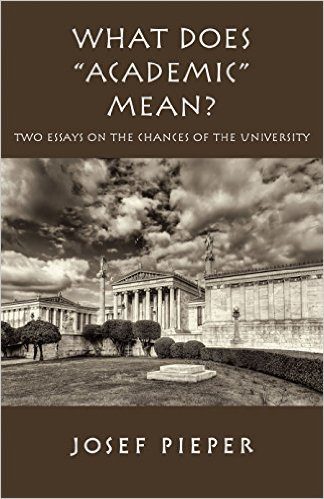 St. Augustine’s Press also published a nifty little book by the famous German Thomist, Josef Pieper, What Does ‘Academic’ Mean? Two Essays on the Chances of the University. If you had to recommend a good book to anyone concerned with the madness on contemporary campuses, this would be the one. Pieper’s two essays are here translated by Dan Farrelly, with an introduction by James V. Schall, S.J. By returning to Plato, the source of the university’s theoretical ideal of the contemplation of being, Pieper shows us the way out the disorders of our time.
Those interested in thinking about how to escape the maelstrom of planetary technological dominance will be interested to read a fascinating new book by the son of Marshall McLuhan, Eric McLuhan, who proposes, in The Sensus Communis, Synesthesia, and the Soul: An Odyssey, what he calls “a Catholic theory of communication”: one which “takes into account the transformation of the users of media” by the new technologies.
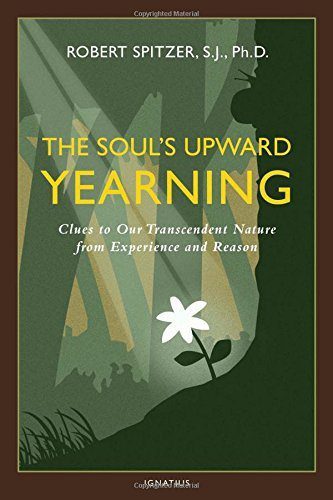 Ignatius Press published a tour-de-force by the polymath Robert J. Spitzer, S.J., The Soul’s Upward Yearning: Clues to Our Transcendent Nature from Experience and Reason. It includes some ideas also published in 2015 by Spitzer with St. Augustine’s Press, Evidence for God from Physics and Philosophy: Extending the Legacy of Monsignor Georges Lemaitre and St. Thomas Aquinas, but it adds all kinds of new material on the most intriguing contemporary evidence for the transcendent nature of the human soul.
Jonathan J. Sanford published a philosophical gem this year with Catholic University of America Press, Before Virtue: Assessing Contemporary Virtue Ethics. Sanford gives an Aristotelian-Thomist assessment of the state of contemporary virtue ethics theory and finds its achievement to be somewhat lacking. Aristotle himself still offers our best account of virtue ethics, as Aquinas can help us discover and appreciate.
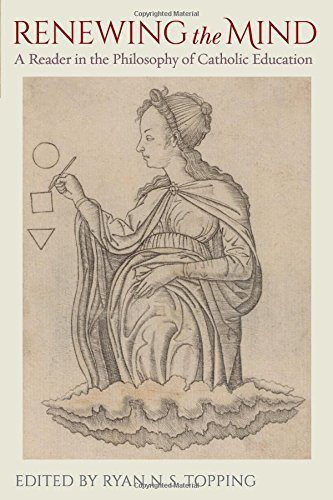 Thanks also to Catholic University of America Press, Renaissance man Ryan Topping gave us Renewing the Mind: A Reader in the Philosophy of Catholic Education, an edited collection to help us think our way out of our educational predicament with the help of the best minds of the tradition. Topping also published with Angelico Press his short but not-to-be-missed meditation on The Case for Catholic Education: Why Parents, Teachers, and Politicians Should Reclaim the Principles of Catholic Pedagogy.
Finally, Peter Redpath’s book, A Not-So-Elementary Christian Metaphysics, was republished in 2015 by En Route Books and Media. It first came out in 2012 but it has been hard to find and difficult to get ahold of. This stimulating book rediscovers and re-presents neglected insights from Thomas Aquinas that Thomists themselves often overlook. The rediscovery of these insights is no small matter, as Redpath asserts in the book’s epic subtitle: Written in the Hope of Ending the Centuries-Old Separation between Philosophy and Science and Science and Wisdom. Re-Establishing an Initial Union among Philosophy, Science, and Wisdom by Recovering our Understanding of Philosophy, Science: How Philosophy, Science, Is, and Always Has Been Chiefly a Study of the Problem of the One and the Many.
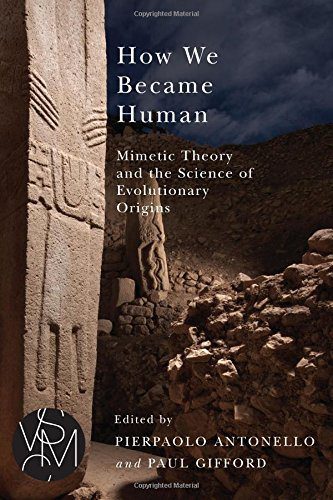 Those ten books sum up the topics I spent a lot of my academic time meditating on during the year. But I also found the following five science and theology books to be delightful sources of ideas for some other ongoing academic projects of mine: Pierpaolo Antonello and Paul Gifford (eds.), How We Became Human: Mimetic Theory and the Science of Evolutionary Origins (Michigan State University Press), and Pierpaolo Antonello and Paul Gifford (eds.), Can We Survive Our Origins? Readings in René Girard’s Theory of Violence and the Sacred (Michigan State University Press); Karl W. Giberson, Saving the Original Sinner: How Christians Have Used the Bible’s First Man to Oppress, Inspire, and Make Sense of the World (Beacon Press); John H. Walton, The Lost World of Adam and Eve: Genesis 2–3 and the Human Origins Debate (IVP Academic); and Stacy Trasancos, Science Was Born of Christianity: The Teaching of Fr. Stanley L. Jaki (The Habitation of Chimham Publishing Company).
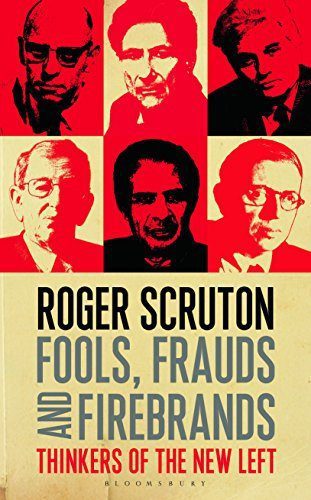 For recreation, I also like to read many politics and history books. These four were my favorites in that category: Roger Scruton, Fools, Frauds, and Firebrands: Thinkers of the New Left (Bloomsbury); Pierre Manent, Seeing Things Politically: Interviews with Bénédicte Delorme-Montini, translated by Ralph C. Hancock, with an introduction by Daniel J. Mahoney (St. Augustine’s Press); Barry Strauss, The Death of Caesar: The Story of History’s Most Famous Assassination (Simon and Schuster); and Bradley J. Birzer, Russell Kirk: American Conservative (University Press of Kentucky).
But some of my most intensely pleasurable reading experiences always happen in the realm of literature and criticism. My favorite novel of the year was by Roger Scruton, The Disappeared (Bloomsbury Reader). It’s a dazzling experience and I can’t recommend it highly enough. Inspired by Scruton’s humane philosophical vision, Mark Dooley’s book, Moral Matters: A Philosophy of Homecoming (Bloomsbury), was also a beautiful literary and philosophical reflection on our contemporary world. Then there was a new posthumous collection of Saul Bellow’s non-fiction, There is Simply Too Much To Think About (Viking), edited by Benjamin Taylor, which is full of delights. James Wood, one of the finest literary critics writing today, gave us the brilliant book on art, The Nearest Thing to Life (Brandeis University Press). Finally, another volume inspired by the work of René Girard was definitely worth reading, Pierpaolo Antonello and Heather Webb (eds.), Mimesis, Desire, and the Novel: René Girard and Literary Criticism (Michigan State University Press), not least because it includes Girard’s own essay, “Literature and Christianity: A Personal View.”
Happy reading in 2016 to all! Long live the printed page, our trusty companion for solitary meditation.
Books mentioned in this essay may be found in The Imaginative Conservative Bookstore.



I didn’t realize Scruton came out with a novel last year. Thank you. Also, The Nearest Thing to Life looks very good.
Hi Chris. Do you have a similar list for 2020?