About Christopher Morrissey

Christopher S. Morrissey teaches Greek and Latin on the Faculty of Philosophy at the Seminary of Christ the King located at the Benedictine monastery of Westminster Abbey in Mission, British Columbia. He also lectures in logic and philosophy at Trinity Western University. He is a Fellow of the Adler-Aquinas Institute and a Member of the Inklings Institute of Canada. He studied Ancient Greek and Latin at the University of British Columbia and has taught classical mythology, history, and ancient languages at Simon Fraser University, where he wrote his Ph.D. dissertation on René Girard. His book of Hesiod’s poetry, Hesiod: Theogony / Works and Days, is published by Talonbooks.

Good Words on a Good Friday

By |2026-04-02T19:09:08-05:00April 2nd, 2026|Categories: Catholicism, Christianity, Easter, Joseph Haydn, Timeless Essays|

The “Seven Last Words of Christ” can seen as the verbal expression of an interior reality: namely, the mind of Christ, as formed according to a deeply ingrained, habitual life practice of living mindfully according to the Lord’s Prayer. Holy Week is an especially fruitful time for prayerful meditation. There are many liturgical events at [...]
The Minor Incident That Sparked the Peloponnesian War

By |2024-08-21T17:06:12-05:00August 21st, 2024|Categories: Christopher Morrissey, History, Senior Contributors, Thucydides, Timeless Essays, War|

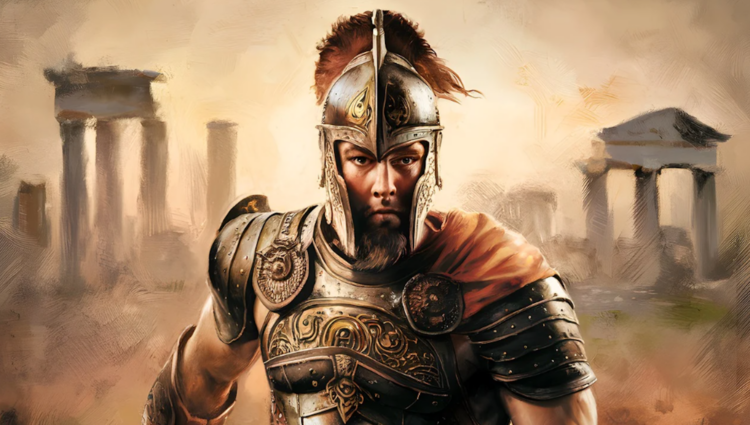
The Peloponnesian War is an example of how, if not properly managed, a small crisis can spiral out of control and eventually into a full-blown war. The Peloponnesian War (431–404 BC) was actually the second war fought between Athens and Sparta in the fifth century. Why did hostilities break out into the open again? The [...]

Technological Servitude & Marshall McLuhan’s Proposal for Liberation

By |2024-07-20T17:46:02-05:00July 20th, 2024|Categories: Christopher Morrissey, Culture, Featured, Nature, Technology, Timeless Essays|

“At the Council of Trent, nobody noticed that it was Gutenberg who made all the problems,” said Marshall McLuhan, “and at Vatican II, nobody mentioned the hidden ground of electric information which has created all the moral and theological problems of our time.” Marshall McLuhan identified our time of postmodernity as the “ecological age” in which [...]

Hans Urs von Balthasar & the Dramatic Project of Theology

By |2024-07-12T11:49:11-05:00July 12th, 2024|Categories: Christopher Morrissey, Hans Urs von Balthasar, Rene Girard, Timeless Essays, Tragedy|

Hans Urs von Balthasar believed that tragedies that feature the death of the hero—the sacrificial crisis of the innocent victim—reflect the fullest dramatic meaning of the Passion of Christ: In these stories, good violence is needed in order to make the bad violence go away. Hans Urs von Balthasar, in Volume IV (The Action) of [...]

An Empire Like No Other

By |2024-07-01T19:11:06-05:00July 1st, 2024|Categories: Christendom, Christianity, Christopher Dawson, Christopher Morrissey, Cluny, Featured, Rome, Theology, Timeless Essays|

The Roman Empire was unique because it espoused the principle of moderation in politics. This is what permitted the unique dynamism of a uniquely changing but uniquely enduring political form: from city, to empire, to nation. And that dynamism may still propel us today as a principle of rebirth, if only we recapture its essence. [...]

Men of Valor: Tacitus & Thomas Aquinas on Virtue

By |2024-04-29T16:30:26-05:00April 29th, 2024|Categories: Aristotle, Christopher Morrissey, Featured, Film, St. Thomas Aquinas, Timeless Essays, Virtue|

In valor, there is hope—namely, the hope that our virtue may be fully complete. It is as men of valor that we will be all we can be. In valor, there is hope. —Tacitus   When it played in the movie theaters, the terrific movie Act of Valor (2012) earned notoriety for two reasons. First [...]

Roger Scruton on the Aesthetics of Architecture

By |2023-01-19T16:48:50-06:00January 19th, 2023|Categories: Architecture, Art, Books, Christianity, Christopher Morrissey, Featured, Roger Scruton, Timeless Essays|

When the modern city enshrines the temporariness of facelessness as a permanently utilitarian way of life, then something has gone dreadfully wrong. The Aesthetics of Architecture by Roger Scruton (320 pages, Princeton University Press, 2013) One of the principal observations of Sir Roger Scruton about the modern city is an architectural observation. Modern architecture expresses [...]

Revisiting Christopher Dawson on Culture

By |2022-08-04T18:39:19-05:00August 4th, 2022|Categories: Christianity, Christopher Dawson, Christopher Morrissey, Culture, Islam, Rome, Timeless Essays|

The essence of Rome, by being conscious of one’s cultural debts, is the refusal to make a definitive synthesis or mediation. Only in Rome are there Athens and Jerusalem. Only because of Rome are there “two cities because one remains silently present.” Remi Brague’s observation about the historical essence of Rome shows that “Romanity” is [...]

Historical Consciousness & the Roman Road

By |2022-08-01T11:32:21-05:00May 21st, 2017|Categories: Christopher Morrissey, Conservatism, Featured, History, Literature, Poetry, Rome, Timeless Essays|

The Roman Road is nothing less than the royal road of all adult historical consciousness. That road is the way of the imaginative conservative, who does not throw away the all-connecting vision of childhood, and then replace it with another, “more sophisticated” way of thinking. Thomas Hardy’s mother died in 1904 at the age of [...]

Roger Scruton on Architectural Principles in an Age of Nihilism

By |2017-05-19T09:20:45-05:00May 18th, 2017|Categories: Architecture, Art, Beauty, Books, Christopher Morrissey, Culture, Modernity, Roger Scruton|

Without defending the citadel of the mind, how can we build a beautiful city? Without the conviction of true propositions, whence do we think beauty will come?… In Conversations with Roger Scruton (2016), Mark Dooley engages in a fascinating book-length interview with the famous English philosopher. While best known academically for unfashionable arguments on behalf [...]

Truth, Cultural Renewal, and the Benedict Option

By |2017-07-01T09:45:02-05:00May 1st, 2017|Categories: Books, Christianity, Christopher Morrissey, Featured, Truth|

If rights are real, and are founded on reality, then perhaps we should also be skeptical of Rod Dreher’s notion of a “Benedict Option.” Being in the world is a necessary condition for not being of it and for generating a genuine cultural flourishing… No doubt Rod Dreher’s book, The Benedict Option, has Imaginative Conservatives talking about the [...]

Stupid from the Beginning: Meditations on the Banality of Evil

By |2017-05-17T21:14:52-05:00March 29th, 2017|Categories: Books, Christopher Morrissey, Featured|

How is it that the most unremarkable and small-minded stupidity can accomplish evils of such enormous magnitude?... Adolf Eichmann In Eichmann at Jerusalem, the book that collects the articles she wrote for The New Yorker about the 1961 trial of the Nazi war criminal Adolf Eichmann, Hannah Arendt puts forth her arresting thesis [...]

Must Digital Technology Make Enemies of Us All?

By |2019-04-23T16:06:12-05:00March 7th, 2017|Categories: Christopher Morrissey, Culture, Featured, Film, Information Age, Technology, William F. Buckley Jr.|

Given the choice, people would rather watch flat-out conflict and crosstalk rather than a more plodding format of elevated discourse and sober deliberation… The documentary film Best of Enemies (2015) is not just a compelling chronicle and contextualization of the famous 1968 television debates between William F. Buckley, Jr., and Gore Vidal. As the sequence [...]

Go to Top